Nyamuryekung'e Shelemia, Cox Andrew, Perea Andres, Estell Richard, Cibils Andres F, Holland John P, Waterhouse Tony, Duff Glenn, Funk Micah, McIntosh Matthew M, Spiegal Sheri, Bestelmeyer Brandon, Utsumi Santiago
Division of Food Production and Society, Norwegian Institute of Bioeconomy Research (NIBIO), PB 115, N-1431 Ås, Norway.
Department of Animal and Range Sciences, New Mexico State University, Las Cruces, NM 88003, USA.
Animals (Basel). 2023 Nov 17;13(22):3558. doi: 10.3390/ani13223558.
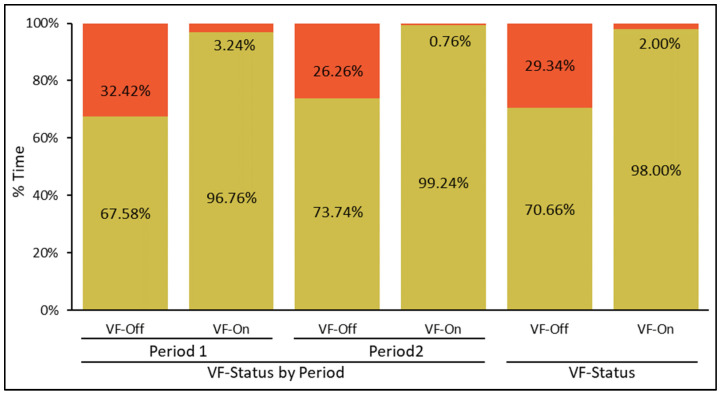
Virtual fencing systems have emerged as a promising technology for managing the distribution of livestock in extensive grazing environments. This study provides comprehensive documentation of the learning process involving two conditional behavioral mechanisms and the documentation of efficient, effective, and safe animal training for virtual fence applications on nursing Brangus cows. Two hypotheses were examined: (1) animals would learn to avoid restricted zones by increasing their use of containment zones within a virtual fence polygon, and (2) animals would progressively receive fewer audio-electric cues over time and increasingly rely on auditory cues for behavioral modification. Data from GPS coordinates, behavioral metrics derived from the collar data, and cueing events were analyzed to evaluate these hypotheses. The results supported hypothesis 1, revealing that virtual fence activation significantly increased the time spent in containment zones and reduced time in restricted zones compared to when the virtual fence was deactivated. Concurrently, behavioral metrics mirrored these findings, with cows adjusting their daily travel distances, exploration area, and cumulative activity counts in response to the allocation of areas with different virtual fence configurations. Hypothesis 2 was also supported by the results, with a decrease in cueing events over time and increased reliance with animals on audio cueing to avert receiving the mild electric pulse. These outcomes underscore the rapid learning capabilities of groups of nursing cows in responding to virtual fence boundaries.
虚拟围栏系统已成为一种有前景的技术,用于在广阔的放牧环境中管理牲畜的分布。本研究全面记录了涉及两种条件行为机制的学习过程,并记录了对哺乳的婆罗门牛进行虚拟围栏应用时高效、有效且安全的动物训练。研究检验了两个假设:(1)动物会通过增加在虚拟围栏多边形内的围合区域的使用来学会避开限制区域,(2)随着时间的推移,动物接收到的音频电信号会逐渐减少,并越来越依赖听觉信号来改变行为。分析了来自GPS坐标、从项圈数据得出的行为指标以及信号事件的数据,以评估这些假设。结果支持了假设1,表明与虚拟围栏未激活时相比,虚拟围栏激活显著增加了在围合区域花费的时间,并减少了在限制区域的时间。同时,行为指标反映了这些发现,奶牛会根据不同虚拟围栏配置区域的分配来调整它们的每日行进距离、探索区域和累积活动计数。结果也支持了假设2,随着时间的推移信号事件减少,并且动物越来越依赖音频信号来避免接收轻微的电脉冲。这些结果强调了哺乳奶牛群体对虚拟围栏边界做出反应的快速学习能力。