Tariqujjaman Md, Rahman Mahfuzur, Luies Sharmin Khan, Karmakar Gobinda, Ahmed Tahmeed, Sarma Haribondhu
Nutrition and Clinical Services Division, International Centre for Diarrhoeal Disease Research, Bangladesh, Dhaka, Bangladesh.
Research School of Population Health, The Australian National University, Acton, Australia.
Matern Child Nutr. 2021 Apr;17(2):e13077. doi: 10.1111/mcn.13077. Epub 2020 Oct 16.
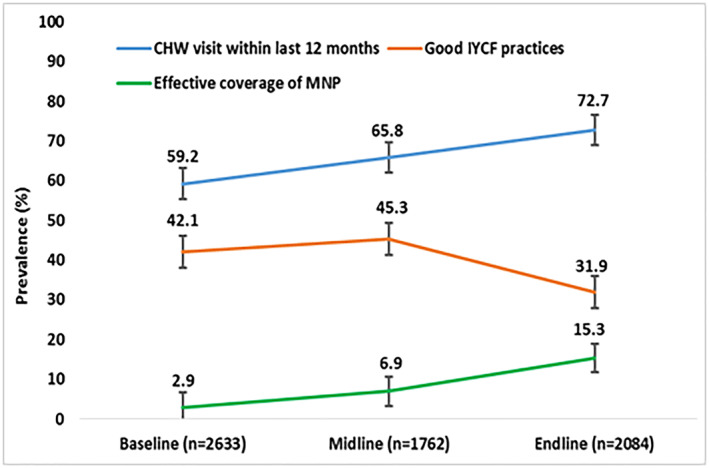
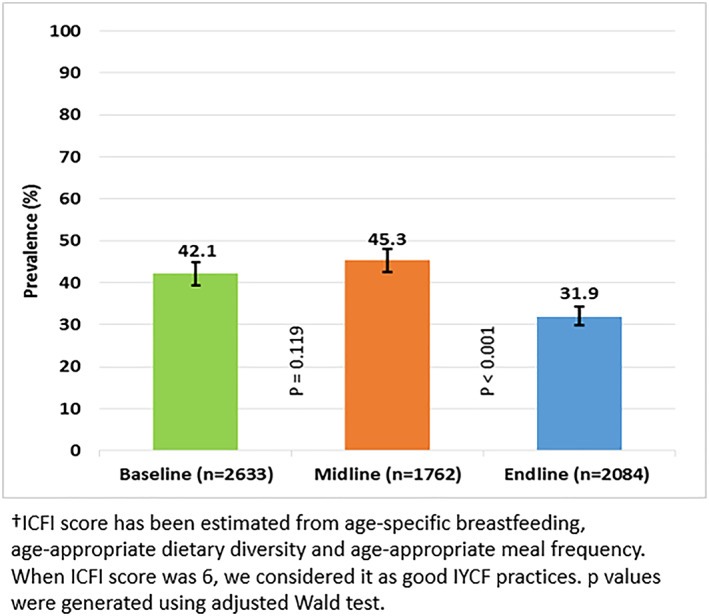
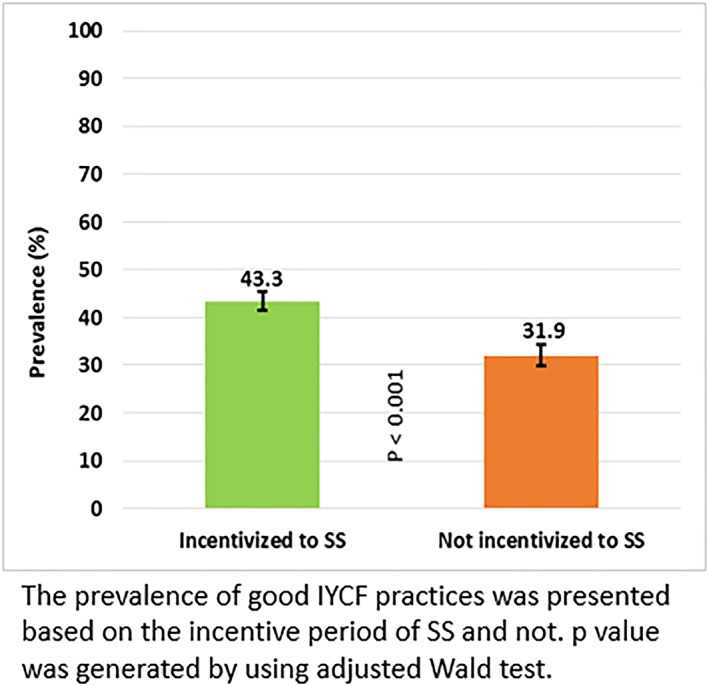
BRAC, an international development organization, implemented a home-fortification programme from 2014 to 2018 in Bangladesh. This study aimed to understand the unintended consequences of programmatic changes that occurred during the implementation of the programme on the prevalence of good infant and young child feeding (IYCF) practices and other associated factors. We used pooled data from eight cross-sectional surveys and data from a series of qualitative investigations carried out as part of a mixed-methods evaluation approach. A total of 6,479 caregivers of children aged 6 to 23 months participated in the surveys. The prevalence of good IYCF practices increased from baseline (42.1%) to midline (45.3%), but it decreased at the endline survey (31.9%). Qualitative investigations identified several reasons for low IYCF practices at the programme level, such as the withdrawal of community health worker (CHW) incentives for promoting IYCF, providing incentives for the home-fortification of micronutrient powder (MNP) and changing the focus from IYCF promotion to MNP promotion. A multivariable generalized estimating equation model for pooled data revealed that caregivers were 28% (adjusted risk ratio [ARR]: 0.72, 95% CI [0.67, 0.78]) less likely to maintain good IYCF practices during the period when CHWs were not incentivized to promote IYCF compared to the period when CHWs were incentivized to promote it. The prevalence of good IYCF practices decreased from both baseline and midline to the endline survey due to the unintended consequences of the programmatic changes. An integrated intervention strategy to promote the home-fortification of MNP and IYCF could be helpful to avoid unintended negative consequences of programmatic changes.
国际发展组织BRAC于2014年至2018年在孟加拉国实施了一项家庭强化计划。本研究旨在了解该计划实施过程中发生的计划性变化对良好婴幼儿喂养(IYCF)实践的普及率及其他相关因素产生的意外后果。我们使用了来自八项横断面调查的汇总数据以及作为混合方法评估方法一部分进行的一系列定性调查的数据。共有6479名6至23个月大儿童的照料者参与了调查。良好IYCF实践的普及率从基线时的42.1%升至中期的45.3%,但在终期调查时有所下降(31.9%)。定性调查确定了计划层面IYCF实践普及率较低的几个原因,例如取消了社区卫生工作者(CHW)推广IYCF的激励措施、为微营养素粉(MNP)的家庭强化提供激励以及将重点从推广IYCF转向推广MNP。针对汇总数据的多变量广义估计方程模型显示,与CHW受到激励推广IYCF的时期相比,在CHW未受到激励推广IYCF的时期,照料者保持良好IYCF实践的可能性降低了28%(调整风险比[ARR]:0.72,95%置信区间[0.67,0.78])。由于计划性变化的意外后果,良好IYCF实践的普及率从基线和中期到终期调查均有所下降。促进MNP家庭强化和IYCF的综合干预策略可能有助于避免计划性变化带来的意外负面后果。