Division of Allergy and Clinical Immunology, Department of Medicine, Brigham and Women's Hospital and Harvard Medical School, Boston, Massachusetts.
Division of Allergy and Immunology, Department of Medicine, Northwestern University Feinberg School of Medicine, Chicago, Illinois; Current Affiliation: Type 2 Inflammation and Fibrosis Cluster, Immunology and Inflammation Therapeutic Area, Sanofi, Cambridge, Massachusetts.
Ann Allergy Asthma Immunol. 2021 Feb;126(2):127-134. doi: 10.1016/j.anai.2020.09.016. Epub 2020 Oct 13.
Local activation of B cells and antibody production are important for protective and pathogenic immune responses. Furthermore, there is evidence that local activation of B cells and antibody production are important for pathogenesis of chronic rhinosinusitis with nasal polyps (CRSwNP) and a severe subset of CRSwNP, aspirin-exacerbated respiratory disease (AERD). This review summarizes these findings and the potential role of B cells and antibodies in disease pathogenesis.
Published literature from PubMed searches.
Studies relevant to B cell development and the roles of B cells and antibodies in the pathogenesis of CRSwNP and AERD.
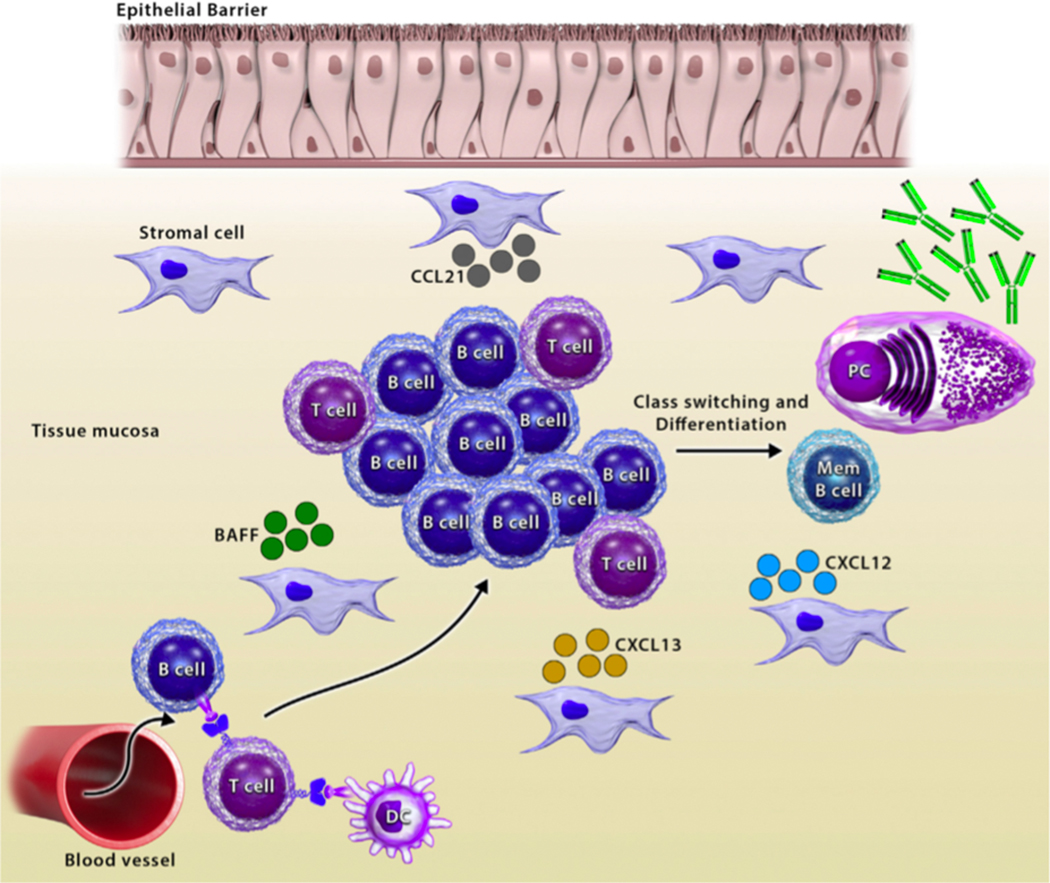
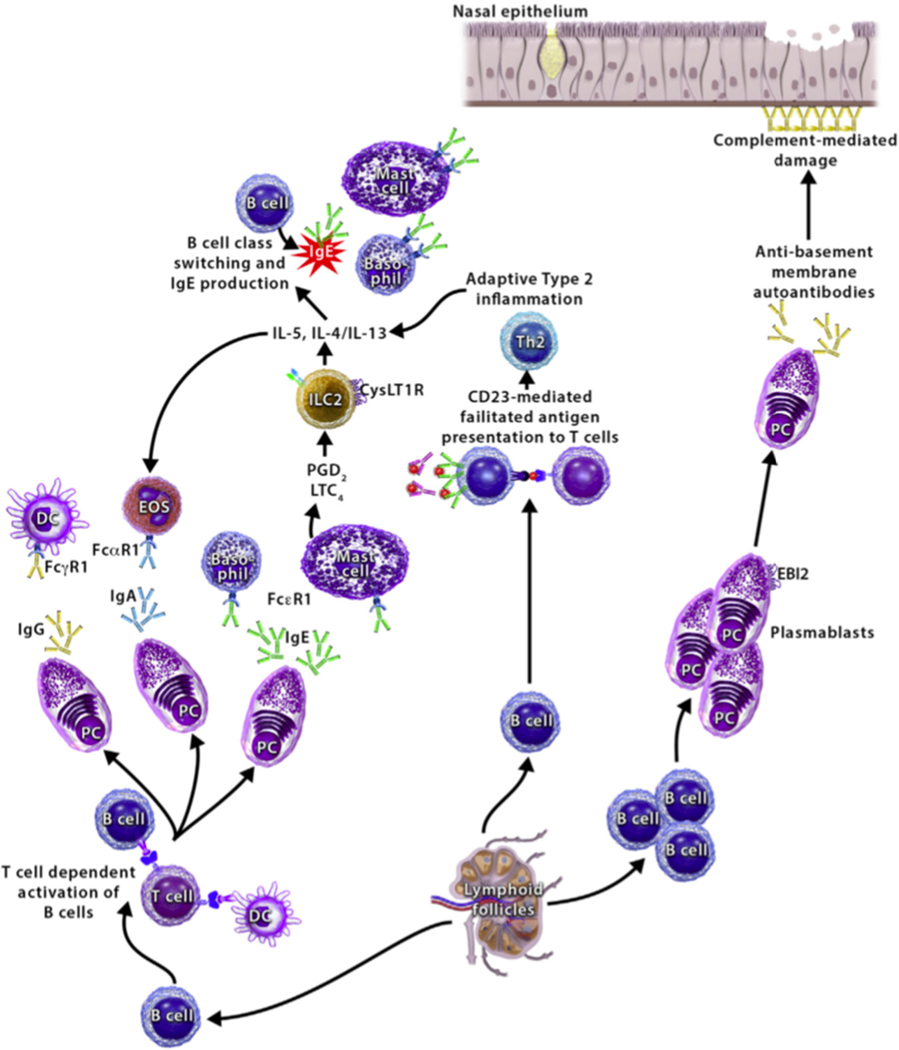
Formation of tertiary lymphoid structures plays a key role in the local activation of B cells and antibody production. This process is important for fighting infections, but it also contributes to autoimmune disease. Furthermore, there is evidence to support a role for local B cell activation and antibody production in a variety of allergic diseases. Nasal polyp tissues from patients with CRSwNP and AERD have elevated levels of activated B cell subsets and locally produced antibodies. These locally produced antibodies may contribute to disease pathogenesis in a variety of ways, including activation of innate effector cells, whereas locally activated B cells may contribute to pathogenesis through the activation of T cells.
More studies are needed to determine the role of B cells and antibodies in driving disease in these patients. However, targeting the processes that drive local B cell activation and antibody production may provide new therapeutic approaches and could help to reduce chronic inflammation.
B 细胞的局部激活和抗体产生对于保护性和致病性免疫反应很重要。此外,有证据表明,B 细胞的局部激活和抗体产生对于慢性鼻-鼻窦炎伴鼻息肉(CRSwNP)和严重 CRSwNP 亚组(阿司匹林加重性呼吸道疾病[AERD])的发病机制很重要。这篇综述总结了这些发现,以及 B 细胞和抗体在疾病发病机制中的潜在作用。
来自 PubMed 搜索的已发表文献。
与 B 细胞发育以及 B 细胞和抗体在 CRSwNP 和 AERD 发病机制中的作用相关的研究。
三级淋巴结构的形成在 B 细胞的局部激活和抗体产生中起着关键作用。该过程对于抗感染很重要,但也有助于自身免疫性疾病。此外,有证据支持局部 B 细胞激活和抗体产生在多种过敏性疾病中的作用。患有 CRSwNP 和 AERD 的患者的鼻息肉组织中存在大量活化的 B 细胞亚群和局部产生的抗体。这些局部产生的抗体可能通过多种方式促进疾病发病机制,包括激活先天效应细胞,而局部激活的 B 细胞可能通过激活 T 细胞来促进发病机制。
需要更多的研究来确定 B 细胞和抗体在驱动这些患者疾病中的作用。然而,针对驱动局部 B 细胞激活和抗体产生的过程可能提供新的治疗方法,并有助于减少慢性炎症。