University Hospital Erlangen, Comprehensive Cancer Center Erlangen-EMN, Department of Gynecology and Obstetrics, Friedrich-Alexander University Erlangen-Nuremberg, Erlangen, Germany.
Highlands Oncology Group, Fayetteville, AR, USA.
Breast. 2020 Dec;54:148-154. doi: 10.1016/j.breast.2020.09.008. Epub 2020 Sep 23.
In the MONALEESA-3 Phase III trial of patients with hormone receptor-positive human epidermal growth factor receptor-negative advanced breast cancer, ribociclib plus fulvestrant significantly improved progression-free survival (PFS) and overall survival (OS). Here, we present patient-reported outcomes from the trial, including health-related quality of life (HRQOL).
Patients were randomized (2:1) to receive ribociclib plus fulvestrant or placebo plus fulvestrant. Time to definitive 10% deterioration (TTD) from baseline in HRQOL (global health status [GHS] from the EORTC QLQ-C30 questionnaire) and pain (BPI-SF questionnaire) were assessed using Kaplan-Meier estimates; a stratified Cox regression model was used to estimate the hazard ratio (HR) and 95% CIs.
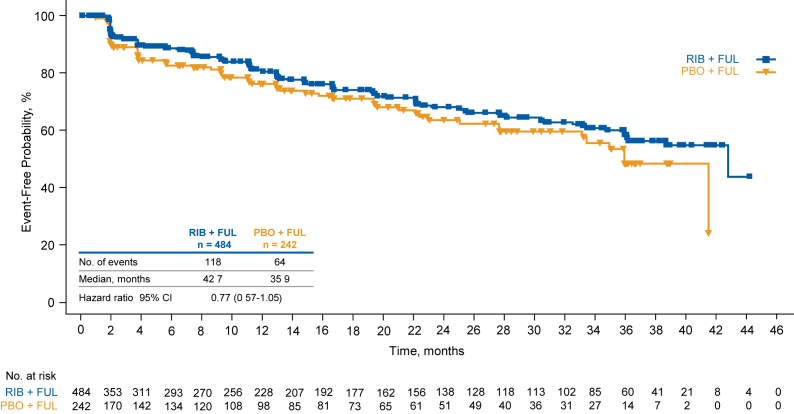
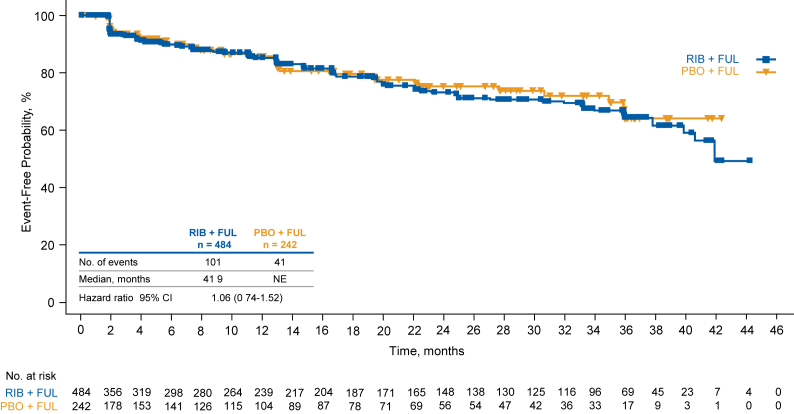
Deterioration ≥10% in the EORTC-QLQ-C30 GHS was observed in 33% of patients in the ribociclib group vs 34% of patients in the placebo (reference) group (HR for TTD ≥ 10% = 0.81 [95% CI, 0.62-1.1]). Similar findings were noted for TTD ≥5% (HR = 0.79 [95% CI, 0.61-1.0]) and TTD ≥15% (HR = 0.81 [95% CI, 0.60-1.08]). TTD ≥10% in emotional functioning (HR = 0.76 [95% CI, 0.57-1.01]) trended in favor of the ribociclib group, whereas results for fatigue and pain were similar between arms. TTD ≥10% in BPI-SF pain severity index score (HR = 0.77 [95% CI, 0.57-1.05]) and worst pain item score (HR = 0.81 [95% CI, 0.58-1.12]) trended in favor of ribociclib vs placebo.
In addition to significantly prolonging PFS and OS compared with placebo plus fulvestrant, adding ribociclib to fulvestrant maintains HRQOL.
在激素受体阳性人表皮生长因子受体阴性的晚期乳腺癌患者的 MONALEESA-3 期试验中,瑞博西利联合氟维司群显著改善了无进展生存期(PFS)和总生存期(OS)。在此,我们报告了该试验的患者报告结局,包括健康相关生活质量(HRQOL)。
患者按 2:1 随机分组,分别接受瑞博西利联合氟维司群或安慰剂联合氟维司群治疗。采用 Kaplan-Meier 估计评估基线时 HRQOL(EORTC QLQ-C30 问卷的全球健康状况[GHS])和疼痛(BPI-SF 问卷)的明确 10%恶化(TTD)时间;采用分层 Cox 回归模型估计风险比(HR)和 95%CI。
瑞博西利组中 33%的患者出现 EORTC-QLQ-C30 GHS 恶化≥10%,安慰剂组(参照组)中恶化≥10%的患者比例为 34%(TTD≥10%的 HR=0.81[95%CI,0.62-1.1])。对于 TTD≥5%(HR=0.79[95%CI,0.61-1.0])和 TTD≥15%(HR=0.81[95%CI,0.60-1.08])也观察到类似的结果。TTD 在情绪功能方面≥10%(HR=0.76[95%CI,0.57-1.01])的倾向有利于瑞博西利组,而疲劳和疼痛的结果在两组间相似。TTD 在 BPI-SF 疼痛严重指数评分(HR=0.77[95%CI,0.57-1.05])和最差疼痛项目评分(HR=0.81[95%CI,0.58-1.12])方面≥10%的倾向有利于瑞博西利组,而不是安慰剂组。
与安慰剂加氟维司群相比,加用瑞博西利不仅显著延长了 PFS 和 OS,而且还保持了 HRQOL。