Department of Otolaryngology, Kaohsiung Chang Gung Memorial Hospital and Chang Gung University College of Medicine, Kaohsiung 83301, Taiwan.
Graduate Institute of Clinical Medical Sciences, College of Medicine, Chang Gung University, Tao-Yuan 33302, Taiwan.
Int J Mol Sci. 2020 Oct 13;21(20):7535. doi: 10.3390/ijms21207535.
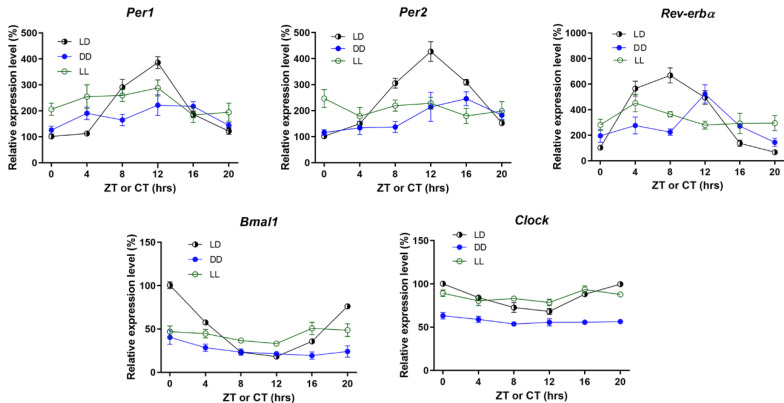
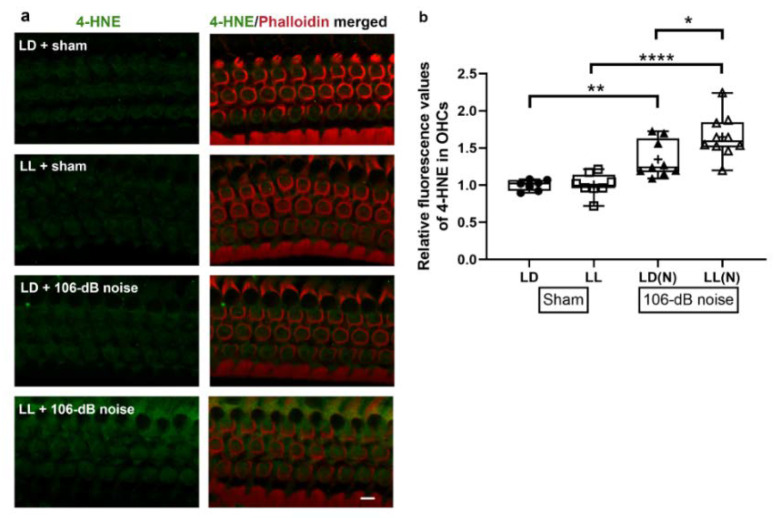
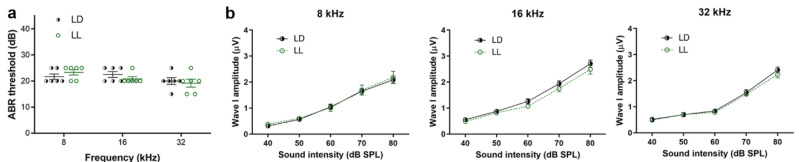
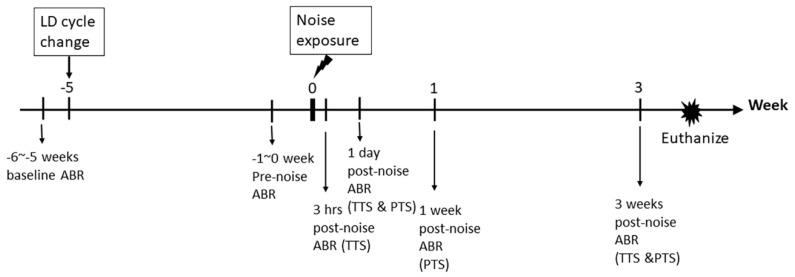
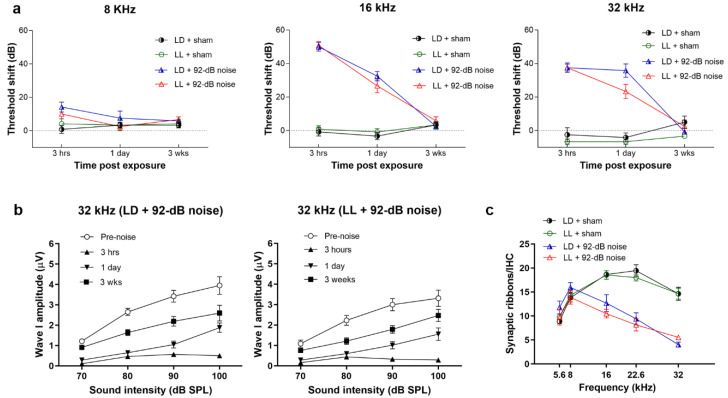
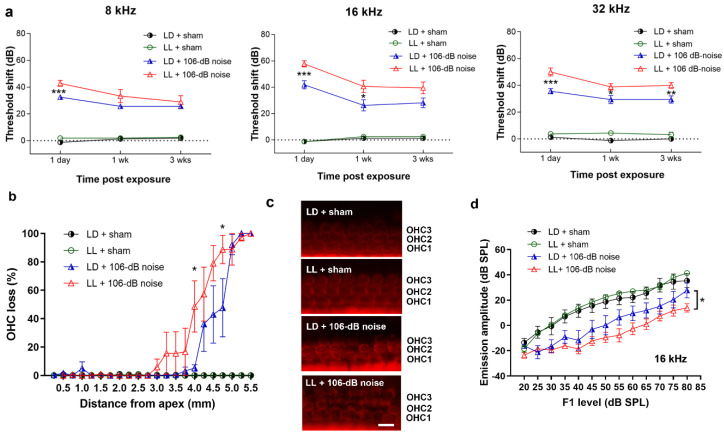
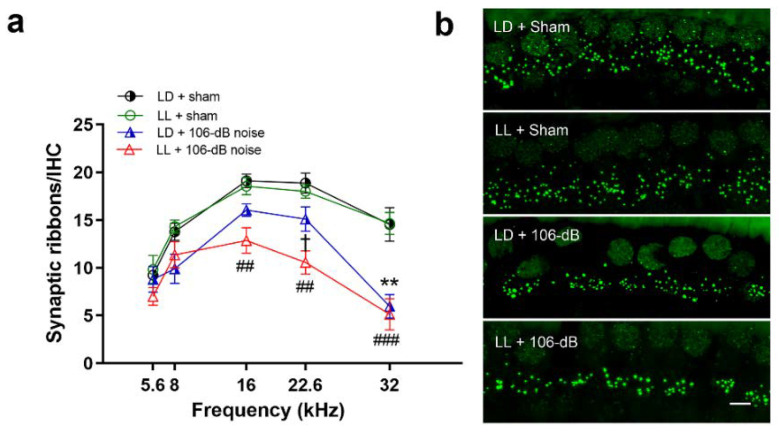
Noise-induced hearing loss is one of the major causes of acquired sensorineural hearing loss in modern society. While people with excessive exposure to noise are frequently the population with a lifestyle of irregular circadian rhythms, the effects of circadian dysregulation on the auditory system are still little known. Here, we disturbed the circadian clock in the cochlea of male CBA/CaJ mice by constant light (LL) or constant dark. LL significantly repressed circadian rhythmicity of circadian clock genes , , , , and in the cochlea, whereas the auditory brainstem response thresholds were unaffected. After exposure to low-intensity (92 dB) noise, mice under LL condition initially showed similar temporary threshold shifts to mice under normal light-dark cycle, and mice under both conditions returned to normal thresholds after 3 weeks. However, LL augmented high-intensity (106 dB) noise-induced permanent threshold shifts, particularly at 32 kHz. The loss of outer hair cells (OHCs) and the reduction of synaptic ribbons were also higher in mice under LL after noise exposure. Additionally, LL enhanced high-intensity noise-induced 4-hydroxynonenal in the OHCs. Our findings convey new insight into the deleterious effect of an irregular biological clock on the auditory system.
噪声性听力损失是现代社会后天性感觉神经性听力损失的主要原因之一。尽管经常接触过大噪声的人群往往具有不规则昼夜节律的生活方式,但昼夜节律失调对听觉系统的影响仍知之甚少。在这里,我们通过持续光照(LL)或持续黑暗扰乱了雄性 CBA/CaJ 小鼠耳蜗中的生物钟。LL 显著抑制了耳蜗中生物钟基因、、、、和的昼夜节律性,而听觉脑干反应阈值不受影响。在暴露于低强度(92 dB)噪声后,LL 条件下的小鼠最初表现出与正常光暗循环下的小鼠相似的暂时阈移,并且在 3 周后两种情况下的小鼠都恢复到正常阈值。然而,LL 增强了高强度(106 dB)噪声引起的永久性阈移,特别是在 32 kHz 时。在噪声暴露后,LL 条件下的小鼠的外毛细胞(OHCs)丢失和突触带减少也更高。此外,LL 增强了高强度噪声诱导的 OHC 中的 4-羟基壬烯醛。我们的研究结果为不规则生物钟对听觉系统的有害影响提供了新的见解。