Calvani Maura, Vignoli Marina, Beltrami Giovanni, Pasha Amada, Scalini Perla, Mannurita Sara Ciullini, Cardellicchio Stefania, Coccoli Luca, Cecchi Cecilia, Marco Emanuela De, Luti Laura, Bernasconi Sayla, Filippi Luca, Casazza Gabriella, Tamburini Angela, Favre Claudio
Division of Pediatric Oncology/Hematology, Meyer University Children's Hospital, 50139 Florence, Italy.
Department of Health Sciences, University of Florence, 50139 Florence, Italy.
Biomedicines. 2020 Oct 13;8(10):413. doi: 10.3390/biomedicines8100413.
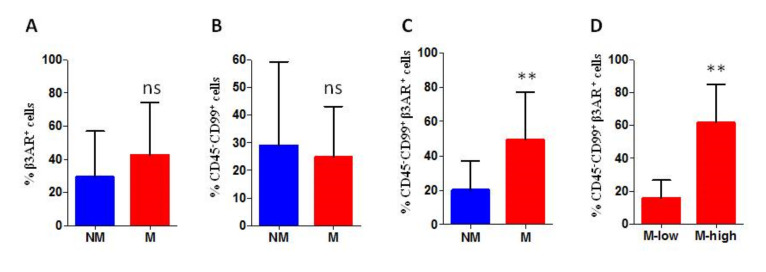
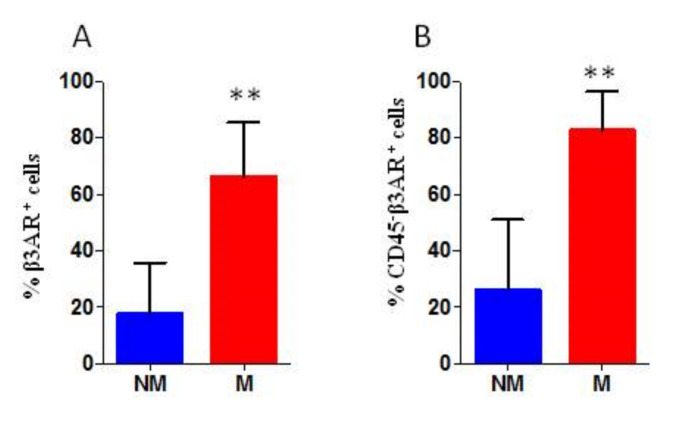
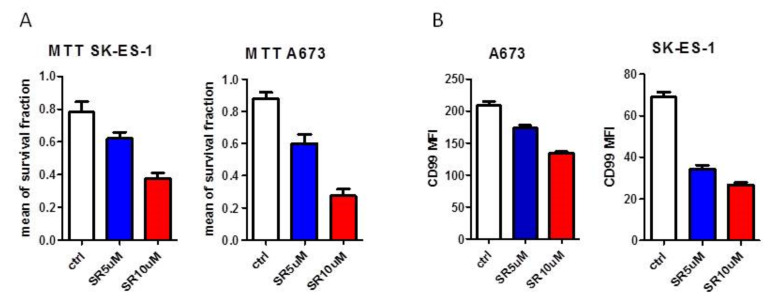
Ewing sarcoma (EWS) is a paediatric aggressive malignant tumour of bones and soft tissues. Multidisciplinary chemotherapies, surgical resection, and radiation represent the only strategies counteracting the disease, however spreading and relapse of disease still remain a clinical issue. Circulating tumour cells (CTCs) are an important feature of EWS but the prognostic significance has not been, yet, clarified. CTCs have been found both in patients with localized disease and in those who recur or metastasize. The identification of markers that can detect recurrences and metastasis remains an important challenge for research. Unfortunately, even most of patients with localized cancer relapsed and the reason has not yet been fully understood. In this clinical study on EWS patients, we evaluated the expression of CD99 antigen and beta-3 adrenergic receptor (β3-AR) on CTCs and bioptic derived cells by flow cytometry. The preliminary data revealed a higher β3-AR expression on cells derived from metastatic or relapsed patients, suggesting a role for the β3-AR as a possible predictive maker of disease recurrence in both patients with metastatic and localized disease.
尤因肉瘤(EWS)是一种发生于儿童骨骼和软组织的侵袭性恶性肿瘤。多学科化疗、手术切除和放疗是对抗该疾病的唯一策略,然而疾病的扩散和复发仍是一个临床问题。循环肿瘤细胞(CTC)是EWS的一个重要特征,但尚未阐明其预后意义。在局限性疾病患者以及复发或转移患者中均发现了CTC。鉴定能够检测复发和转移的标志物仍然是研究的一项重要挑战。不幸的是,即使是大多数局限性癌症患者也会复发,其原因尚未完全明确。在这项针对EWS患者的临床研究中,我们通过流式细胞术评估了CTC以及活检来源细胞上CD99抗原和β3肾上腺素能受体(β3-AR) 的表达。初步数据显示,转移性或复发性患者来源的细胞上β3-AR表达较高,这表明β3-AR可能作为转移性和局限性疾病患者疾病复发的预测指标。