Lopes Mariana, Pierrepont Chloé, Duarte Carla Margarida, Filipe Alexandra, Medronho Bruno, Sousa Isabel
LEAF-Linking Landscape, Environment, Agriculture and Food, Instituto Superior de Agronomia, University of Lisbon, Tapada da Ajuda, 1349-017 Lisboa, Portugal.
CIEPQPF, Department of Chemical Engineering, University of Coimbra, Pólo II-R. Silvio Lima, 3030-790 Coimbra, Portugal.
Foods. 2020 Oct 14;9(10):1458. doi: 10.3390/foods9101458.
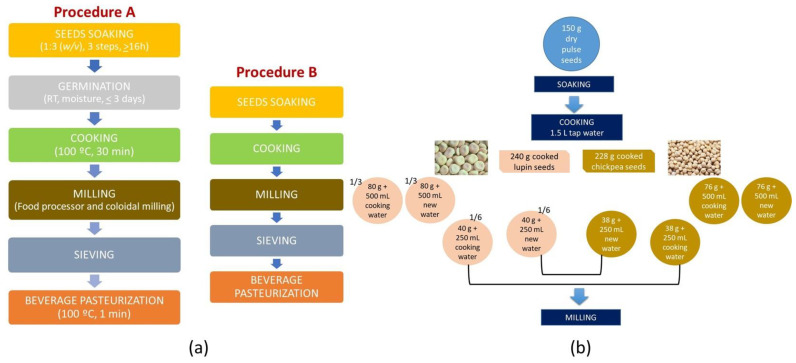
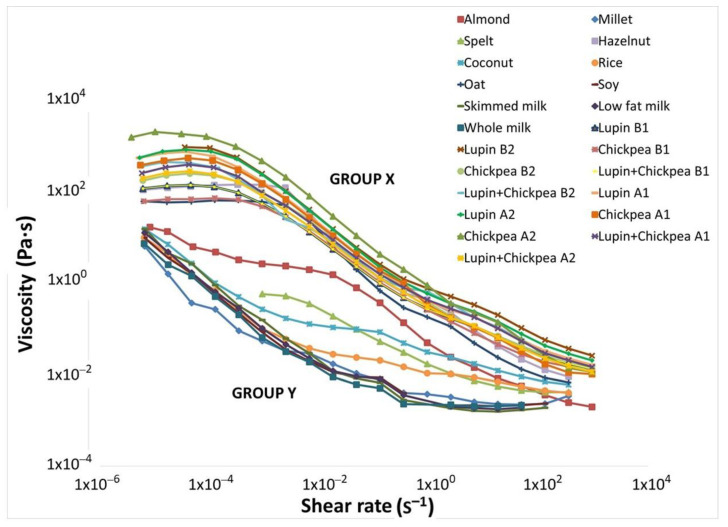
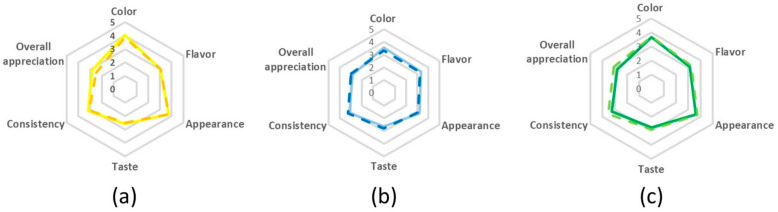
Recently, milk consumption has been declining and there is a high demand for non-dairy beverages. However, market offers are mainly cereal and nut-based beverages, which are essentially poor in protein (typically, less than 1.5% against the 3.5% in milk) and are not true milk replacers in that sense. In this work, new beverages from different pulses (i.e., pea, chickpea and lupin) were developed using technologies that enable the incorporation of a high level of seed components, with low or no discharge of by-products. Different processing steps were sequentially tested and discussed for the optimization of the sensorial features and stability of the beverage, considering the current commercial non-dairy beverages trends. The lupin beverage protein contents ranged from 1.8% to 2.4% (/) and the chickpea beverage varied between 1.0% and 1.5% (/). The "milk" yield obtained for the optimized procedure B was 1221 g/100 g of dry seed and 1247 g/100 g of dry seed, for chickpea beverage and lupin beverage, respectively. Sensory results show that chickpea beverage with cooking water has the best taste. All pulses-based beverages are typical non-Newtonian fluids, similarly to current non-dairy alternative beverages. In this respect, the sprouted chickpea beverage, without the cooking water, presents the most pronounced shear-thinning behavior of all formulations.
最近,牛奶的消费量一直在下降,对非乳类饮料的需求很高。然而,市场上提供的主要是谷物和坚果类饮料,这些饮料的蛋白质含量很低(通常低于1.5%,而牛奶中的蛋白质含量为3.5%),从这个意义上说,它们并不是真正的牛奶替代品。在这项研究中,利用能够使大量种子成分得以保留且副产品排放少或无排放的技术,开发了来自不同豆类(即豌豆、鹰嘴豆和羽扇豆)的新型饮料。考虑到当前商业非乳类饮料的趋势,依次测试并讨论了不同的加工步骤,以优化饮料的感官特性和稳定性。羽扇豆饮料的蛋白质含量在1.8%至2.4%之间(/),鹰嘴豆饮料的蛋白质含量在1.0%至1.5%之间(/)。优化后的工艺B所获得的“牛奶”产量,鹰嘴豆饮料为1221克/100克干种子,羽扇豆饮料为1247克/100克干种子。感官结果表明,含煮豆水的鹰嘴豆饮料口感最佳。与目前的非乳类替代饮料一样,所有基于豆类的饮料都是典型的非牛顿流体。在这方面,不含煮豆水的发芽鹰嘴豆饮料在所有配方中表现出最明显的剪切变稀行为。