Rezaei Mohammad K, Deokar Amit, Tar'an Bunyamin
Crop Development Centre/Department of Plant Sciences, College of Agriculture and Bioresources, University of Saskatchewan Saskatoon, SK, Canada.
Front Plant Sci. 2016 Dec 15;7:1867. doi: 10.3389/fpls.2016.01867. eCollection 2016.
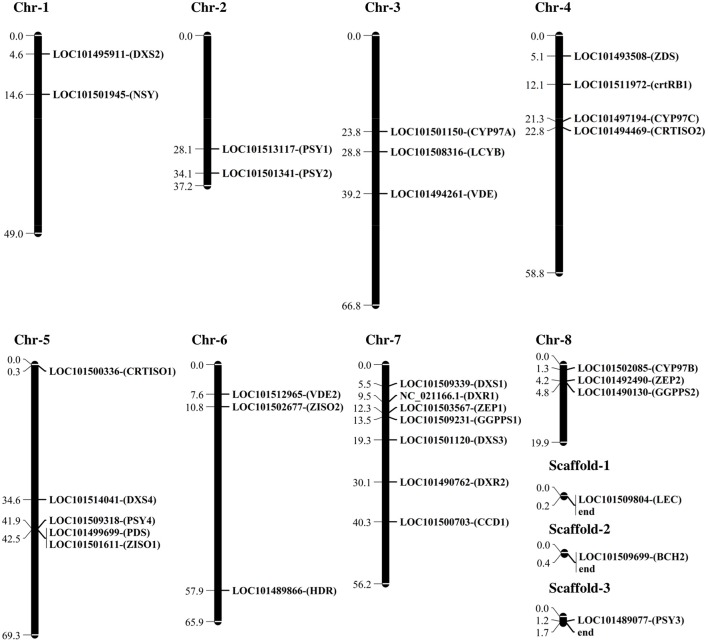
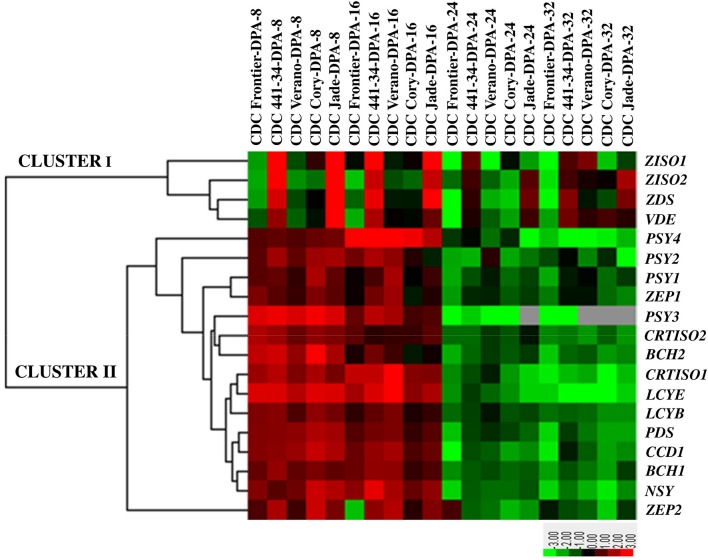
Plant carotenoids have a key role in preventing various diseases in human because of their antioxidant and provitamin A properties. Chickpea is a good source of carotenoid among legumes and its diverse germplasm and genome accessibility makes it a good model for carotenogenesis studies. The structure, location, and copy numbers of genes involved in carotenoid biosynthesis were retrieved from the chickpea genome. The majority of the single nucleotide polymorphism (SNPs) within these genes across five diverse chickpea cultivars was synonymous mutation. We examined the expression of the carotenogenesis genes and their association with carotenoid concentration at different seed development stages of five chickpea cultivars. Total carotenoid concentration ranged from 22 μg g in yellow cotyledon kabuli to 44 μg g in green cotyledon desi at 32 days post anthesis (DPA). The majority of carotenoids in chickpea seeds consists of lutein and zeaxanthin. The expression of the selected 19 genes involved in carotenoid biosynthesis pathway showed common pattern across five cultivars with higher expression at 8 and/or 16 DPA then dropped considerably at 24 and 32 DPA. Almost all genes were up-regulated in CDC Jade cultivar. Correlation analysis between gene expression and carotenoid concentration showed that the genes involved in the primary step of carotenoid biosynthesis pathway including carotenoid desaturase and isomerase positively correlated with various carotenoid components in chickpea seeds. A negative correlation was found between hydroxylation activity and provitamin A concentration in the seeds. The highest provitamin A concentration including β-carotene and β-cryptoxanthin were found in green cotyledon chickpea cultivars.
植物类胡萝卜素因其抗氧化和维生素A原特性,在预防人类多种疾病中发挥着关键作用。鹰嘴豆是豆类中类胡萝卜素的良好来源,其多样的种质资源和基因组易获取性使其成为类胡萝卜素合成研究的良好模型。从鹰嘴豆基因组中检索了参与类胡萝卜素生物合成的基因的结构、位置和拷贝数。在五个不同鹰嘴豆品种中,这些基因内的大多数单核苷酸多态性(SNP)为同义突变。我们研究了五个鹰嘴豆品种在不同种子发育阶段类胡萝卜素合成基因的表达及其与类胡萝卜素浓度的关系。在开花后32天(DPA),总类胡萝卜素浓度范围从黄子叶卡布利鹰嘴豆的22μg/g到绿子叶德西鹰嘴豆的44μg/g。鹰嘴豆种子中的大多数类胡萝卜素由叶黄素和玉米黄质组成。参与类胡萝卜素生物合成途径的19个选定基因的表达在五个品种中呈现出共同模式,在8和/或16 DPA时表达较高,然后在24和32 DPA时大幅下降。几乎所有基因在CDC Jade品种中上调。基因表达与类胡萝卜素浓度的相关性分析表明,参与类胡萝卜素生物合成途径第一步的基因,包括类胡萝卜素去饱和酶和异构酶,与鹰嘴豆种子中的各种类胡萝卜素成分呈正相关。在种子中发现羟基化活性与维生素A原浓度呈负相关。在绿子叶鹰嘴豆品种中发现了最高的维生素A原浓度,包括β-胡萝卜素和β-隐黄质。