Department of Physiological Chemistry, Faculty of Chemistry, University of Vienna, Althanstrasse 14, 1090 Vienna, Austria.
Christian Doppler Laboratory for Taste Research, Faculty of Chemistry, University of Vienna, Althanstrasse 14, 1090 Vienna, Austria.
Nutrients. 2020 Oct 14;12(10):3133. doi: 10.3390/nu12103133.
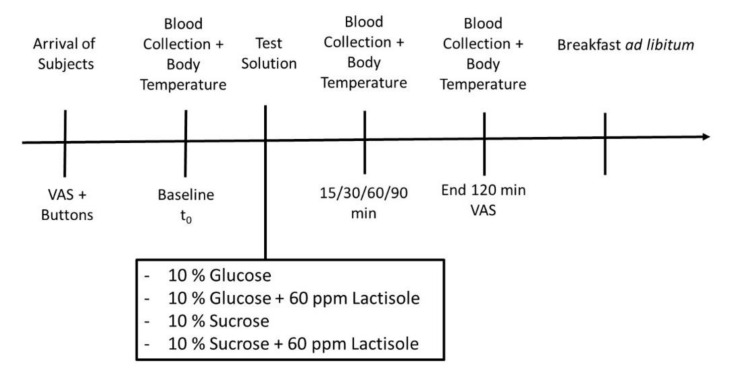
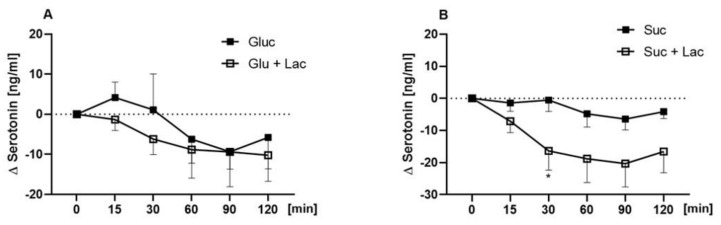
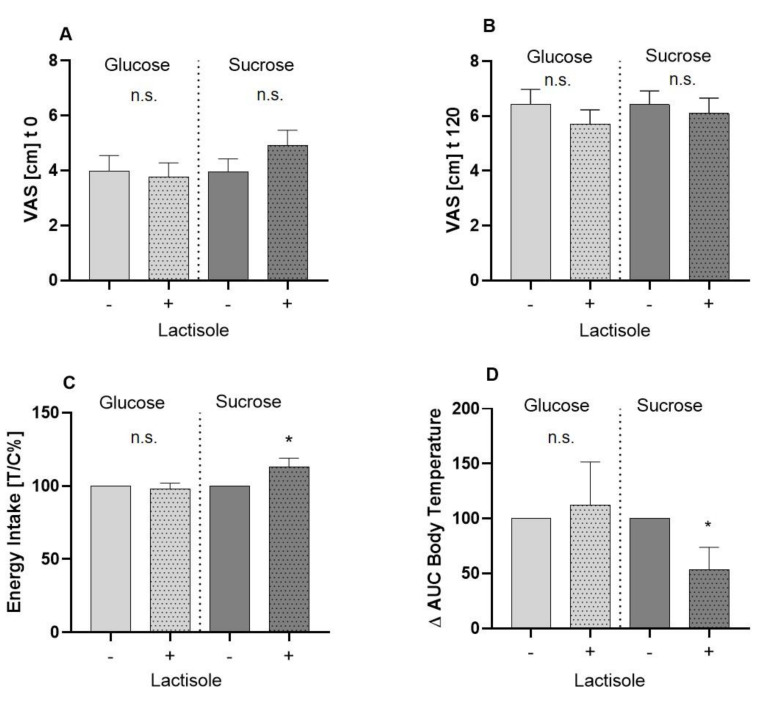
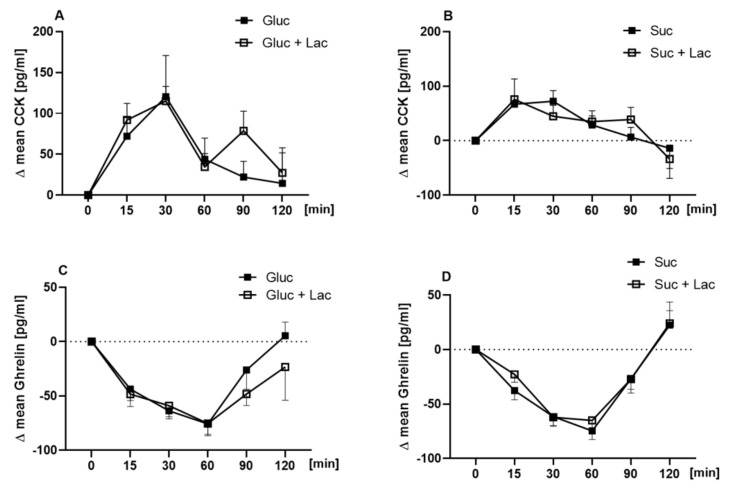
Knowledge regarding the involvement of sweetness perception on energy intake is scarce. Here, the impact of glucose and sucrose sweetness, beyond their caloric load, on subsequent food intake and biomarkers of satiation was evaluated by co-administration of the sweet taste receptor inhibitor lactisole. A total of 27 healthy, male subjects received solutions of either 10% glucose / 60 ppm lactisole or 10% sucrose / 60 ppm lactisole. Subsequent food intake from a standardized breakfast was evaluated 2 h after receiving the respective test solution. Changes in postprandial plasma concentrations of cholecystokinin, ghrelin, and serotonin were determined over a period of 120 min, as was the body temperature. Administration of lactisole to the sucrose solution increased the energy intake from the subsequent standardized breakfast by 12.9 ± 5.8% ( = 0.04), led to a decreased Δ AUC of the body core temperature by 46 ± 20% ( = 0.01), and time-dependently reduced Δ serotonin plasma concentrations (-16.9 ± 6.06 ng/mL vs. -0.56 ± 3.7 ng/mL after sucrose administration, = 0.03). The present study shows that lactisole increases energy intake and decreases plasma serotonin concentrations as well as body core temperature induced by sucrose, but not glucose. This finding may be associated with the different binding affinities of sucrose and glucose to the sweet taste receptor.
关于甜味感知对能量摄入的影响的知识还很缺乏。在这里,通过共同给予甜味受体抑制剂乳链球菌肽,评估了葡萄糖和蔗糖甜味除了其卡路里负荷之外对随后的食物摄入和饱腹感生物标志物的影响。共有 27 名健康的男性受试者接受了 10%葡萄糖/60ppm 乳链球菌肽或 10%蔗糖/60ppm 乳链球菌肽的溶液。在接受各自的测试溶液后 2 小时评估了标准化早餐的后续食物摄入量。在 120 分钟的时间内,确定了餐后血浆胆囊收缩素、胃饥饿素和血清素浓度的变化,以及体温的变化。将乳链球菌肽添加到蔗糖溶液中会使随后的标准化早餐的能量摄入量增加 12.9±5.8%(=0.04),导致体核温度的Δ AUC 降低 46±20%(=0.01),并随时间降低Δ血清素血浆浓度(与蔗糖给药后相比,-16.9±6.06ng/mL 与-0.56±3.7ng/mL,=0.03)。本研究表明,乳链球菌肽增加了能量摄入,降低了由蔗糖引起的血浆血清素浓度和体核温度,但不会引起葡萄糖。这一发现可能与蔗糖和葡萄糖与甜味受体的不同结合亲和力有关。