Jayasinghe Shakeela N, Kruger Rozanne, Walsh Daniel C I, Cao Guojiao, Rivers Stacey, Richter Marilize, Breier Bernhard H
School of Food and Nutrition, College of Health, Massey University, Auckland 0745, New Zealand.
Institute for Natural and Mathematical Sciences, College of Sciences, Massey University, Auckland 0745, New Zealand.
Nutrients. 2017 Jul 14;9(7):750. doi: 10.3390/nu9070750.
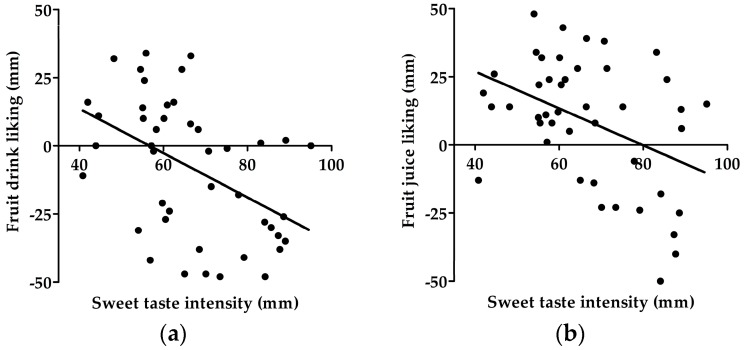
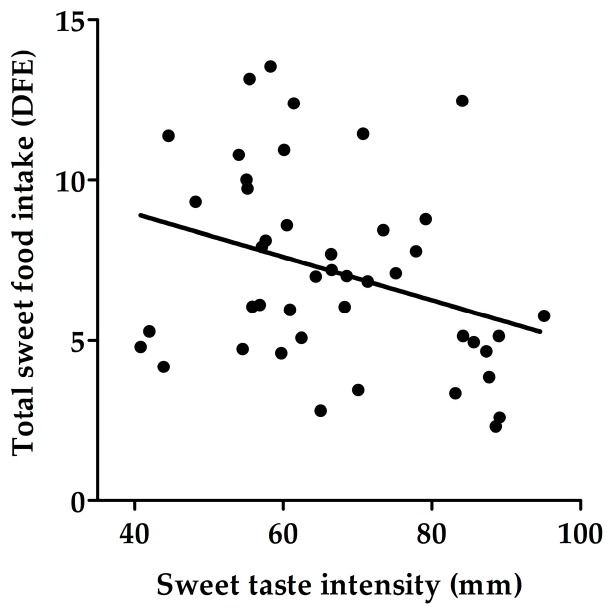
A range of psychophysical taste measurements are used to characterize an individual's sweet taste perception and to assess links between taste perception and dietary intake. The aims of this study were to investigate the relationship between four different psychophysical measurements of sweet taste perception, and to explore which measures of sweet taste perception relate to sweet food intake. Forty-four women aged 20-40 years were recruited for the study. Four measures of sweet taste perception (detection and recognition thresholds, and sweet taste intensity and hedonic liking of suprathreshold concentrations) were assessed using glucose as the tastant. Dietary measurements included a four-day weighed food record, a sweet food-food frequency questionnaire and a sweet beverage liking questionnaire. Glucose detection and recognition thresholds showed no correlation with suprathreshold taste measurements or any dietary intake measurement. Importantly, sweet taste intensity correlated negatively with total energy and carbohydrate (starch, total sugar, fructose, glucose) intakes, frequency of sweet food intake and sweet beverage liking. Furthermore, sweet hedonic liking correlated positively with total energy and carbohydrate (total sugar, fructose, glucose) intakes. The present study shows a clear link between sweet taste intensity and hedonic liking with sweet food liking, and total energy, carbohydrate and sugar intake.
一系列心理物理学味觉测量方法被用于刻画个体的甜味感知,并评估味觉感知与饮食摄入之间的联系。本研究的目的是调查甜味感知的四种不同心理物理学测量方法之间的关系,并探究哪些甜味感知测量方法与甜食摄入量相关。44名年龄在20至40岁之间的女性被招募参与该研究。使用葡萄糖作为味觉刺激物,评估了甜味感知的四种测量方法(检测阈值、识别阈值、甜味强度以及阈上浓度的喜好程度)。饮食测量包括为期四天的称重食物记录、甜食食物频率问卷以及甜饮料喜好问卷。葡萄糖检测阈值和识别阈值与阈上味觉测量或任何饮食摄入量测量均无相关性。重要的是,甜味强度与总能量、碳水化合物(淀粉、总糖、果糖、葡萄糖)摄入量、甜食摄入频率以及甜饮料喜好呈负相关。此外,甜味喜好程度与总能量和碳水化合物(总糖、果糖、葡萄糖)摄入量呈正相关。本研究表明甜味强度和喜好程度与甜食喜好、总能量、碳水化合物和糖摄入量之间存在明显联系。