Kerklaan Jasmijn, Hannan Elyssa, Hanson Camilla, Guha Chandana, Cho Yeoungjee, Christian Martin, Hamiwka Lorraine, Ryan Jessica, Sinha Aditi, Wong Germaine, Craig Jonathan, Groothoff Jaap, Tong Allison
Sydney School of Public Health, The University of Sydney, Sydney, New South Wales, Australia
Centre for Kidney Research, The Children's Hospital at Westmead, Westmead, New South Wales, Australia.
BMJ Open. 2020 Oct 16;10(10):e037840. doi: 10.1136/bmjopen-2020-037840.
To describe the perspectives on life participation by young adults with childhood-onset chronic kidney disease (CKD).
Semi-structured interviews; thematic analysis.
Multiple centres across six countries (Australia, Canada, India, UK, USA and New Zealand).
Thirty young adults aged 18 to 35 years diagnosed with CKD during childhood.
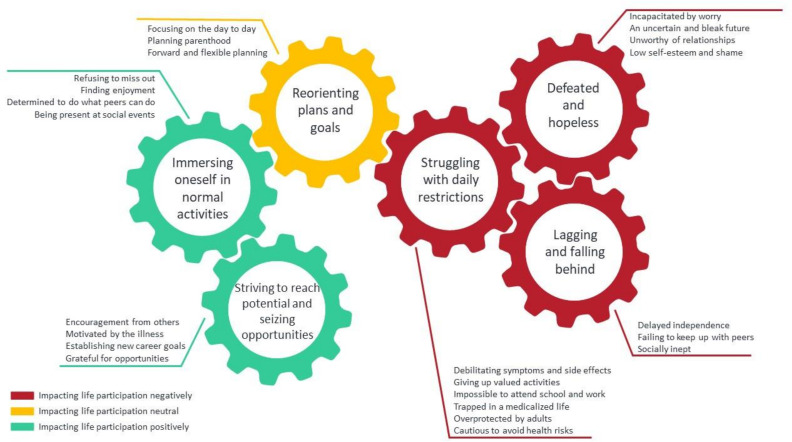
We identified six themes: struggling with daily restrictions (debilitating symptoms and side effects, giving up valued activities, impossible to attend school and work, trapped in a medicalised life, overprotected by adults and cautious to avoid health risks); lagging and falling behind (delayed independence, failing to keep up with peers and socially inept); defeated and hopeless (incapacitated by worry, an uncertain and bleak future, unworthy of relationships and low self-esteem and shame); reorienting plans and goals (focussing on the day-to-day, planning parenthood and forward and flexible planning); immersing oneself in normal activities (refusing to miss out, finding enjoyment, determined to do what peers do and being present at social events); and striving to reach potential and seizing opportunities (encouragement from others, motivated by the illness, establishing new career goals and grateful for opportunities).
Young adults encounter lifestyle limitations and missed school and social opportunities as a consequence of developing CKD during childhood and as a consequence lack confidence and social skills, are uncertain of the future, and feel vulnerable. Some re-adjust their goals and become more determined to participate in 'normal' activities to avoid missing out. Strategies are needed to improve life participation in young adult 'graduates' of childhood CKD and thereby strengthen their mental and social well-being and enhance their overall health.
描述童年期起病的慢性肾脏病(CKD)青年成人对生活参与的看法。
半结构化访谈;主题分析。
六个国家(澳大利亚、加拿大、印度、英国、美国和新西兰)的多个中心。
30名18至35岁在童年期被诊断为CKD的青年成人。
我们确定了六个主题:与日常限制作斗争(使人衰弱的症状和副作用、放弃珍视的活动、无法上学和工作、被困在医疗化的生活中、被成年人过度保护以及谨慎避免健康风险);滞后和落后(独立延迟、跟不上同龄人且社交能力差);挫败和绝望(因担忧而丧失能力、未来不确定且黯淡、不值得拥有人际关系、自卑和羞耻);重新调整计划和目标(关注日常、规划为人父母以及前瞻性和灵活的规划);融入正常活动(拒绝错过、找到乐趣、决心做同龄人做的事并出席社交活动);以及努力发挥潜力和抓住机会(他人的鼓励、受疾病激励、确立新的职业目标并感激机会)。
由于童年期患CKD,青年成人面临生活方式限制以及错过学校和社交机会,因此缺乏自信和社交技能,对未来不确定,并感到脆弱。一些人重新调整目标,更加坚定地参与“正常”活动以避免错过。需要采取策略来改善童年期CKD青年成人“毕业生”的生活参与度,从而增强他们的心理和社会幸福感,提高他们的整体健康水平。