School of Health & Social Development, Deakin University, Burwood, Vic., Australia.
Centre of Urban Transition, Swinburne University of Technology, Swinburne Place West, Hawthorn, Vic., Australia.
Health Promot J Austr. 2021 Oct;32 Suppl 2(Suppl 2):8-21. doi: 10.1002/hpja.434. Epub 2020 Nov 23.
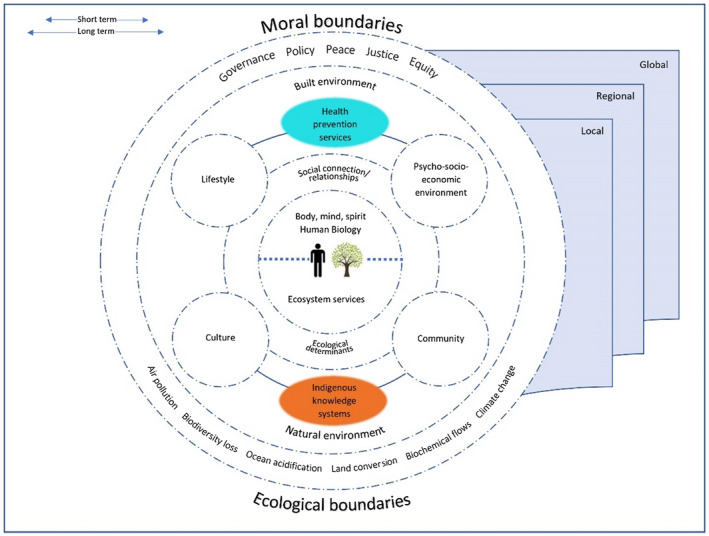
The Anthropocene is a new era in which human activity has been the dominant influence on climate and the environment. The negative impact humans have on the earth's systems pose significant threats to human health. Health promotion is a discipline well placed to respond to planetary health challenges of the Anthropocene. The overarching aim of this paper is to describe the elements of 21st century socio-ecological health and apply them in a revised socio-ecological framework for health promotion.
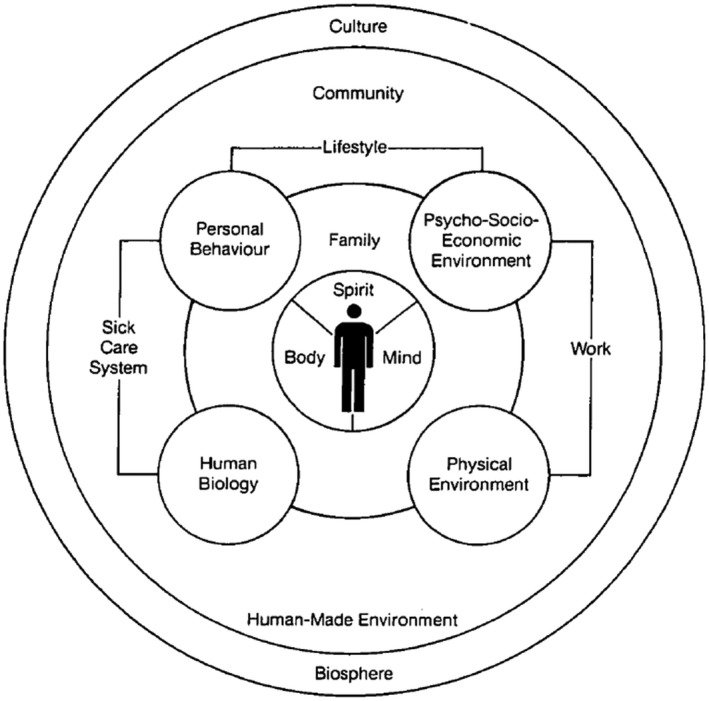
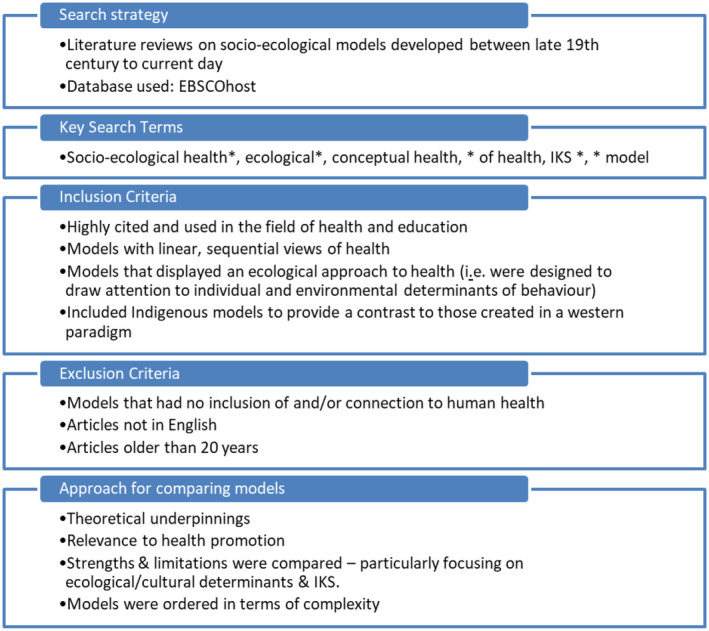
A qualitative description study design was employed to explore the significance of ecological and cultural determinants of health and review models in contemporary health promotion to inform the development of a revised Mandala of Health. Purposeful sampling was used to recruit ten experts from across Australia including academics and practitioners working at the nexus of health promotion, environmental management and sustainability. Data were analysed thematically, using deductive and inductive methods.
A revised Mandala of Health could address existing gaps in health promotion theory and practice. Ecological and cultural determinants of health were considered essential components of health promotion that is often lacking in socio-ecological frameworks. Indigenous Knowledge Systems were considered immensely important when addressing ecological and cultural determinants of health.
A revised Mandala of Health could encourage development of contemporary health models, assisting health promotion to evolve with the health and environmental issues of the Anthropocene. This study highlights the need for more theoretical development and empirical research regarding ecological and cultural determinants of health in a health promotion context. SO WHAT?: In the context of the Anthropocene, this study highlights the potential gaps in health promotion theory and practice in terms of the natural environment and health and emphasises the need of a paradigm shift to embed ecological and cultural determinants with other determinants of health.
人类世是一个新的时代,人类活动对气候和环境产生了主导影响。人类对地球系统的负面影响对人类健康构成了重大威胁。健康促进是一个能够应对人类世地球健康挑战的学科。本文的总体目标是描述 21 世纪社会生态健康的要素,并将其应用于修订后的健康促进社会生态框架中。
采用定性描述性研究设计,探索健康的生态和文化决定因素的意义,并审查当代健康促进模型,为修订后的健康曼陀罗提供信息。目的抽样用于从澳大利亚各地招募了包括在健康促进、环境管理和可持续性交叉点工作的学者和从业者在内的 10 名专家。使用演绎和归纳方法对数据进行了主题分析。
修订后的健康曼陀罗可以解决健康促进理论和实践中的现有差距。健康的生态和文化决定因素被认为是健康促进的基本组成部分,而这在社会生态框架中往往缺乏。在解决生态和文化决定因素时,本土知识系统被认为是非常重要的。
修订后的健康曼陀罗可以鼓励发展当代健康模型,帮助健康促进随着人类世的健康和环境问题而发展。本研究强调了在健康促进背景下,需要更多关于生态和文化决定因素的理论发展和实证研究。那么,这意味着什么呢?在人类世的背景下,本研究强调了健康促进理论和实践在自然环境与健康方面的潜在差距,并强调需要转变思维模式,将生态和文化决定因素与其他健康决定因素结合起来。