• 文献检索
  • 文档翻译
  • 深度研究
  • 学术资讯
  • Suppr Zotero 插件Zotero 插件
  • 邀请有礼
  • 套餐&价格
  • 历史记录
应用&插件
Suppr Zotero 插件Zotero 插件浏览器插件Mac 客户端Windows 客户端微信小程序
定价
高级版会员购买积分包购买API积分包
服务
文献检索文档翻译深度研究API 文档MCP 服务
关于我们
关于 Suppr公司介绍联系我们用户协议隐私条款
关注我们

Suppr 超能文献

核心技术专利:CN118964589B侵权必究
粤ICP备2023148730 号-1Suppr @ 2026

文献检索

告别复杂PubMed语法,用中文像聊天一样搜索,搜遍4000万医学文献。AI智能推荐,让科研检索更轻松。

立即免费搜索

文件翻译

保留排版,准确专业,支持PDF/Word/PPT等文件格式,支持 12+语言互译。

免费翻译文档

深度研究

AI帮你快速写综述,25分钟生成高质量综述,智能提取关键信息,辅助科研写作。

立即免费体验

伊朗赞詹省2019冠状病毒病大流行期间的卒中护理趋势。来自CASCADE倡议:统计分析计划和初步结果。

Stroke Care Trends During COVID-19 Pandemic in Zanjan Province, Iran. From the CASCADE Initiative: Statistical Analysis Plan and Preliminary Results.

作者信息

Ghoreishi Abdoreza, Arsang-Jang Shahram, Sabaa-Ayoun Ziad, Yassi Nawaf, Sylaja P N, Akbari Yama, Divani Afshin A, Biller Jose, Phan Thanh, Steinwender Sandy, Silver Brian, Zand Ramin, Basri Hamidon Bin, Iqbal Omer M, Ranta Annemarei, Ruland Sean, Macri Elizabeth, Ma Henry, Nguyen Thanh N, Abootalebi Shahram, Gupta Animesh, Alet Matias, Lattanzi Simona, Desai Masoom, Gagliardi Rubens J, Girotra Tarun, Inoue Manabu, Yoshimoto Takeshi, Isaac Cristian Flavo, Mayer Stephan A, Morovatdar Negar, Nilanont Yongchai, Nobleza Christa O'Hana S, Saber Hamidreza, Kamenova Saltanat, Kondybayeva Aida, Krupinski Jerzy, Siegler James E, Stranges Saverio, Torbey Michel T, Yorio Diana, Zurrú María Cristina, Rubinos Clio Aracelli, Shahripour Reza Bavarsad, Borhani-Haghighi Afshin, Napoli Mario Di, Azarpazhooh M Reza

机构信息

Stroke Research Group, Department of Neurology and Stroke Unit, Vali-e-Asr hospital, School of Medicine, Zanjan University of Medical Sciences, Zanjan, Iran.

Department of Biostatistics and Epidemiology, School of Medicine, Zanjan University of Medical Sciences, Zanjan, Iran.

出版信息

J Stroke Cerebrovasc Dis. 2020 Dec;29(12):105321. doi: 10.1016/j.jstrokecerebrovasdis.2020.105321. Epub 2020 Sep 16.

DOI:10.1016/j.jstrokecerebrovasdis.2020.105321
PMID:33069086
原文链接:https://pmc.ncbi.nlm.nih.gov/articles/PMC7494258/
Abstract

BACKGROUND

The emergence of the COVID-19 pandemic has significantly impacted global healthcare systems and this may affect stroke care and outcomes. This study examines the changes in stroke epidemiology and care during the COVID-19 pandemic in Zanjan Province, Iran.

METHODS

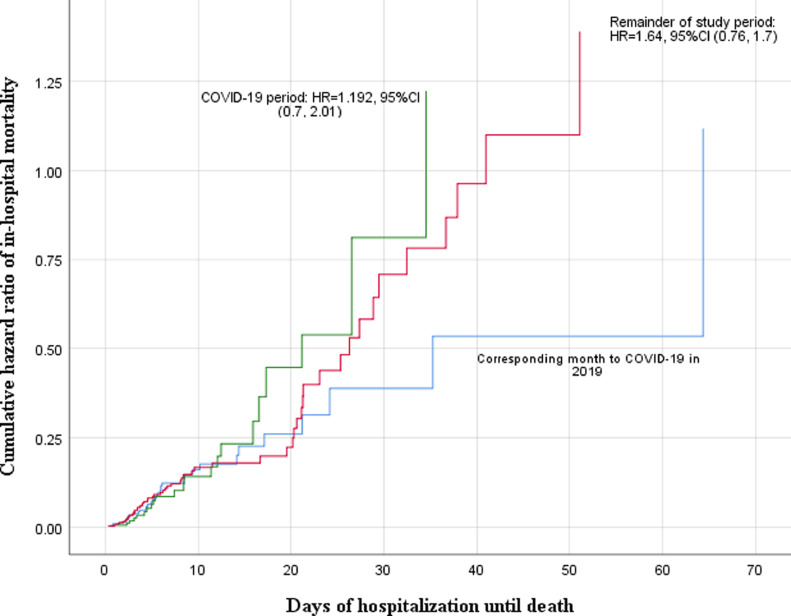
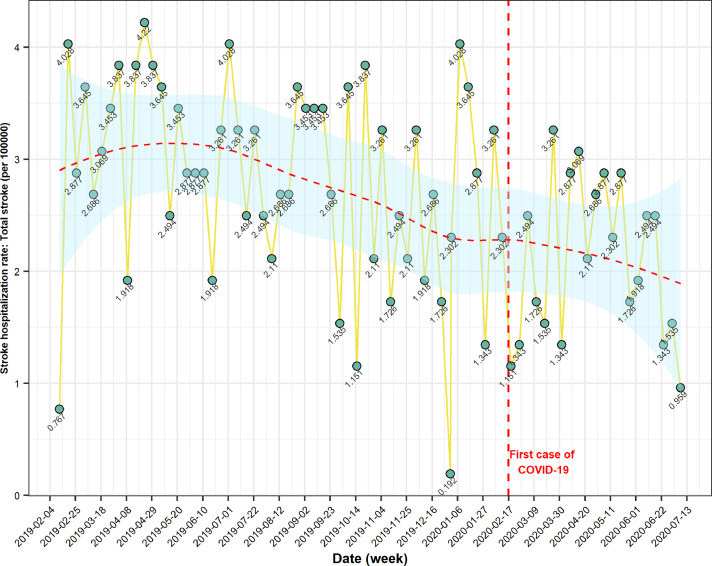
This study is part of the CASCADE international initiative. From February 18, 2019, to July 18, 2020, we followed ischemic and hemorrhagic stroke hospitalization rates and outcomes in Valiasr Hospital, Zanjan, Iran. We used a Bayesian hierarchical model and an interrupted time series analysis (ITS) to identify changes in stroke hospitalization rate, baseline stroke severity [measured by the National Institutes of Health Stroke Scale (NIHSS)], disability [measured by the modified Rankin Scale (mRS)], presentation time (last seen normal to hospital presentation), thrombolytic therapy rate, median door-to-needle time, length of hospital stay, and in-hospital mortality. We compared in-hospital mortality between study periods using Cox-regression model.

RESULTS

During the study period, 1,026 stroke patients were hospitalized. Stroke hospitalization rates per 100,000 population decreased from 68.09 before the pandemic to 44.50 during the pandemic, with a significant decline in both Bayesian [Beta: -1.034; Standard Error (SE): 0.22, 95% CrI: -1.48, -0.59] and ITS analysis (estimate: -1.03, SE = 0.24, p < 0.0001). Furthermore, we observed lower admission rates for patients with mild (NIHSS < 5) ischemic stroke (p < 0.0001). Although, the presentation time and door-to-needle time did not change during the pandemic, a lower proportion of patients received thrombolysis (-10.1%; p = 0.004). We did not see significant changes in admission rate to the stroke unit and in-hospital mortality rate; however, disability at discharge increased (p < 0.0001).

CONCLUSION

In Zanjan, Iran, the COVID-19 pandemic has significantly impacted stroke outcomes and altered the delivery of stroke care. Observed lower admission rates for milder stroke may possibly be due to fear of exposure related to COVID-19. The decrease in patients treated with thrombolysis and the increased disability at discharge may indicate changes in the delivery of stroke care and increased pressure on existing stroke acute and subacute services. The results of this research will contribute to a similar analysis of the larger CASCADE dataset in order to confirm findings at a global scale and improve measures to ensure the best quality of care for stroke patients during the COVID-19 pandemic.

摘要

背景

新型冠状病毒肺炎疫情的出现对全球医疗系统产生了重大影响,这可能会影响中风护理及治疗结果。本研究调查了伊朗赞詹省在新型冠状病毒肺炎疫情期间中风流行病学及护理的变化情况。

方法

本研究是“全球急性中风研究协作组(CASCADE)”国际倡议的一部分。2019年2月18日至2020年7月18日,我们追踪了伊朗赞詹省瓦利阿斯尔医院缺血性和出血性中风的住院率及治疗结果。我们使用贝叶斯分层模型和中断时间序列分析(ITS)来确定中风住院率、基线中风严重程度[通过美国国立卫生研究院中风量表(NIHSS)测量]、残疾程度[通过改良Rankin量表(mRS)测量]、就诊时间(最后一次正常状态至入院时间)、溶栓治疗率、中位门到针时间、住院时间和院内死亡率的变化。我们使用Cox回归模型比较了研究期间的院内死亡率。

结果

在研究期间,1026例中风患者住院治疗。每10万人口的中风住院率从疫情前的68.09降至疫情期间的44.50,贝叶斯分析[贝塔值:-1.034;标准误(SE):0.22,95%可信区间:-1.48,-0.59]和ITS分析均显示显著下降(估计值:-1.03,SE = 0.24,p < 0.0001)。此外,我们观察到轻度(NIHSS < 5)缺血性中风患者的入院率较低(p < 0.0001)。尽管在疫情期间就诊时间和门到针时间没有变化,但接受溶栓治疗的患者比例较低(-10.1%;p = 0.004)。我们未观察到中风单元的入院率和院内死亡率有显著变化;然而,出院时的残疾程度有所增加(p < 0.0001)。

结论

在伊朗赞詹,新型冠状病毒肺炎疫情对中风治疗结果产生了重大影响,并改变了中风护理的提供方式。观察到较轻中风患者入院率较低可能是由于对新型冠状病毒肺炎感染风险的担忧。溶栓治疗患者数量减少以及出院时残疾程度增加可能表明中风护理提供方式发生了变化,现有中风急性和亚急性服务压力增大。本研究结果将有助于对更大规模的CASCADE数据集进行类似分析,以在全球范围内确认研究结果,并改进措施以确保在新型冠状病毒肺炎疫情期间为中风患者提供最佳护理质量。
https://cdn.ncbi.nlm.nih.gov/pmc/blobs/b5f5/7494258/5f1ee09c2c85/gr2_lrg.jpg
https://cdn.ncbi.nlm.nih.gov/pmc/blobs/b5f5/7494258/c3baeea29824/gr1_lrg.jpg
https://cdn.ncbi.nlm.nih.gov/pmc/blobs/b5f5/7494258/5f1ee09c2c85/gr2_lrg.jpg
https://cdn.ncbi.nlm.nih.gov/pmc/blobs/b5f5/7494258/c3baeea29824/gr1_lrg.jpg
https://cdn.ncbi.nlm.nih.gov/pmc/blobs/b5f5/7494258/5f1ee09c2c85/gr2_lrg.jpg

相似文献

1
Stroke Care Trends During COVID-19 Pandemic in Zanjan Province, Iran. From the CASCADE Initiative: Statistical Analysis Plan and Preliminary Results.伊朗赞詹省2019冠状病毒病大流行期间的卒中护理趋势。来自CASCADE倡议:统计分析计划和初步结果。
J Stroke Cerebrovasc Dis. 2020 Dec;29(12):105321. doi: 10.1016/j.jstrokecerebrovasdis.2020.105321. Epub 2020 Sep 16.
2
The impact of COVID-19 on acute ischemic stroke admissions: Analysis from a community-based tertiary care center.新型冠状病毒肺炎对急性缺血性卒中入院情况的影响:来自一家社区三级医疗中心的分析
J Stroke Cerebrovasc Dis. 2020 Dec;29(12):105344. doi: 10.1016/j.jstrokecerebrovasdis.2020.105344. Epub 2020 Sep 25.
3
Stroke Code Presentations, Interventions, and Outcomes Before and During the COVID-19 Pandemic.COVID-19 大流行前后的中风救治流程、干预措施和结局。
Stroke. 2020 Sep;51(9):2664-2673. doi: 10.1161/STR.0000000000000347. Epub 2020 Jul 31.
4
Patient Characteristics and Outcomes Associated with Decline in Stroke Volumes During the Early COVID-19 Pandemic.与 COVID-19 大流行早期脑卒中量下降相关的患者特征和结局。
J Stroke Cerebrovasc Dis. 2021 Jun;30(6):105569. doi: 10.1016/j.jstrokecerebrovasdis.2020.105569. Epub 2020 Dec 26.
5
The Role of Hemorrhagic Transformation in Acute Ischemic Stroke Upon Clinical Complications and Outcomes.出血性转化在急性缺血性卒中临床并发症及预后中的作用。
J Stroke Cerebrovasc Dis. 2020 Aug;29(8):104898. doi: 10.1016/j.jstrokecerebrovasdis.2020.104898. Epub 2020 May 13.
6
COVID-19 Lockdown Effects on Acute Stroke Care in Latin America.拉丁美洲 COVID-19 封锁对急性脑卒中治疗的影响。
J Stroke Cerebrovasc Dis. 2021 Sep;30(9):105985. doi: 10.1016/j.jstrokecerebrovasdis.2021.105985. Epub 2021 Jul 3.
7
Safety and Outcomes of Intravenous Thrombolytic Therapy in Ischemic Stroke Patients with COVID-19: CASCADE Initiative.COVID-19 相关缺血性脑卒中患者静脉溶栓治疗的安全性和结局:CASCAdE 研究。
J Stroke Cerebrovasc Dis. 2021 Dec;30(12):106121. doi: 10.1016/j.jstrokecerebrovasdis.2021.106121. Epub 2021 Sep 20.
8
Quality of acute ischemic stroke care in Thailand: a prospective multicenter countrywide cohort study.泰国急性缺血性脑卒中治疗质量:一项前瞻性多中心全国性队列研究。
J Stroke Cerebrovasc Dis. 2014 Feb;23(2):213-9. doi: 10.1016/j.jstrokecerebrovasdis.2012.12.001. Epub 2013 Jan 8.
9
Sex and racial disparity in utilization and outcomes of t-PA and thrombectomy in acute ischemic stroke.急性缺血性脑卒中患者 t-PA 和血栓切除术的利用和结局存在性别和种族差异。
J Stroke Cerebrovasc Dis. 2020 Sep;29(9):104954. doi: 10.1016/j.jstrokecerebrovasdis.2020.104954. Epub 2020 Jun 30.
10
Stroke pathway performance assessment: a retrospective observational study.脑卒中路径表现评估:一项回顾性观察研究。
BMC Health Serv Res. 2023 Dec 11;23(1):1391. doi: 10.1186/s12913-023-10343-8.

引用本文的文献

1
Rapid outpatient transient ischemic attack clinic and stroke service activity during the SARS-CoV-2 pandemic: a multicenter time series analysis.严重急性呼吸综合征冠状病毒2(SARS-CoV-2)大流行期间快速门诊短暂性脑缺血发作诊所及卒中服务活动:一项多中心时间序列分析
Front Neurol. 2024 Feb 7;15:1351769. doi: 10.3389/fneur.2024.1351769. eCollection 2024.
2
The Impact of the COVID-19 Pandemic on Hospitalization Rates due to Prosthetic Valve Thrombosis.2019年冠状病毒病大流行对人工瓣膜血栓形成导致的住院率的影响。
J Tehran Heart Cent. 2023 Apr;18(2):136-141. doi: 10.18502/jthc.v18i2.13324.
3
Association of the COVID-19 pandemic on stroke admissions and treatment globally: a systematic review.
COVID-19 大流行对全球卒中住院和治疗的影响:系统评价。
BMJ Open. 2023 Mar 17;13(3):e062734. doi: 10.1136/bmjopen-2022-062734.
4
Global Impact of the COVID-19 Pandemic on Stroke Volumes and Cerebrovascular Events: A 1-Year Follow-up.COVID-19 大流行对脑卒中量和脑血管事件的全球影响:1 年随访。
Neurology. 2023 Jan 24;100(4):e408-e421. doi: 10.1212/WNL.0000000000201426. Epub 2022 Oct 18.
5
Impact of COVID-19 pandemic on haemorrhagic stroke admissions: a systematic review and meta-analysis.COVID-19 大流行对出血性脑卒中入院的影响:系统评价和荟萃分析。
BMJ Open. 2021 Dec 14;11(12):e050559. doi: 10.1136/bmjopen-2021-050559.
6
Safety and Outcomes of Intravenous Thrombolytic Therapy in Ischemic Stroke Patients with COVID-19: CASCADE Initiative.COVID-19 相关缺血性脑卒中患者静脉溶栓治疗的安全性和结局:CASCAdE 研究。
J Stroke Cerebrovasc Dis. 2021 Dec;30(12):106121. doi: 10.1016/j.jstrokecerebrovasdis.2021.106121. Epub 2021 Sep 20.
7
The impact of the COVID-19 pandemic on cerebrovascular disease.新型冠状病毒肺炎大流行对脑血管疾病的影响。
Semin Vasc Surg. 2021 Jun;34(2):20-27. doi: 10.1053/j.semvascsurg.2021.05.001. Epub 2021 May 20.
8
SARS-CoV-2 Is a Culprit for Some, but Not All Acute Ischemic Strokes: A Report from the Multinational COVID-19 Stroke Study Group.新型冠状病毒肺炎(COVID-19)相关卒中多国研究组报告:严重急性呼吸综合征冠状病毒2(SARS-CoV-2)是部分而非所有急性缺血性卒中的病因
J Clin Med. 2021 Mar 1;10(5):931. doi: 10.3390/jcm10050931.
9
Response to Letter to the Editor.对致编辑信的回复。
J Stroke Cerebrovasc Dis. 2021 Aug;30(8):105723. doi: 10.1016/j.jstrokecerebrovasdis.2021.105723. Epub 2021 Mar 10.
10
Addressing Stroke Admissions During COVID-19 Pandemic Beyond Fear and Constraining Health Factors.在新冠疫情期间应对中风入院问题,超越恐惧和限制健康因素。
J Stroke Cerebrovasc Dis. 2021 Aug;30(8):105693. doi: 10.1016/j.jstrokecerebrovasdis.2021.105693. Epub 2021 Feb 26.