Shahjouei Shima, Anyaehie Michelle, Koza Eric, Tsivgoulis Georgios, Naderi Soheil, Mowla Ashkan, Avula Venkatesh, Vafaei Sadr Alireza, Chaudhary Durgesh, Farahmand Ghasem, Griessenauer Christoph, Azarpazhooh Mahmoud Reza, Misra Debdipto, Li Jiang, Abedi Vida, Zand Ramin
Neurology Department, Neuroscience Institute, Geisinger Health System, Danville, PA 17822, USA.
Neuroscience Institute, Geisinger Commonwealth School of Medicine, Scranton, PA 18510, USA.
J Clin Med. 2021 Mar 1;10(5):931. doi: 10.3390/jcm10050931.
SARS-CoV-2 infected patients are suggested to have a higher incidence of thrombotic events such as acute ischemic strokes (AIS). This study aimed at exploring vascular comorbidity patterns among SARS-CoV-2 infected patients with subsequent stroke. We also investigated whether the comorbidities and their frequencies under each subclass of TOAST criteria were similar to the AIS population studies prior to the pandemic.
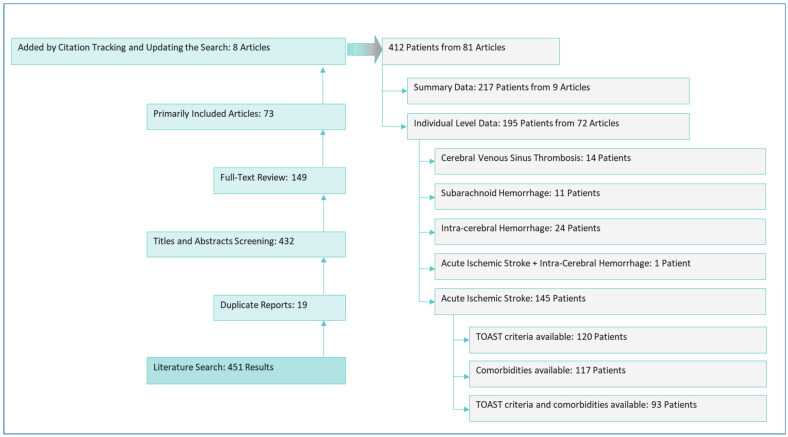
This is a report from the Multinational COVID-19 Stroke Study Group. We present an original dataset of SASR-CoV-2 infected patients who had a subsequent stroke recorded through our multicenter prospective study. In addition, we built a dataset of previously reported patients by conducting a systematic literature review. We demonstrated distinct subgroups by clinical risk scoring models and unsupervised machine learning algorithms, including hierarchical K-Means (ML-K) and Spectral clustering (ML-S).
This study included 323 AIS patients from 71 centers in 17 countries from the original dataset and 145 patients reported in the literature. The unsupervised clustering methods suggest a distinct cohort of patients (ML-K: 36% and ML-S: 42%) with no or few comorbidities. These patients were more than 6 years younger than other subgroups and more likely were men (ML-K: 59% and ML-S: 60%). The majority of patients in this subgroup suffered from an embolic-appearing stroke on imaging (ML-K: 83% and ML-S: 85%) and had about 50% risk of large vessel occlusions (ML-K: 50% and ML-S: 53%). In addition, there were two cohorts of patients with large-artery atherosclerosis (ML-K: 30% and ML-S: 43% of patients) and cardioembolic strokes (ML-K: 34% and ML-S: 15%) with consistent comorbidity and imaging patterns. Binominal logistic regression demonstrated that ischemic heart disease (odds ratio (OR), 4.9; 95% confidence interval (CI), 1.6-14.7), atrial fibrillation (OR, 14.0; 95% CI, 4.8-40.8), and active neoplasm (OR, 7.1; 95% CI, 1.4-36.2) were associated with cardioembolic stroke.
Although a cohort of young and healthy men with cardioembolic and large vessel occlusions can be distinguished using both clinical sub-grouping and unsupervised clustering, stroke in other patients may be explained based on the existing comorbidities.
感染严重急性呼吸综合征冠状病毒2(SARS-CoV-2)的患者发生血栓形成事件(如急性缺血性卒中(AIS))的发生率较高。本研究旨在探讨感染SARS-CoV-2且随后发生卒中的患者的血管合并症模式。我们还调查了在急性卒中治疗Org 10172标准(TOAST)标准各亚类下的合并症及其频率是否与大流行前的AIS人群研究相似。
这是一份来自多国COVID-19卒中研究组的报告。我们展示了通过多中心前瞻性研究记录的感染SARS-CoV-2且随后发生卒中的患者的原始数据集。此外,我们通过系统的文献综述建立了先前报告患者的数据集。我们通过临床风险评分模型和无监督机器学习算法(包括分层K均值聚类(ML-K)和谱聚类(ML-S))展示了不同的亚组。
本研究纳入了来自原始数据集的17个国家71个中心的323例AIS患者以及文献中报告的145例患者。无监督聚类方法显示出一组合并症极少或无合并症的不同患者群体(ML-K:36%,ML-S:42%)。这些患者比其他亚组年轻6岁以上,且更可能为男性(ML-K:59%,ML-S:60%)。该亚组中的大多数患者在影像学上表现为栓塞性卒中(ML-K:83%,ML-S:85%),且有大约50%的大血管闭塞风险(ML-K:50%,ML-S:53%)。此外,有两组患有大动脉粥样硬化的患者(ML-K:30%,ML-S:43%的患者)和心源性栓塞性卒中患者(ML-K:34%,ML-S:15%),其合并症和影像学模式一致。二项逻辑回归显示,缺血性心脏病(比值比(OR),4.9;95%置信区间(CI),1.6 - 14.7)、心房颤动(OR,14.0;95% CI,4.8 - 40.8)和活动性肿瘤(OR,7.1;95% CI,1.4 - 36.2)与心源性栓塞性卒中相关。
尽管使用临床亚组划分和无监督聚类都可以区分出一组患有心源性栓塞和大血管闭塞的年轻健康男性,但其他患者的卒中可能可以根据现有的合并症来解释。