Center for Spatial and Functional Genomics, Philadelphia, Pennsylvania; Division of Human Genetics, Philadelphia, Pennsylvania.
Division of Molecular Genetics (Pediatrics), Naomi Berrie Diabetes Center, Columbia University Vagelos College of Physicians and Surgeons, New York, New York.
Cell Mol Gastroenterol Hepatol. 2021;11(3):667-682. doi: 10.1016/j.jcmgh.2020.10.004. Epub 2020 Oct 16.
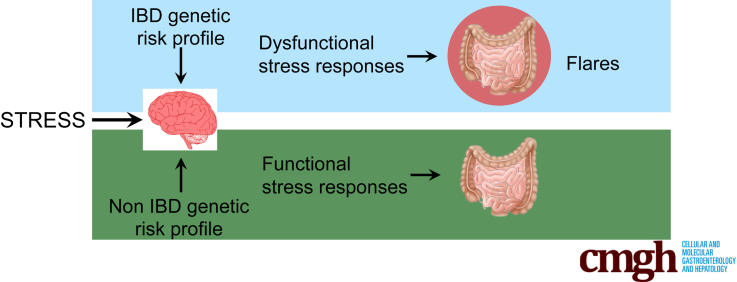
BACKGROUND & AIMS: Inflammatory bowel disease (IBD) is a polygenic disorder characterized principally by dysregulated inflammation impacting the gastrointestinal tract. However, there also is increasing evidence for a clinical association with stress and depression. Given the role of the hypothalamus in stress responses and in the pathogenesis of depression, useful insights could be gleaned from understanding its genetic role in IBD.
We conducted genetic correlation analyses on publicly available genome-wide association study summary statistics for depression and IBD traits to identify genetic commonalities. We used partitioned linkage disequilibrium score regression, leveraging our ATAC sequencing and promoter-focused Capture C data, to measure enrichment of IBD single-nucleotide polymorphisms within promoter-interacting open chromatin regions of human embryonic stem cell-derived hypothalamic-like neurons (HNs). Using the same data sets, we performed variant-to-gene mapping to implicate putative IBD effector genes in HNs. To contrast these results, we similarly analyzed 3-dimensional genomic data generated in epithelium-derived colonoids from rectal biopsy specimens from donors without pathologic disease noted at the time of colonoscopy. Finally, we conducted enrichment pathway analyses on the implicated genes to identify putative IBD dysfunctional pathways.
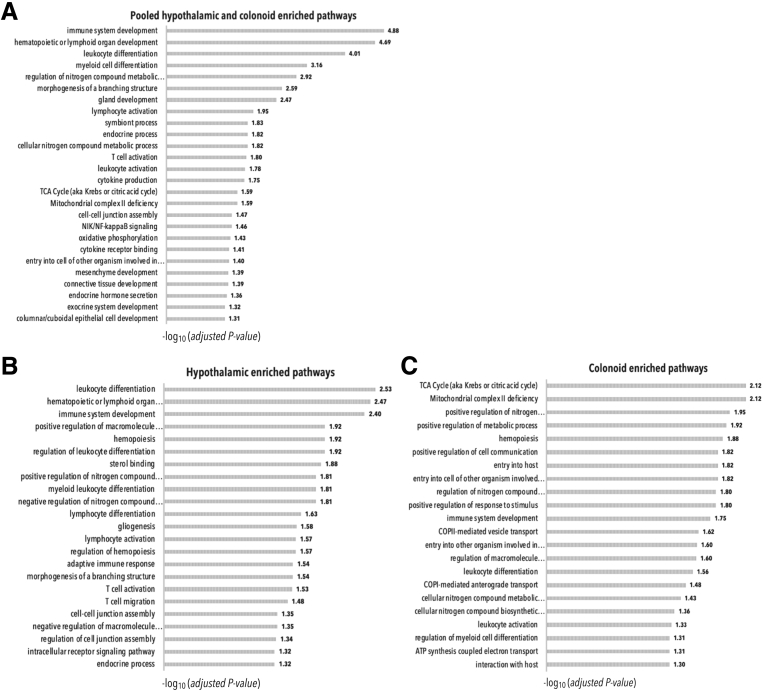
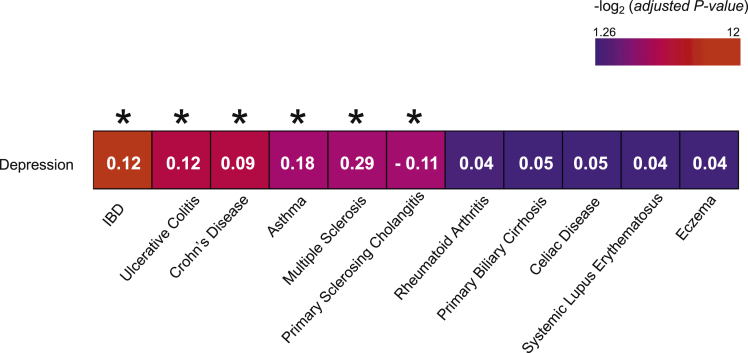
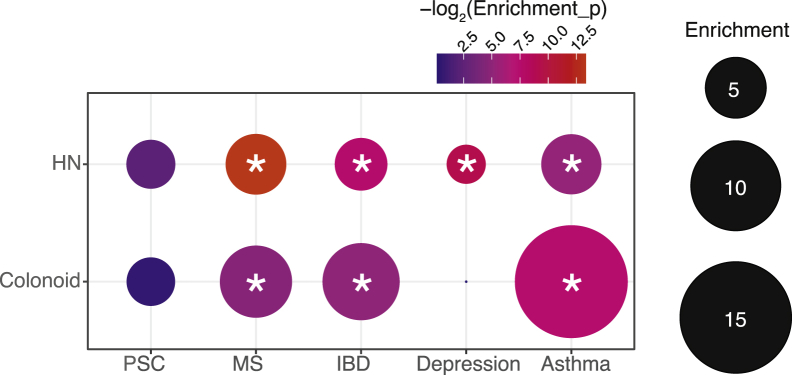
We found significant genetic correlations (rg) of 0.122 with an adjusted P (P) = 1.4 × 10 for IBD: rg = 0.122; P = 2.5 × 10 for ulcerative colitis and genetic correlation (rg) = 0.094; P = 2.5 × 10 for Crohn's disease, and significant approximately 4-fold (P = .005) and approximately 7-fold (P = .03) enrichment of IBD single-nucleotide polymorphisms in HNs and colonoids, respectively. We implicated 25 associated genes in HNs, among which CREM, CNTF, and RHOA encode key regulators of stress. Seven genes also additionally were implicated in the colonoids. We observed an overall enrichment for immune and hormonal signaling pathways, and a colonoid-specific enrichment for microbiota-relevant terms.
Our results suggest that the hypothalamus warrants further study in the context of IBD pathogenesis.
炎症性肠病(IBD)是一种多基因疾病,主要表现为胃肠道失调的炎症。然而,越来越多的证据表明它与压力和抑郁有关。鉴于下丘脑在应激反应和抑郁症发病机制中的作用,从理解其在 IBD 中的遗传作用中可以获得有用的见解。
我们对公开的全基因组关联研究抑郁和 IBD 特征的汇总统计数据进行了遗传相关性分析,以确定遗传共性。我们使用分区连锁不平衡评分回归,利用我们的 ATAC 测序和启动子聚焦捕获 C 数据,测量人类胚胎干细胞衍生的下丘脑样神经元(HN)中启动子相互作用的开放染色质区域内 IBD 单核苷酸多态性的富集。使用相同的数据,我们进行了变体到基因映射,以确定 HN 中的潜在 IBD 效应基因。为了对比这些结果,我们同样分析了从无明显疾病的直肠活检标本中衍生的上皮源性结肠类器官的 3 维基因组数据。最后,我们对所涉及的基因进行了富集途径分析,以确定潜在的 IBD 功能障碍途径。
我们发现 IBD 与抑郁之间存在显著的遗传相关性(rg),调整后的 P 值(P)为 1.4×10,rg 为 0.122;P 值为 2.5×10,用于溃疡性结肠炎,遗传相关性(rg)为 0.094;P 值为 2.5×10,用于克罗恩病,并且在 HN 和结肠类器官中,IBD 单核苷酸多态性的富集程度分别显著增加约 4 倍(P = 0.005)和约 7 倍(P = 0.03)。我们在 HN 中确定了 25 个相关基因,其中 CREM、CNTF 和 RHOA 编码应激的关键调节剂。另外还有 7 个基因在结肠类器官中也有涉及。我们观察到免疫和激素信号通路的总体富集,以及结肠类器官特有的微生物群相关术语的富集。
我们的结果表明,下丘脑在 IBD 发病机制中值得进一步研究。