Social Intervention Group, Columbia University School of Social Work, 1255 Amsterdam Avenue, New York, NY, 10027, USA.
National Institute on Drug Abuse, 3WFN RM 08A45 MSC 6025, 301 North Stonestreet Avenue, Rockville, MD, 20892, USA.
Drug Alcohol Depend. 2020 Dec 1;217:108331. doi: 10.1016/j.drugalcdep.2020.108331. Epub 2020 Oct 1.
With opioid misuse, opioid use disorder (OUD), and opioid overdose deaths persisting at epidemic levels in the U.S., the largest implementation study in addiction research-the HEALing Communities Study (HCS)-is evaluating the impact of the Communities That Heal (CTH) intervention on reducing opioid overdose deaths in 67 disproportionately affected communities from four states (i.e., "sites"). Community-tailored dashboards are central to the CTH intervention's mandate to implement a community-engaged and data-driven process. These dashboards support a participating community's decision-making for selection and monitoring of evidence-based practices to reduce opioid overdose deaths.
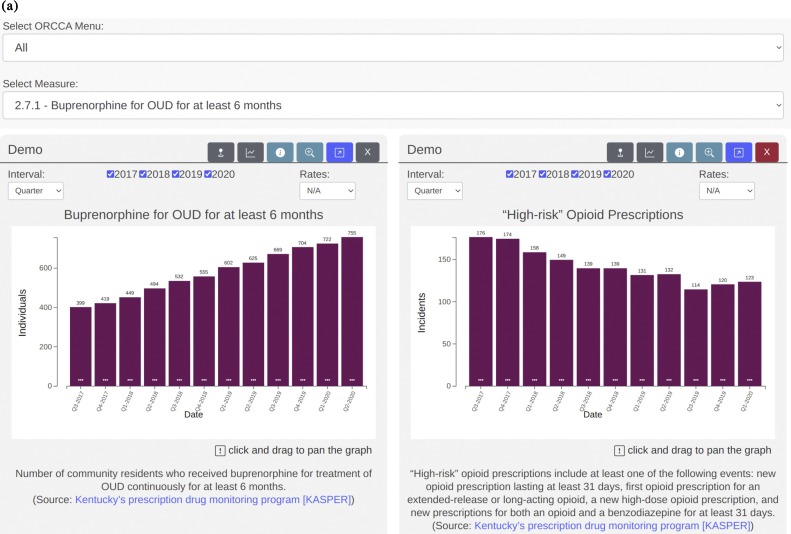
METHODS/DESIGN: A community-tailored dashboard is a web-based set of interactive data visualizations of community-specific metrics. Metrics include opioid overdose deaths and other OUD-related measures, as well as drivers of change of these outcomes in a community. Each community-tailored dashboard is a product of a co-creation process between HCS researchers and stakeholders from each community. The four research sites used a varied set of technical approaches and solutions to support the scientific design and CTH intervention implementation. Ongoing evaluation of the dashboards involves quantitative and qualitative data on key aspects posited to shape dashboard use combined with website analytics.
The HCS presents an opportunity to advance how community-tailored dashboards can foster community-driven solutions to address the opioid epidemic. Lessons learned can be applied to inform interventions for public health concerns and issues that have disproportionate impact across communities and populations (e.g., racial/ethnic and sexual/gender minorities and other marginalized individuals).
ClinicalTrials.gov (NCT04111939).
在美国,阿片类药物滥用、阿片类药物使用障碍(OUD)和阿片类药物过量死亡持续处于流行水平,HEALing 社区研究(HCS)是成瘾研究中最大的实施研究,正在评估 Communities That Heal(CTH)干预措施对减少四个州(即“站点”)67 个受影响不成比例的社区的阿片类药物过量死亡的影响。社区定制的仪表板是 CTH 干预措施的核心,旨在实施社区参与和数据驱动的过程。这些仪表板支持参与社区为选择和监测减少阿片类药物过量死亡的循证实践做出决策。
方法/设计:社区定制的仪表板是一组基于网络的交互式数据可视化社区特定指标。指标包括阿片类药物过量死亡和其他 OUD 相关措施,以及这些结果在社区中的变化驱动因素。每个社区定制的仪表板都是 HCS 研究人员和每个社区的利益相关者之间共同创造过程的产物。四个研究地点使用了各种技术方法和解决方案来支持科学设计和 CTH 干预措施的实施。对仪表板的持续评估涉及对假设影响仪表板使用的关键方面的定量和定性数据,以及网站分析。
HCS 提供了一个机会,可以推进社区定制仪表板如何促进社区驱动的解决方案,以应对阿片类药物流行。吸取的经验教训可应用于为公共卫生关注和对社区和人群(例如,种族/族裔和性/性别少数群体和其他边缘化个人)产生不成比例影响的问题提供干预措施。
ClinicalTrials.gov(NCT04111939)。