Rossi Fernanda S, Adams Meredith C B, Aarons Gregory, McGovern Mark P
Stanford Center for Dissemination and Implementation (CDI), Department of Psychiatry and Behavioral Sciences, Stanford University School of Medicine, Palo Alto, CA, USA.
Stanford Center for Dissemination and Implementation (CDI), Department of Psychiatry & Behavioral Sciences, Stanford University School of Medicine, 1070 Arastradero Road, Suite 371, Palo Alto, CA, 94304, USA.
Implement Sci. 2025 Apr 22;20(1):16. doi: 10.1186/s13012-025-01430-x.
Dashboards-tools that compile and summarize key performance data-have become increasingly utilized for supporting data organization and decision-making processes across various fields, such as business, economics, healthcare, and policy. The dashboard's impact is dependent on its use by the individuals for whom it was designed. Yet, few studies measure dashboard use, and of those that do, their utility is limited. When dashboards go unused, they provide little value and impact. We argue that successful and long-term use of dashboards can be achieved using human-centered design and implementation science methods.
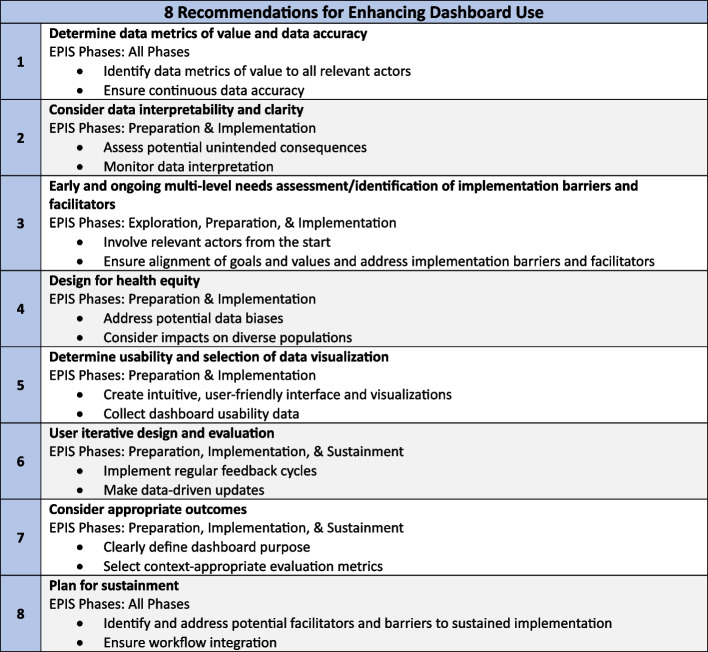
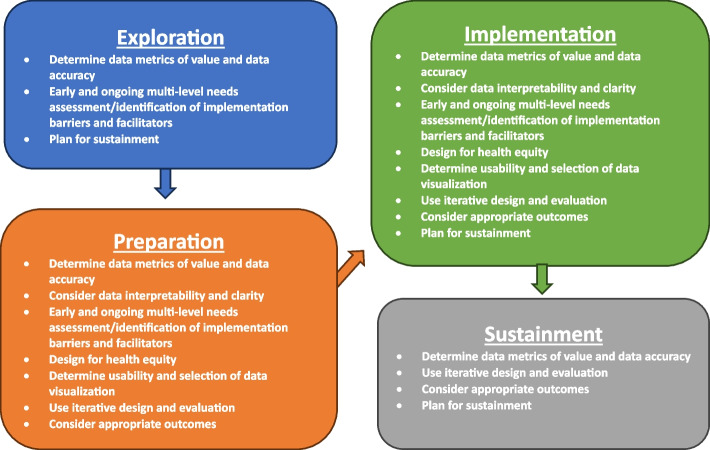
In this article, we describe the characteristics of dashboards and provide examples of existing dashboards. We discuss the common pitfalls of dashboards that result in their limited use. Next, we proffer how human-centered design and implementation science can improve dashboard relevance. We provide eight recommendations from across the design to the sustainment phase. To guide dashboard developers and implementers, we organize our recommendations using the Exploration, Preparation, Implementation, and Sustainment (EPIS) Framework. Lastly, we raise several cautions when using human-centered design and implementation science methods in dashboard development and implementation.
There is a need for more effective, sustainable, and impactful dashboards. We suggest that incorporating human-centered design and implementation science methods can facilitate achieving this goal.
仪表板——用于汇总关键绩效数据的工具——在商业、经济、医疗保健和政策等各个领域越来越多地被用于支持数据组织和决策过程。仪表板的影响取决于其设计对象的使用情况。然而,很少有研究衡量仪表板的使用情况,即便有这样的研究,其效用也很有限。当仪表板无人使用时,它们几乎没有价值和影响。我们认为,采用以人为本的设计和实施科学方法可以实现仪表板的成功长期使用。
在本文中,我们描述了仪表板的特点,并提供了现有仪表板的示例。我们讨论了导致仪表板使用受限的常见陷阱。接下来,我们提出以人为本的设计和实施科学如何能够提高仪表板的相关性。我们提供了从设计到维护阶段的八条建议。为了指导仪表板开发者和实施者,我们使用探索、准备、实施和维护(EPIS)框架来组织我们的建议。最后,我们在仪表板开发和实施中使用以人为本的设计和实施科学方法时提出了几点注意事项。
需要更有效、可持续且有影响力的仪表板。我们建议纳入以人为本的设计和实施科学方法有助于实现这一目标。