Zaragozá Rosa
Department of Human Anatomy and Embriology, School of Medicine, IIS INCLIVA, University of Valencia, Valencia, Spain.
Front Physiol. 2020 Sep 23;11:973. doi: 10.3389/fphys.2020.00973. eCollection 2020.
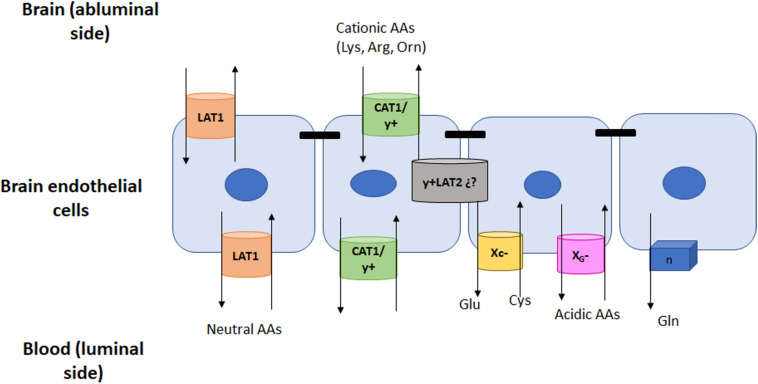
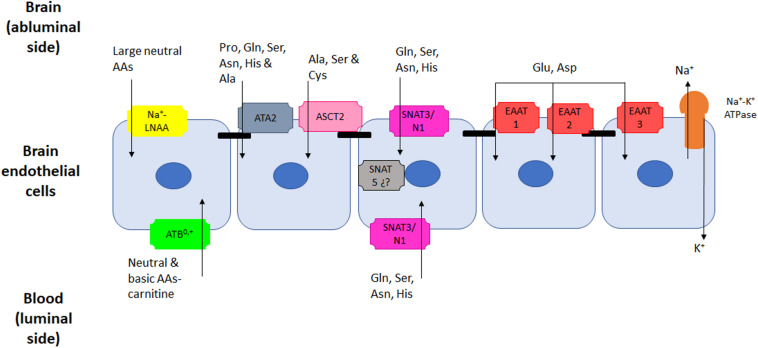
The blood-brain-barrier (BBB), present in brain capillaries, constitutes an essential barrier mechanism for normal functioning and development of the brain. The presence of tight junctions between adjacent endothelial cells restricts permeability and movement of molecules between extracellular fluid and plasma. The protein complexes that control cell-cell attachment also polarize cellular membrane, so that it can be divided into luminal (blood-facing) and abluminal (brain) sides, and each solute that enters/leaves the brain must cross both membranes. Several amino acid (AA) transport systems with different distributions on both sides of the BBB have been described. In a broad sense, there are at least five different systems of facilitative transporters and all of them are found in the luminal membrane. Some of these transporters are very specific for a small group of substrates and are located exclusively on the luminal side of the BBB. However, the two major facilitative carriers, system L and system y, are located in both membranes, although asymmetrically. The position of these Na-independent transporters ensures AA availability in the brain and also its bidirectional transport across the endothelial cells. On the other hand, there are several Na-dependent transport systems that transport AAs against its concentration gradient together with the movement of Na ions. The majority of these active transporters are present exclusively at the abluminal membrane and are responsible for AA efflux from the brain into the endothelial cells. Since they are Na-coupled, the sodium pump Na/K-ATPase is also highly expressed on this abluminal side of the BBB. Once inside the cell, the facilitative transporters located in the luminal membranes mediate export from the endothelial cell to the blood. In summary, the polarized distribution of these transport systems between the luminal and abluminal membranes, and the fact that more than one transporter may carry the same substrate, ensures supply and excretion of AAs in and out of the brain, thereby controlling its homeostasis and proper function.
血脑屏障(BBB)存在于脑毛细血管中,是大脑正常功能和发育的重要屏障机制。相邻内皮细胞之间紧密连接的存在限制了细胞外液和血浆之间分子的通透性和移动。控制细胞间附着的蛋白质复合物还使细胞膜极化,从而可分为腔面(面向血液)和非腔面(面向脑)两侧,并且每个进出大脑的溶质都必须穿过这两层膜。已经描述了几种在血脑屏障两侧具有不同分布的氨基酸(AA)转运系统。从广义上讲,至少有五种不同的易化转运体系统,它们都存在于腔面膜中。其中一些转运体对一小类底物非常特异,并且仅位于血脑屏障的腔面。然而,两个主要的易化载体,系统L和系统y,虽然不对称,但存在于两层膜中。这些不依赖钠的转运体的位置确保了大脑中氨基酸的可用性及其在内皮细胞间的双向转运。另一方面,有几种依赖钠的转运系统,它们将氨基酸逆浓度梯度与钠离子的移动一起转运。这些主动转运体中的大多数仅存在于非腔面膜中,并负责氨基酸从大脑向内皮细胞的流出。由于它们与钠偶联,钠泵Na/K-ATP酶在血脑屏障的这个非腔面也高度表达。一旦进入细胞,位于腔面膜中的易化转运体介导从内皮细胞向血液的输出。总之,这些转运系统在腔面和非腔面膜之间的极化分布,以及不止一种转运体可能携带相同底物这一事实,确保了氨基酸进出大脑的供应和排泄,从而控制其体内平衡和正常功能。