Max Planck Institute of Psychiatry, Munich, Germany.
Max Planck Institute of Biochemistry, Martinsried, Germany.
Front Immunol. 2020 Sep 18;11:2165. doi: 10.3389/fimmu.2020.02165. eCollection 2020.
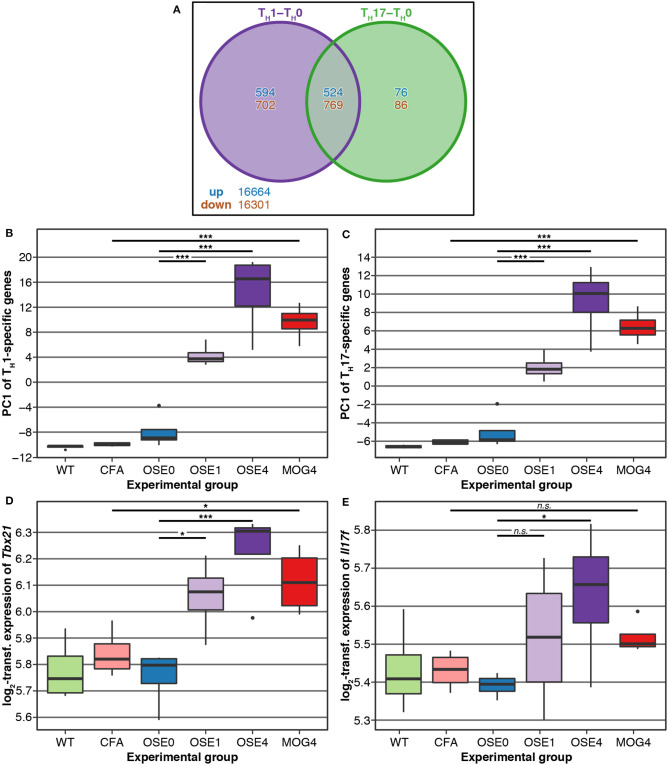
Recent genome-wide association studies have identified over 230 genetic risk loci for multiple sclerosis. Current experimental autoimmune encephalomyelitis (EAE) models requiring active induction of disease may not be optimally suited for the characterization of the function of these genes. We have thus used gene expression profiling to study whether spontaneous opticospinal EAE (OSE) or MOG-induced EAE mirrors the genetic contribution to the pathogenesis of multiple sclerosis more faithfully. To this end, we compared gene expression in OSE and MOG EAE models and analyzed the relationship of both models to human multiple sclerosis risk genes and T helper cell biology. We observed stronger gene expression changes and an involvement of more pathways of the adaptive immune system in OSE than MOG EAE. Furthermore, we demonstrated a more extensive enrichment of human MS risk genes among transcripts differentially expressed in OSE than was the case for MOG EAE. Transcripts differentially expressed only in diseased OSE mice but not in MOG EAE were significantly enriched for T helper cell-specific transcripts. These transcripts are part of immune-regulatory pathways. The activation of the adaptive immune system and the enrichment of both human multiple sclerosis risk genes and T helper cell-specific transcripts were also observed in OSE mice showing only mild disease signs. These expression changes may, therefore, be indicative of processes at disease onset. In summary, more human multiple sclerosis risk genes were differentially expressed in OSE than was observed for MOG EAE, especially in T1 cells. When studying the functional role of multiple sclerosis risk genes and pathways during disease onset and their interactions with the environment, spontaneous OSE may thus show advantages over MOG-induced EAE.
最近的全基因组关联研究已经确定了超过 230 个多发性硬化症的遗传风险位点。目前需要主动诱导疾病的实验性自身免疫性脑脊髓炎 (EAE) 模型可能并不完全适合这些基因功能的特征。因此,我们使用基因表达谱分析来研究自发性视神经脊髓炎 (OSE) 或 MOG 诱导的 EAE 是否更能真实反映基因对多发性硬化症发病机制的贡献。为此,我们比较了 OSE 和 MOG EAE 模型中的基因表达,并分析了这两种模型与人类多发性硬化症风险基因和辅助性 T 细胞生物学之间的关系。我们观察到 OSE 中的基因表达变化比 MOG EAE 更强,适应性免疫系统的更多途径也参与其中。此外,我们证明了在 OSE 中差异表达的转录本中,人类多发性硬化症风险基因的富集程度比在 MOG EAE 中更为广泛。仅在患病的 OSE 小鼠中而不在 MOG EAE 中差异表达的转录本明显富集了辅助性 T 细胞特异性转录本。这些转录本是免疫调节途径的一部分。适应性免疫系统的激活以及人类多发性硬化症风险基因和辅助性 T 细胞特异性转录本的富集也在仅表现出轻微疾病迹象的 OSE 小鼠中观察到。因此,这些表达变化可能表明疾病发作时的过程。总之,与 MOG EAE 相比,OSE 中差异表达的人类多发性硬化症风险基因更多,尤其是在 T1 细胞中。在研究多发性硬化症风险基因和途径在疾病发作时的功能作用及其与环境的相互作用时,自发性 OSE 可能比 MOG 诱导的 EAE 具有优势。