Damavandi Donya Shahedi, Javan Mina, Moshashaei Hamidreza, Forootan Mojgan, Darvishi Mohammad
Faculty of Medicine, Tehran Medical Sciences Branch, Islamic Azad University, Tehran, Iran.
Department of Gastroenterology, Gastrointestinal and Liver Diseases Research Center (RCGLD),Shahid Beheshti University of Medical Sciences, Tehran, Iran.
J Med Life. 2020 Jul-Sep;13(3):342-348. doi: 10.25122/jml-2019-0071.
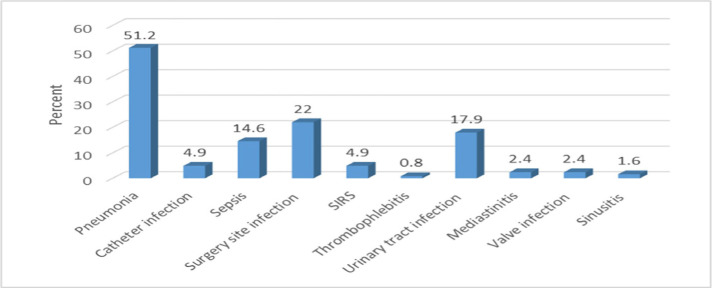
Surgery site infection is one of the most common postoperative complications which is associated with increased morbidity, mortality and admission costs. It is considered a priority to determine the level of nosocomial infection and its control in reflecting the quality of care. Therefore, this study aimed to evaluate the microbial contamination after cardiac surgery at a hospital cardiac surgery ward of Besat Hospital, Tehran. In this cross-sectional descriptive-analytic study (2013-2017), 610 patients underwent surgery at the Department of Cardiac Surgery of Besat Hospital. All necessary information such as urine culture, surgical site, histopathologic examination for the diagnosis of microbial contamination and microorganisms were collected from the patient records and inserted in the questionnaire. The data were analyzed using SPSS (version 25). The incidence of nosocomial infections following cardiac surgery reportedly ranged from 17% to 23%. Accordingly, pneumonia (51.2%) and local infections (22%) were the most common infections in the studied population. The mortality rate in our population was 11.4%. Moreover, 64.3% of the total mortality cases were reported in patients with sepsis. The mean age and duration of admission of patients with catheter infection were significantly higher than other subjects. Given the relatively high prevalence of the infection and its importance, it is necessary to take more serious measures to prevent and control these infections.
手术部位感染是最常见的术后并发症之一,与发病率、死亡率和住院费用增加相关。在反映医疗质量方面,确定医院感染水平及其控制被视为一项优先事项。因此,本研究旨在评估德黑兰贝萨特医院心脏外科病房心脏手术后的微生物污染情况。在这项横断面描述性分析研究(2013 - 2017年)中,610例患者在贝萨特医院心脏外科接受了手术。从患者记录中收集了所有必要信息,如尿培养、手术部位、用于诊断微生物污染和微生物的组织病理学检查,并录入问卷。数据使用SPSS(版本25)进行分析。据报道,心脏手术后医院感染的发生率在17%至23%之间。相应地,肺炎(51.2%)和局部感染(22%)是研究人群中最常见的感染。我们研究人群的死亡率为11.4%。此外,64.3%的总死亡病例报告于脓毒症患者。导管感染患者的平均年龄和住院时间显著高于其他受试者。鉴于感染的相对高患病率及其重要性,有必要采取更严格的措施来预防和控制这些感染。