Khamis Ahmed Gharib, Senkoro Mbazi, Mwanri Akwilina Wendelin, Kreppel Katharina, Mfinanga Sayoki Godfrey, Bonfoh Bassirou, Kwesigabo Gideon
Department of Epidemiology and Biostatistics, Muhimbili University of Health and Allied Sciences, Dar-es-Salaam, Tanzania.
National Institute for Medical Research, Muhimbili Research Centre, Dar-es-Salaam, Tanzania.
Arch Public Health. 2020 Oct 14;78:99. doi: 10.1186/s13690-020-00485-0. eCollection 2020.
Hypertension is among the growing non-communicable diseases (NCDs) in developing countries and the leading cause of death worldwide. Pastoral areas have been identified to be at a higher risk of diseases due to challenges in their daily food production, livelihoods or mobility. Unfortunately, the prevalence of hypertension and the risk factors particularly affecting rural and pastoral populations are not fully understood, making intervention efforts challenging. The aim of this study was to determine the prevalence of hypertension and identify the risk factors among adults living in Monduli district in Tanzania. The findings will be useful for the provision of tailored interventions focused on community-specific nutritional and behavioral practices.
We conducted a community based cross-sectional study involving a sample of 510 adults aged above 18 years selected using a multistage cluster sampling in the Monduli district of Arusha region, Tanzania. Data were collected by using interviewer-administered questionnaires containing socio-demographic, physical activity, smoking and alcohol consumption. Anthropometry, systolic (SBP) and diastolic blood pressure (DBP) levels were measured. A one-day 24 h diet recall was conducted to evaluate the dietary habits of all participants. Both linear and logistic regression analysis were used to identify the independent predictors for hypertension and blood pressure levels.
The prevalence of hypertension in this study was 25.7% ( 131, 95% CI; 22.1-29.7). The odds of hypertension increased with being male (AOR = 1.75, 95%CI, 1.06-2.88), belonging to the older age group of 30-39 year olds (AOR = 3.3, 95%CI, 1.76-6.38), 40-59 year olds (AOR = 3.34, 95%CI, 1.75-6.37) and ≥ 60 year olds (AOR = 4.2, 95%CI, 2.02-8.87), being overweight or obese (AOR = 3.37, 95%CI, 1.18-9.62), have more hours spent sedentary (AOR = 3.19, 95%CI, 1.61-6.32), and consumption of fatty foods (AOR = 2.23, 95%CI, 1.27-3.93). The odds for hypertension was significantly reduced among participants who reported higher income (AOR = 0.47, 95% CI, 0.25-0.91), high level of physical activity (AOR = 0.55, 95%CI, 0.31-0.96) and those reported to consume fruit (AOR = 0.37, 95% CI, 0.18-0.77). Consumption of cereals was negatively associated with levels of SBP (β = - 17.4, 95% CI, - 23.8; - 11.0) and DBP (β = - 6.6, 95% CI, - 11.5,-1.79).
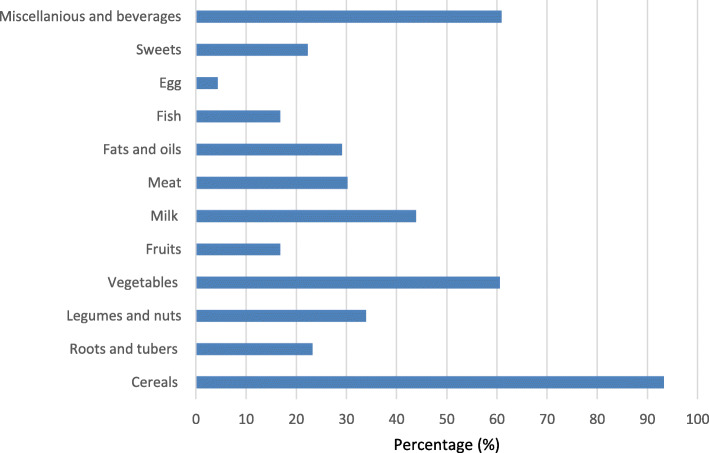
About one in every four adults living in pastoral communities have been found to have hypertension in this study. Our findings suggest that older age, obesity or overweight, low physical activity, low income, and consumption of fatty foods increase the risk of hypertension among study population. Their diet was dominated by cereals with moderate intake of meat and milk and low fruits. There is a need to promote physical activities and consumption of fruits in the study population in order to fight against hypertension. Further research should be done to confirm the associations.
高血压是发展中国家日益增多的非传染性疾病之一,也是全球主要死因。由于牧区在日常食物生产、生计或流动性方面面临挑战,已被确定为疾病高发地区。遗憾的是,高血压的患病率以及尤其影响农村和牧区人口的风险因素尚未完全明确,这使得干预工作颇具挑战。本研究的目的是确定坦桑尼亚蒙杜利区成年人中高血压的患病率,并识别风险因素。研究结果将有助于提供针对社区特定营养和行为习惯的定制干预措施。
我们在坦桑尼亚阿鲁沙地区蒙杜利区进行了一项基于社区的横断面研究,采用多阶段整群抽样方法选取了510名18岁以上的成年人作为样本。通过使用包含社会人口统计学、身体活动、吸烟和饮酒情况的访谈问卷收集数据。测量了人体测量指标、收缩压(SBP)和舒张压(DBP)水平。进行了一天的24小时饮食回顾以评估所有参与者的饮食习惯。使用线性和逻辑回归分析来确定高血压和血压水平的独立预测因素。
本研究中高血压的患病率为25.7%(131例,95%置信区间;22.1 - 29.7)。高血压的患病几率随着男性(调整后比值比[AOR]=1.75,95%置信区间,1.06 - 2.88)、属于30 - 39岁年龄组(AOR = 3.3,95%置信区间,1.76 - 6.38)、40 - 59岁年龄组(AOR = 3.34,95%置信区间,1.75 - 6.37)以及≥60岁年龄组(AOR = 4.2,95%置信区间,2.02 - 8.87)、超重或肥胖(AOR =
