Department of Epidemiology and Applied Biostatistics, Institute of Public Health, Kilimanjaro Christian Medical University College, Kilimanjaro, Tanzania.
Muhimbili Medical Research Centre, National Institute for Medical Research, Dar es salaam, Tanzania.
PLoS One. 2020 Jun 1;15(6):e0233777. doi: 10.1371/journal.pone.0233777. eCollection 2020.
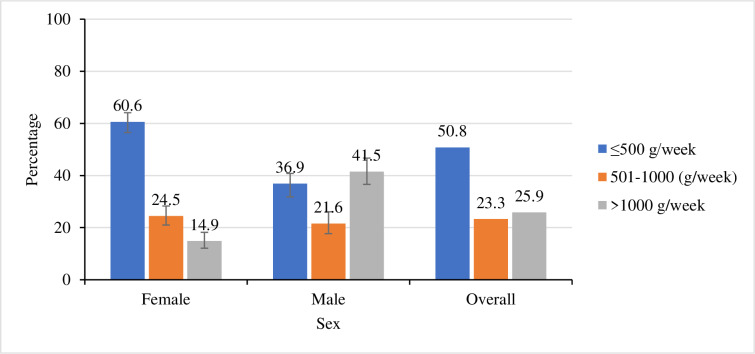
Red meat is an important dietary source of protein and other essential nutrients. Its high intake has been associated with an increased risk of cardiovascular morbidity and mortality, including hypertension (HTN) and hyperlipidaemia (HLP). Despite being physically active, the Maasai at Ngorongoro Conservation Area (NCA) depend heavily on animals' products as their staple food with fewer intakes of vegetables or fruits due to restriction from carrying out agricultural activities within the NCA. This study aimed at determining the prevalence of HTN and HLP and their association with red meat consumption among adult Maasai of NCA.
A community-based cross-sectional study was conducted in October 2018 using multistage sampling technique. Eight hundred and ninety-four (894) participants enrolled from seven villages in three wards within NCA Data were collected using a modified WHO NCDs-STEPS tool. Anthropometric measurements, blood pressure (BP) measurements, and blood samples for glucose and cholesterol tests were obtained from the study participants. Crude and adjusted prevalence ratio (PR) for factors associated with HTN and HLP were estimated using Ordinal and Bayesian logistic regression models, respectively.
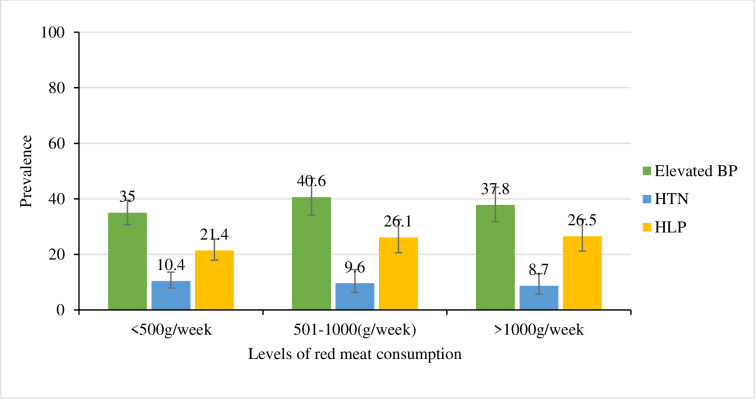
The prevalence of HLP was 23.7 percent. The levels were higher among males than were among the females (29.0% vs. 20.1%, p = 0.002). The prevalence of HTN and pre-HTN (elevated BP) were 9.8 and 37.0 percent, respectively. Both HTN and elevated BP were higher among males than were among females (hypertensive [10.9% vs. 9.0%]; elevated BP [44.0% vs. 32.1%], p<0.001). The prevalence of HLP was significantly associated with level II (PR = 1.56, 95%CrI: 1.10-2.09) and level III (PR = 1.64, 95%CrI: 1.08-2.41) of red meat consumption as opposed to level I.
The prevalence of hyperlipidaemia and elevated BP were high among NCA Maasai. We found a significant association between red meat consumption and hyperlipidaemia. Further follow-up studies are warranted to establish a temporal relationship between red meat consumption and both conditions.
红肉是蛋白质和其他必需营养素的重要膳食来源。其高摄入量与心血管发病率和死亡率的增加有关,包括高血压(HTN)和高脂血症(HLP)。尽管在 Ngorongoro 保护区(NCA)的马赛人身体活跃,但由于在 NCA 内进行农业活动受到限制,他们仍然严重依赖动物产品作为主食,蔬菜和水果的摄入量较少。本研究旨在确定 NCA 成年马赛人中高血压和高脂血症的患病率及其与红肉消费的关系。
2018 年 10 月,采用多阶段抽样技术,在 NCA 的七个村庄的三个区进行了一项基于社区的横断面研究。从 NCA 内的七个村庄的 894 名参与者中收集数据。使用经过修改的世界卫生组织非传染性疾病- STEPS 工具收集数据。从研究参与者那里获得了人体测量学测量、血压(BP)测量和血糖和胆固醇测试的血液样本。使用有序和贝叶斯逻辑回归模型分别估计与高血压和高脂血症相关的因素的粗患病率比(PR)和调整后 PR。
高脂血症的患病率为 23.7%。男性的水平高于女性(29.0%比 20.1%,p=0.002)。高血压和前期高血压(血压升高)的患病率分别为 9.8%和 37.0%。高血压和血压升高在男性中的发生率均高于女性(高血压[10.9%比 9.0%];血压升高[44.0%比 32.1%],p<0.001)。高脂血症的患病率与红肉消费的二级(PR=1.56,95%CrI:1.10-2.09)和三级(PR=1.64,95%CrI:1.08-2.41)水平显著相关,而与一级水平无关。
NCA 马赛人中高脂血症和血压升高的患病率很高。我们发现红肉消费与高脂血症之间存在显著关联。需要进一步的随访研究来确定红肉消费与这两种情况之间的时间关系。