Nguyen Quan Dong, Heier Jeffrey S, Do Diana V, Mirando Adam C, Pandey Niranjan B, Sheng Huan, Heah Theresa
Spencer Center for Vision Research, Byers Eye Institute, Stanford University, 2370 Watson Court, Suite 200, Palo Alto, CA 94303 USA.
Ophthalmic Consultants of Boston, Boston, MA USA.
Int J Retina Vitreous. 2020 Oct 13;6:48. doi: 10.1186/s40942-020-00250-z. eCollection 2020.
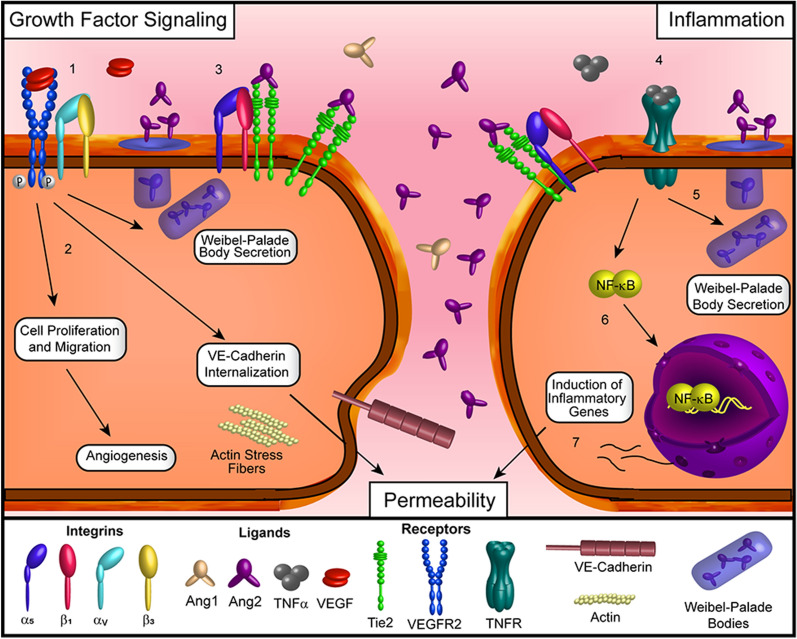
Retinal vascular diseases such as neovascular age-related macular degeneration, diabetic retinopathy and/or diabetic macular edema, and retinal vein occlusion with macular edema-share several key pathophysiologic aspects including neovascularization, vascular permeability, and inflammation. The role of vascular endothelial growth factor (VEGF) in these processes, and the therapeutic benefits of VEGF inhibition, have been well characterized. Anti-VEGF therapy is highly effective for many patients but is not uniformly effective in all patients and imposes a significant treatment burden. More recently, the role of the Tie2 signaling pathway in the pathophysiology of retinal vascular diseases has been investigated, and the Tie2 pathway represents a novel therapeutic target for these conditions.
The index review describes the Tie2 pathway and its complementary role to the VEGF pathway in the angiogenesis cascade and will summarize studies of molecules in development to therapeutically modulate the Tie2 pathway in retinal vascular diseases.
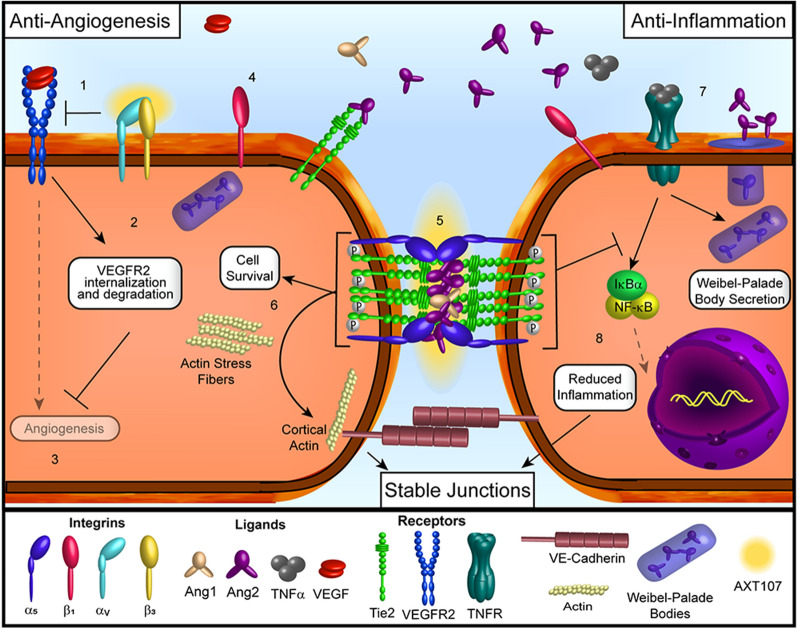
Activation of the Tie2 pathway leads to downstream signaling that promotes vascular health and stability and decreases vascular permeability and inflammation. AXT107 is a collagen IV-derived synthetic peptide with a dual mechanism of action that involves suppression of VEGF signaling and activation of the Tie2 pathway; these actions are accomplished by AXT107 binding to and disrupting different integrin, leading to blockade of the VEGF receptor and rearrangement of cellular Tie2 rendering it susceptible to Ang2 agonism. Other Tie2 agonist compounds are also in development, including faricimab and razuprotafib. Tie2 activation only modestly impacts angiogenesis on its own but significantly potentiates VEGF suppression. Co-regulation of the VEGF and Tie2 signaling pathways has the potential to improve functional and structural outcomes in eyes with retinal vascular diseases.
视网膜血管疾病,如新血管性年龄相关性黄斑变性、糖尿病性视网膜病变和/或糖尿病性黄斑水肿,以及伴有黄斑水肿的视网膜静脉阻塞,具有几个关键的病理生理方面,包括新生血管形成、血管通透性和炎症。血管内皮生长因子(VEGF)在这些过程中的作用以及VEGF抑制的治疗益处已得到充分表征。抗VEGF治疗对许多患者非常有效,但并非对所有患者都同样有效,且带来了巨大的治疗负担。最近,Tie2信号通路在视网膜血管疾病病理生理学中的作用已得到研究,Tie2通路是这些病症的一个新的治疗靶点。
本综述描述了Tie2通路及其在血管生成级联反应中对VEGF通路的互补作用,并将总结正在研发的用于治疗性调节视网膜血管疾病中Tie2通路的分子研究。
Tie2通路的激活导致下游信号传导,促进血管健康和稳定性,并降低血管通透性和炎症。AXT107是一种源自IV型胶原的合成肽,具有双重作用机制,包括抑制VEGF信号传导和激活Tie2通路;这些作用是通过AXT107与不同整合素结合并破坏整合素实现的,导致VEGF受体的阻断和细胞Tie2的重排,使其易受Ang2激动作用的影响。其他Tie2激动剂化合物也在研发中,包括faricimab和razuprotafib。Tie2激活本身仅适度影响血管生成,但能显著增强VEGF抑制作用。VEGF和Tie2信号通路的共同调节有可能改善患有视网膜血管疾病的眼睛的功能和结构结果。