Zhou Wei, Dimitriadis Evdokia
Department of Obstetrics and Gynaecology, The University of Melbourne, Parkville, VIC, Australia.
Gynaecology Research Centre, The Royal Women's Hospital, Parkville, VIC, Australia.
Front Cell Dev Biol. 2020 Sep 22;8:586510. doi: 10.3389/fcell.2020.586510. eCollection 2020.
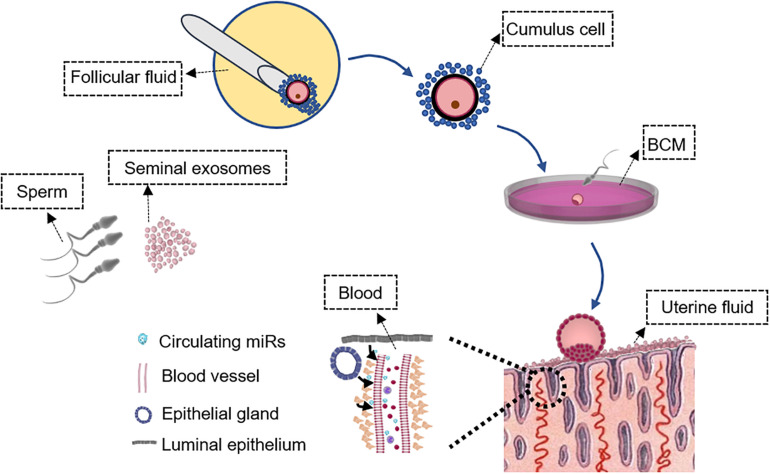
Embryo implantation failure is considered a leading cause of infertility and a significant bottleneck for fertilization (IVF) treatment. Confirmed factors that lead to implantation failure involve unhealthy embryos, unreceptive endometrium, and asynchronous development and communication between the two. The quality of embryos is further dependent on sperm parameters, oocyte quality, and early embryo development after fertilization. The extensive involvement of such different factors contributes to the variability of implantation potential across different menstrual cycles. An ideal approach to predict the implantation outcome should not compromise embryo implantation. The use of clinical material, including follicular fluid, cumulus cells, sperm, seminal exosomes, spent blastocyst culture medium, blood, and uterine fluid, that can be collected relatively non-invasively without compromising embryo implantation in a transfer cycle opens new perspectives for the diagnosis of embryo implantation potential. Compositional comparison of these samples between fertile women and women or couples with implantation failure has identified both quantitative and qualitative differences in the expression of microRNAs (miRs) that hold diagnostic potential for implantation failure. Here, we review current findings of secreted miRs that have been identified to potentially be useful in predicting implantation outcome using material that can be collected relatively non-invasively. Developing non-invasive biomarkers of implantation potential would have a major impact on implantation failure and infertility.
胚胎着床失败被认为是不孕症的主要原因,也是体外受精(IVF)治疗的重大瓶颈。导致着床失败的已确认因素包括不健康的胚胎、未接受胚胎着床的子宫内膜,以及两者之间的不同步发育和相互作用。胚胎质量还进一步取决于精子参数、卵母细胞质量以及受精后的早期胚胎发育。如此众多不同因素的广泛参与导致不同月经周期的着床潜力存在差异。预测着床结果的理想方法不应损害胚胎着床。使用临床材料,包括卵泡液、卵丘细胞、精子、精浆外泌体、废弃囊胚培养基、血液和子宫液,这些材料可以在不影响胚胎移植周期着床的情况下相对无创地收集,为诊断胚胎着床潜力开辟了新的前景。对有生育能力的女性与着床失败的女性或夫妇之间这些样本的成分比较,已经确定了微小RNA(miRs)表达在数量和质量上的差异,这些差异具有着床失败的诊断潜力。在这里,我们回顾了目前关于分泌型miRs的研究结果,这些miRs已被确定可能有助于使用相对无创收集的材料来预测着床结果。开发着床潜力的非侵入性生物标志物将对着床失败和不孕症产生重大影响。