Keogh-Brown Marcus R, Jensen Henning Tarp, Edmunds W John, Smith Richard D
Faculty of Public Health and Policy, London School of Hygiene and Tropical Medicine, 15-17 Tavistock Place, London, WC1H 9SH, UK.
Department of Food and Resource Economics, Faculty of Science, University of Copenhagen, Rolighedsvej 25, DK-1958, Frederiksberg C, Denmark.
SSM Popul Health. 2020 Dec;12:100651. doi: 10.1016/j.ssmph.2020.100651. Epub 2020 Oct 14.
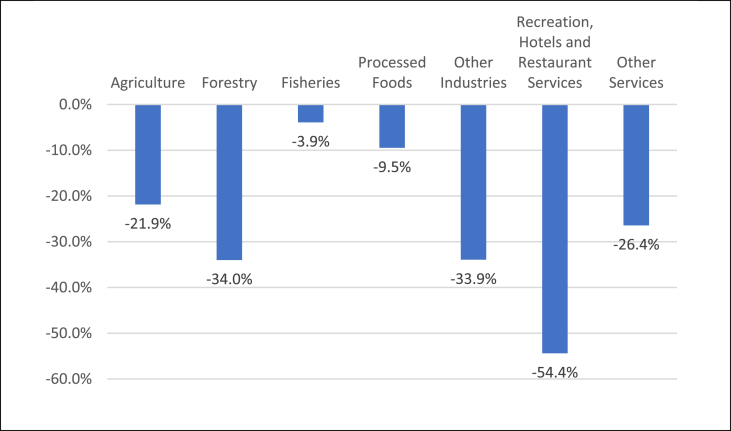
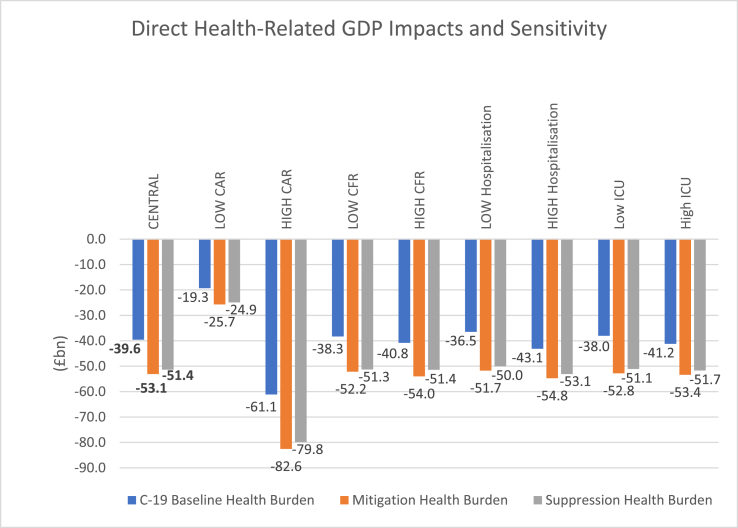
We estimate the potential impact of COVID-19 on the United Kingdom economy, including direct disease effects, preventive public actions and associated policies. A sectoral, whole-economy macroeconomic model was linked to a population-wide epidemiological demographic model to assess the potential macroeconomic impact of COVID-19, together with policies to mitigate or suppress the pandemic by means of home quarantine, school closures, social distancing and accompanying business closures. Our simulations indicate that, assuming a clinical attack rate of 48% and a case fatality ratio of 1.5%, COVID-19 alone would impose a direct health-related economic burden of £39.6bn (1.73% of GDP) on the UK economy. Mitigation strategies imposed for 12 weeks reduce case fatalities by 29%, but the total cost to the economy is £308bn (13.5% of GDP); £66bn (2.9% of GDP) of which is attributable to labour lost from working parents during school closures, and £201bn (8.8% of GDP) of which is attributable to business closures. Suppressing the pandemic over a longer period of time may reduce deaths by 95%, but the total cost to the UK economy also increases to £668bn (29.2% of GDP), where £166bn (7.3% of GDP) is attributable to school closures and 502bn (21.9% of GDP) to business closures. Our analyses suggest Covid-19 has the potential to impose unprecedented economic costs on the UK economy, and whilst public actions are necessary to minimise mortality, the duration of school and business closures are key to determining the economic cost. The initial economic support package promised by the UK government may be proportionate to the costs of mitigating Covid-19, but without alternative measures to reduce the scale and duration of school and business closures, the economic support may be insufficient to compensate for longer term suppression of the pandemic which could generate an even greater health impact through major recession.
我们评估了新冠疫情对英国经济的潜在影响,包括疾病的直接影响、预防性公共行动及相关政策。一个部门性的全经济宏观经济模型与一个全人口范围的流行病学人口模型相联系,以评估新冠疫情的潜在宏观经济影响,以及通过居家隔离、学校关闭、社交距离措施及随之而来的企业关闭来减轻或抑制疫情的政策。我们的模拟表明,假设临床感染率为48%,病死率为1.5%,仅新冠疫情就将给英国经济带来396亿英镑(占GDP的1.73%)的直接健康相关经济负担。实施12周的缓解策略可将病死率降低29%,但经济总成本为3080亿英镑(占GDP的13.5%);其中660亿英镑(占GDP的2.9%)可归因于学校关闭期间在职父母的劳动力损失,以及2010亿英镑(占GDP的8.8%)可归因于企业关闭。在更长时间内抑制疫情可能使死亡人数减少95%,但英国经济的总成本也会增至6680亿英镑(占GDP的29.2%),其中1660亿英镑(占GDP的7.3%)可归因于学校关闭,5020亿英镑(占GDP的21.9%)可归因于企业关闭。我们的分析表明,新冠疫情有可能给英国经济带来前所未有的经济成本,虽然公共行动对于将死亡率降至最低是必要的,但学校和企业关闭的持续时间是决定经济成本的关键。英国政府承诺的初始经济支持计划可能与减轻新冠疫情的成本相称,但如果没有其他措施来减少学校和企业关闭的规模和持续时间,经济支持可能不足以补偿长期抑制疫情所带来的影响,而这可能通过严重衰退对健康产生更大的影响。