Sennfält Stefan, Petersson Jesper, Ullberg Teresa, Norrving Bo
Stroke Policy and Quality Register Research Group, Lund university, Sweden.
Department of Neurology, Skåne University Hospital, Lund, Sweden.
Eur Stroke J. 2020 Sep;5(3):286-296. doi: 10.1177/2396987320925205. Epub 2020 Jun 15.
While acute treatment and secondary prevention in stroke have undergone major improvements, hospital readmission after index stroke remains high. However, there are few reports on long-term readmission patterns.
For this prospective observational study, data on demographics, functional status and living conditions were obtained from the Swedish Stroke Register (Riksstroke). Data on comorbidity and hospital readmissions up to five years post-index stroke were obtained from the Swedish National Patient Register. Patients were grouped based on number of readmissions: low (0-1) intermediate (2-4), high (5-9) or very high (≥10).
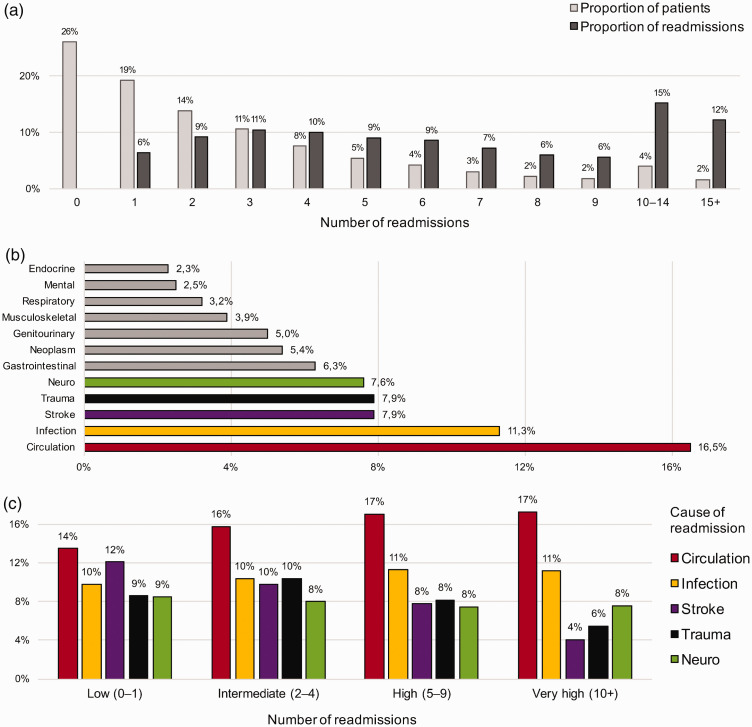
Of the 10,092 patients included, 43.7% had been readmitted within 12 months and 74.0% within 5 years. There was an average of three readmissions per individual during the five-year interval. A small group of patients with a high-comorbidity burden accounted for the majority of readmissions: approximately 20% of patients accounted for 60% of readmissions, and 5% of patients accounted for 25%. Circulatory conditions were the most common cause followed by infectious disease, stroke, trauma and diseases of the nervous system other than stroke. The proportion of readmissions due to stroke decreased sharply in the first six months.
A small number of patients with a high degree of comorbidity accounted for the majority of hospital readmissions after index stroke. Our results highlight the need for further development of strategies to support high-risk comorbid stroke patients in the community setting. Further research describing characteristics and healthcare utilisation patterns in this group is warranted.
虽然中风的急性治疗和二级预防已经有了重大改进,但首次中风后的医院再入院率仍然很高。然而,关于长期再入院模式的报道很少。
在这项前瞻性观察研究中,人口统计学、功能状态和生活条件的数据来自瑞典中风登记处(Riksstroke)。合并症和首次中风后长达五年的医院再入院数据来自瑞典国家患者登记处。患者根据再入院次数分组:低(0 - 1次)、中等(2 - 4次)、高(5 - 9次)或非常高(≥10次)。
在纳入的10092名患者中,43.7%在12个月内再次入院,74.0%在5年内再次入院。在五年期间,每位患者平均有三次再入院。一小部分合并症负担高的患者占再入院的大多数:约20%的患者占再入院的60%,5%的患者占25%。循环系统疾病是最常见的原因,其次是传染病、中风、创伤和非中风的神经系统疾病。中风导致的再入院比例在前六个月急剧下降。
少数合并症程度高的患者占首次中风后医院再入院的大多数。我们的结果凸显了在社区环境中进一步制定策略以支持高风险合并症中风患者的必要性。有必要进一步研究描述该群体的特征和医疗保健利用模式。