Medical Research Council, Uganda Virus Research Institute and London School of Hygiene and Tropical Medicine Uganda Research Unit , Entebbe, Uganda.
London School of Hygiene and Tropical Medicine , London, UK.
Glob Health Action. 2020 Dec 31;13(1):1829829. doi: 10.1080/16549716.2020.1829829.
The 2013-2016 Ebola epidemic in West Africa is the worst ever caused by with over 28,000 human cases and 11,325 deaths. The World Health Organisation (WHO) declared the epidemic a public health crisis that required accelerated development of novel interventions including vaccines. The Medical Research Council/Uganda Virus Research Institute and London School of Hygiene and Tropical Medicine Uganda Research Unit (MRC/UVRI & LSHTM Uganda Research Unit) was among the African research sites that implemented the VAC52150EBL1004 Ebola vaccine trial.
We report on the strategies utilised by the Unit and sponsor in ensuring expedited clinical trial approval and accelerated conduct.
Janssen Vaccines and Prevention B.V. conducted a phase 1 trial to evaluate the safety, tolerability, and immunogenicity of heterologous two-dose vaccination regimens using Ad26.ZEBOV and MVA-BN-Filo, in healthy adults in Africa. Accelerated implementation strategies are hereby presented.
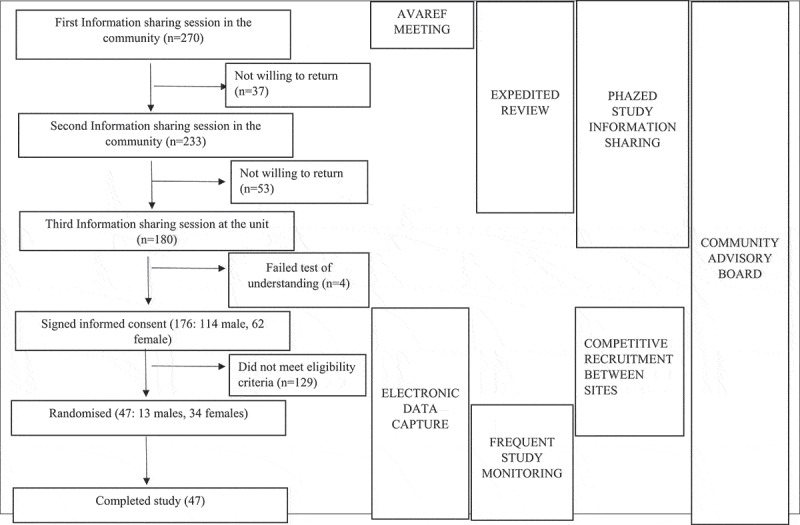
Strategies included: holding the African Vaccine Regulatory Forum (AVAREF) joint review meeting; expedited review by institutional ethics and country-specific regulatory bodies; competitive recruitment between sites; electronic data capture (EDC); frequent study monitoring schedule; involvement of a community advisory board (CAB); and utilization of a 'phased' study information-sharing approach in community engagement and participant recruitment. These strategies enabled the site to acquire approvals within 2 months and enrol 47 participants within a spurn of five. The same milestone is usually acquired in at least 1 year without accelerated implementation.
The use of well-thought strategies by sponsors and research sites can enable the implementation of accelerated research. We recommend the use of similar strategies in other settings.
2013-2016 年西非埃博拉疫情是有史以来最严重的一次,导致超过 28000 例人类感染和 11325 例死亡。世界卫生组织(WHO)宣布该疫情为公共卫生危机,需要加速开发新型干预措施,包括疫苗。医学研究委员会/乌干达病毒研究所和伦敦卫生与热带医学院乌干达研究单位(MRC/UVRI & LSHTM Uganda Research Unit)是在非洲实施 VAC52150EBL1004 埃博拉疫苗试验的研究点之一。
我们报告该单位和赞助商所采用的策略,以确保加速临床试验的批准和加速进行。
杨森疫苗和预防公司(Janssen Vaccines and Prevention B.V.)进行了一项 1 期试验,以评估在非洲健康成年人中使用 Ad26.ZEBOV 和 MVA-BN-Filo 的异源两剂量疫苗接种方案的安全性、耐受性和免疫原性。本文介绍了加速实施的策略。
策略包括:举行非洲疫苗监管论坛(AVAREF)联合审查会议;机构伦理和国家特定监管机构的加速审查;研究点之间的竞争性招募;电子数据捕获(EDC);频繁的研究监测时间表;社区咨询委员会(CAB)的参与;以及在社区参与和参与者招募中采用“分阶段”研究信息共享方法。这些策略使该研究点能够在 2 个月内获得批准,并在短短五个月内招募了 47 名参与者。如果没有加速实施,通常至少需要 1 年才能达到这一里程碑。
赞助商和研究点使用深思熟虑的策略可以实现加速研究的实施。我们建议在其他环境中使用类似的策略。