Shalgunov Vladimir, Xiong Mengfei, L'Estrade Elina T, Raval Nakul R, Andersen Ida V, Edgar Fraser G, Speth Nikolaj R, Baerentzen Simone L, Hansen Hanne D, Donovan Lene L, Nasser Arafat, Peitersen Siv T, Kjaer Andreas, Knudsen Gitte M, Syvänen Stina, Palner Mikael, Herth Matthias M
Department of Drug Design and Pharmacology, Faculty of Health and Medical Sciences, University of Copenhagen, Jagtvej 160, 2100, Copenhagen, Denmark.
Department of Clinical Physiology, Nuclear Medicine and PET, Copenhagen University Hospital, Rigshospitalet, Blegdamsvej 9, 2100, Copenhagen, Denmark.
EJNMMI Res. 2020 Oct 19;10(1):124. doi: 10.1186/s13550-020-00718-x.
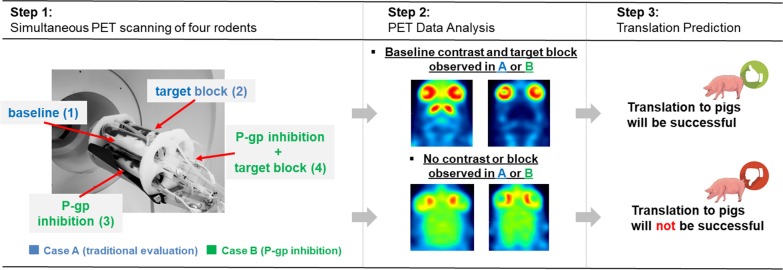
Positron emission tomography (PET) is a molecular imaging technique that can be used to investigate the in vivo pharmacology of drugs. Initial preclinical evaluation of PET tracers is often conducted in rodents due to the accessibility of disease models as well as economic considerations. Compared to larger species, rodents display a higher expression and/or activity of efflux transporters such as the P-glycoprotein (P-gp). Low brain uptake could, therefore, be species-specific and uptake in rodents not be predictive for that in humans. We hypothesized that a better prediction from rodent data could be achieved when a tracer is evaluated under P-gp inhibition. Consequently, we compared the performance of eight neuroreceptor tracers in rats with and without P-gp inhibition including a specific binding blockade. This data set was then used to predict the binding of these eight tracers in pigs.
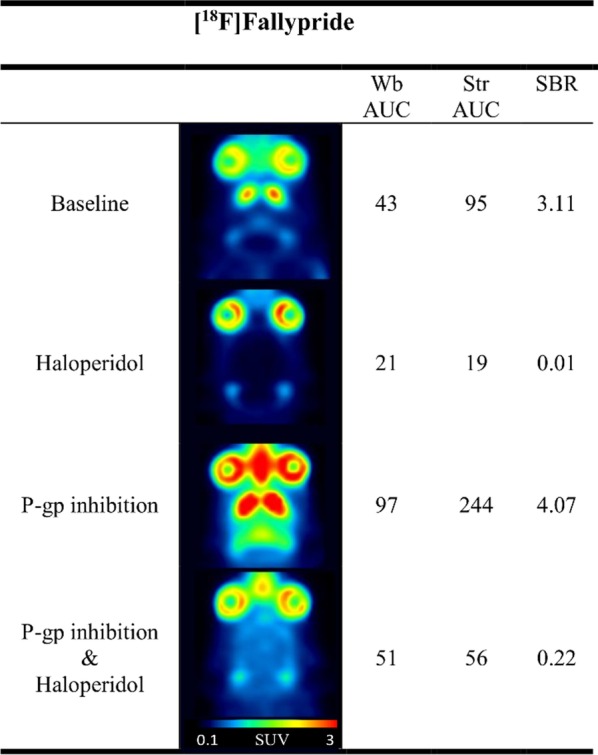
PET tracers targeting serotonin 5-HT receptors ([F]MH.MZ, [F]Altanserin, [C]Cimbi-36, [C]Pimavanserin), serotonin 5-HT receptors ([C]Cimbi-701, [C]Cimbi-717 and [C]BA-10) and dopamine D receptors ([F]Fallypride) were used in the study. The brain uptake and target-specific binding of these PET radiotracers were evaluated in rats with and without inhibition of P-gp. Rat data were subsequently compared to the results obtained in pigs.
Without P-gp inhibition, the amount of target-specific binding in the rat brain was sufficient to justify further translation for three out of eight evaluated tracers. With P-gp inhibition, results for five out of eight tracers justified further translation. The performance in pigs could correctly be predicted for six out of eight tracers when rat data obtained under P-gp inhibition were used, compared to four out of eight tracers without P-gp inhibition.
P-gp strongly affects the uptake of PET tracers in rodents, but false prediction outcomes can be reduced by evaluating a tracer under P-gp inhibition.
正电子发射断层扫描(PET)是一种分子成像技术,可用于研究药物的体内药理学。由于疾病模型的可及性以及经济因素,PET示踪剂的初步临床前评估通常在啮齿动物中进行。与较大的物种相比,啮齿动物表现出更高的外排转运蛋白表达和/或活性,如P-糖蛋白(P-gp)。因此,低脑摄取可能具有物种特异性,啮齿动物中的摄取情况可能无法预测人类的摄取情况。我们假设,当在P-gp抑制下评估示踪剂时,可以从啮齿动物数据中获得更好的预测。因此,我们比较了八种神经受体示踪剂在有和没有P-gp抑制(包括特异性结合阻断)的大鼠中的性能。然后使用该数据集预测这八种示踪剂在猪中的结合情况。
本研究使用了靶向5-羟色胺5-HT受体([F]MH.MZ、[F]阿坦色林、[C]Cimbi-36、[C]匹莫范色林)、5-羟色胺5-HT受体([C]Cimbi-701、[C]Cimbi-717和[C]BA-10)以及多巴胺D受体([F]法利必利)的PET示踪剂。在有和没有P-gp抑制的大鼠中评估了这些PET放射性示踪剂的脑摄取和靶点特异性结合。随后将大鼠数据与在猪中获得的结果进行比较。
在没有P-gp抑制的情况下,大鼠脑中靶点特异性结合的量足以证明对八种评估示踪剂中的三种进行进一步转化是合理的。在有P-gp抑制的情况下,八种示踪剂中有五种的结果证明进一步转化是合理的。当使用在P-gp抑制下获得的大鼠数据时,八种示踪剂中有六种在猪中的性能可以正确预测,而在没有P-gp抑制的情况下,八种示踪剂中只有四种。
P-gp强烈影响PET示踪剂在啮齿动物中的摄取,但通过在P-gp抑制下评估示踪剂可以减少错误的预测结果。