Ellenbroek Bart, Youn Jiun
School of Psychology, Victoria University of Wellington, PO Box 600, Wellington 6041, New Zealand
School of Psychology, Victoria University of Wellington, PO Box 600, Wellington 6041, New Zealand.
Dis Model Mech. 2016 Oct 1;9(10):1079-1087. doi: 10.1242/dmm.026120.
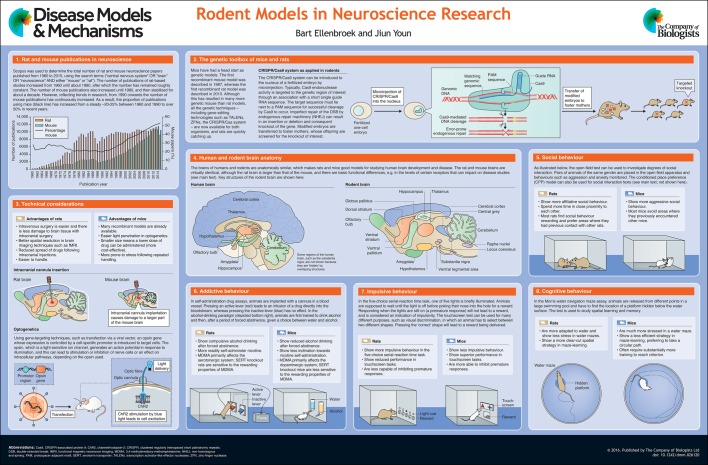
Rodents (especially Mus musculus and Rattus norvegicus) have been the most widely used models in biomedical research for many years. A notable shift has taken place over the last two decades, with mice taking a more and more prominent role in biomedical science compared to rats. This shift was primarily instigated by the availability of a much larger genetic toolbox for mice, particularly embryonic-stem-cell-based targeting technology for gene disruption. With the recent emergence of tools for altering the rat genome, notably genome-editing technologies, the technological gap between the two organisms is closing, and it is becoming more important to consider the physiological, anatomical, biochemical and pharmacological differences between rats and mice when choosing the right model system for a specific biological question. The aim of this short review and accompanying poster is to highlight some of the most important differences, and to discuss their impact on studies of human diseases, with a special focus on neuropsychiatric disorders.
多年来,啮齿动物(尤其是小家鼠和褐家鼠)一直是生物医学研究中使用最广泛的模型。在过去二十年中发生了显著变化,与大鼠相比,小鼠在生物医学科学中发挥着越来越突出的作用。这种转变主要是由于小鼠有了大得多的基因工具箱,特别是基于胚胎干细胞的基因敲除靶向技术。随着最近改变大鼠基因组工具的出现,尤其是基因组编辑技术,这两种生物之间的技术差距正在缩小,在为特定生物学问题选择合适的模型系统时,考虑大鼠和小鼠之间的生理、解剖、生化和药理学差异变得更加重要。本简短综述及随附海报的目的是突出一些最重要的差异,并讨论它们对人类疾病研究的影响,特别关注神经精神疾病。