From the Department of Obstetrics and Gynaecology, University of British Columbia, Vancouver, Canada.
Epidemiology. 2021 Jan;32(1):14-17. doi: 10.1097/EDE.0000000000001275.
Fetal growth standards (prescriptive charts derived from low-risk pregnancies) are theoretically better tools to monitor fetal growth than conventional references. We examined how modifying chart inclusion criteria influenced the resulting curves.
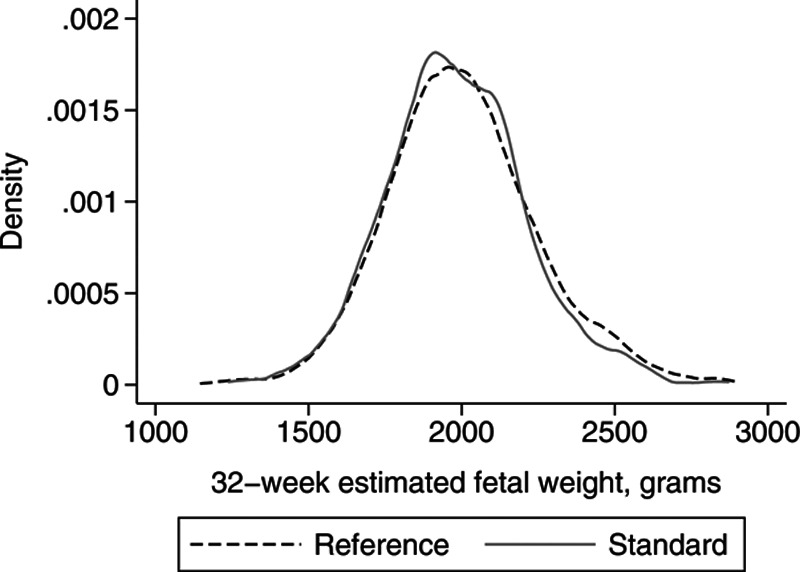
We summarized estimated fetal weight (EFW) distributions from a hospital's routine 32-week ultrasound in all nonanomalous singleton fetuses (reference) and in those without maternal-fetal conditions affecting fetal growth (standard). We calculated EFWs for the 3rd, 5th, 10th, and 50th percentiles, and the proportion of fetuses each chart classified as small for gestational age.
Of 2309 fetuses in our reference, 690 (30%) met the standard's inclusion criteria. There were no meaningful differences between the EFW distributions of the reference and standard curves (50th percentile: 1989 g reference vs. 1968 g standard; 10th percentile: 1711 g reference vs. 1710 g standard), or the proportion of small for gestational age fetuses (both 9.9%).
In our study, there was little practical difference between a fetal growth reference and standard for detecting small infants.
胎儿生长标准(基于低风险妊娠制定的规定性图表)理论上是监测胎儿生长的更好工具,优于传统参考值。我们研究了修改图表纳入标准如何影响得出的曲线。
我们总结了医院常规 32 周超声检查中所有非畸形单胎胎儿(参考组)和无影响胎儿生长的母婴情况的胎儿(标准组)的估计胎儿体重(EFW)分布。我们计算了第 3、5、10 和 50 百分位数的 EFW,以及每个图表分类为胎龄小的胎儿比例。
在我们的参考组 2309 例胎儿中,有 690 例(30%)符合标准的纳入标准。参考组和标准组的 EFW 分布(第 50 百分位数:参考组 1989g,标准组 1968g;第 10 百分位数:参考组 1711g,标准组 1710g)或胎龄小的胎儿比例(均为 9.9%)均无显著差异。
在我们的研究中,用于检测小婴儿的胎儿生长参考值和标准之间几乎没有实际差异。