Department of Dermatology, Cliniques universitaires Saint-Luc, Université catholique de Louvain (UCLouvain), Avenue Hippocrate 10, 1200, Brussels, Belgium.
Int J Infect Dis. 2021 Jan;102:53-55. doi: 10.1016/j.ijid.2020.10.021. Epub 2020 Oct 16.
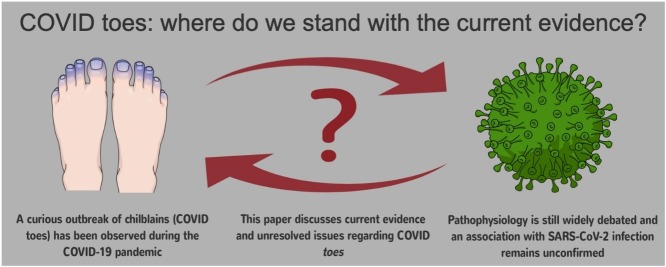
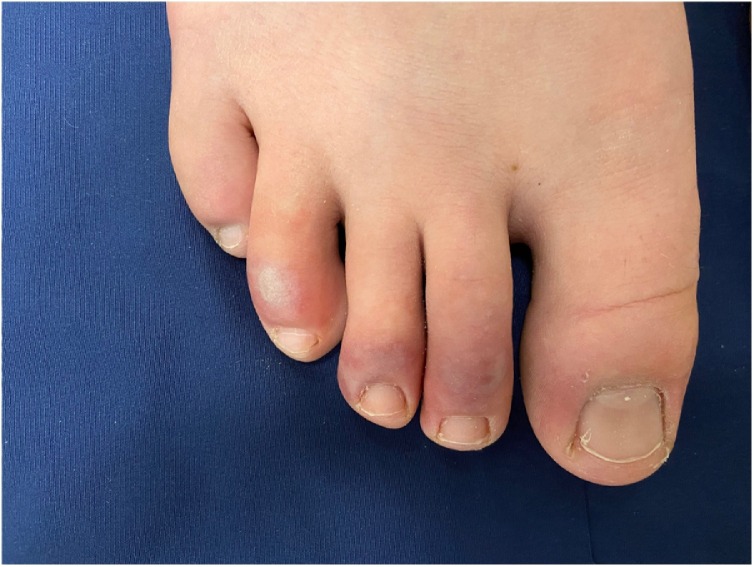
Numerous of cases of chilblains have been observed, mainly in young subjects with no or mild symptoms compatible with COVID-19. The pathophysiology of these lesions is still widely debated and an association with SARS-CoV-2 infection remains unconfirmed.
This paper focus on the unresolved issues about these COVID toes and in particular whether or not they are associated with COVID-19.
The temporal link between the outbreak of chilblains and the COVID-19 pandemic is a first suggests a link between the two events. Positive anti-SARS-CoV/SARS-CoV-2 immunostaining on skin biopsy of chilblains seem to confirm the presence of the virus in the lesions, but lack specificity and must be interpreted with caution. Conversely, RT-PCR and anti-SARS-CoV-2 serology were negative in the majority of patients with chilblains. Therefore, SARS-CoV-2 infection can be excluded, with relative certainty, even after accounting for possible lower immunization in mild/asymptomatic patients and for some differences in sensitivity/specificity between the tests used. Some authors hypothesize that chilblains could be the cutaneous expression of a strong type I interferon (IFN-I) response. High production of IFN-I is suggested to be associated with early viral control and may suppress antibody response. However, the absence of other cutaneous or extracutaneous symptoms as observed in other interferonopathies raises unanswered questions. To date, a direct link between chilblains and COVID-19 still seems impossible to confirm. A more indirect association due to lifestyle changes induced by lockdown is a possible explanation. Improvement of chilblains when protective measures were adopted and after lifting of lockdown, support this hypothesis.
Conflicting current evidence highlights the need for systematic and repeated testing of larger numbers of patients and the need for valid follow-up data that take into consideration epidemic curves and evolution of lockdown measures.
已观察到许多冻疮病例,主要发生在症状轻微或无症状的年轻患者中,这些症状与 COVID-19 相符。这些病变的病理生理学仍存在广泛争议,与 SARS-CoV-2 感染的关联尚未得到证实。
本文重点关注这些 COVID 脚趾尚未解决的问题,特别是它们是否与 COVID-19 有关。
冻疮的爆发与 COVID-19 大流行之间的时间关联是第一个提示两者之间存在关联的线索。皮肤活检中阳性的抗 SARS-CoV/SARS-CoV-2 免疫染色似乎证实了病毒在病变中的存在,但缺乏特异性,必须谨慎解读。相反,大多数冻疮患者的 RT-PCR 和抗 SARS-CoV-2 血清学检测结果均为阴性。因此,即使考虑到轻度/无症状患者免疫接种率可能较低以及使用的检测方法之间存在一定的敏感性/特异性差异,也可以相对肯定地排除 SARS-CoV-2 感染。一些作者假设冻疮可能是强烈 I 型干扰素 (IFN-I) 反应的皮肤表现。高水平的 IFN-I 产生被认为与早期病毒控制有关,并可能抑制抗体反应。然而,与其他干扰素病不同的是,观察到其他皮肤或皮肤外症状的缺失提出了未解决的问题。迄今为止,冻疮与 COVID-19 之间的直接关联似乎仍然难以确认。由于封锁引起的生活方式改变的间接关联是一种可能的解释。当采取保护措施和解除封锁后,冻疮得到改善,支持了这一假设。
相互矛盾的现有证据强调需要对更多患者进行系统和重复的检测,并需要有效的随访数据,这些数据需要考虑流行曲线和封锁措施的演变。