Sun Zhiyuan, Wang Long, Zhou Jinyang, Fan Xun, Xie Hanghai, Zhang Han, Zhang Guangcheng, Shi Xuetao
Queen Mary University of London Engineering School, Northwestern Polytechnical University, Xi'an 710129, China.
NPU-QMUL Joint Research Institute of Advanced Materials and Structures, Northwestern Polytechnical University, Xi'an 710072, China.
Polymers (Basel). 2020 Oct 15;12(10):2362. doi: 10.3390/polym12102362.
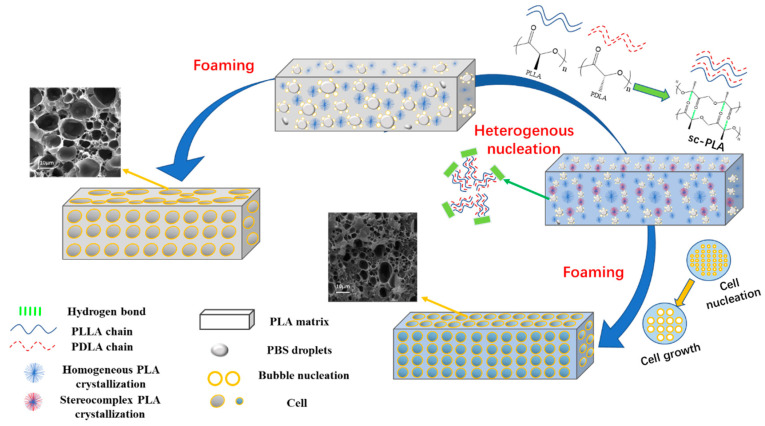
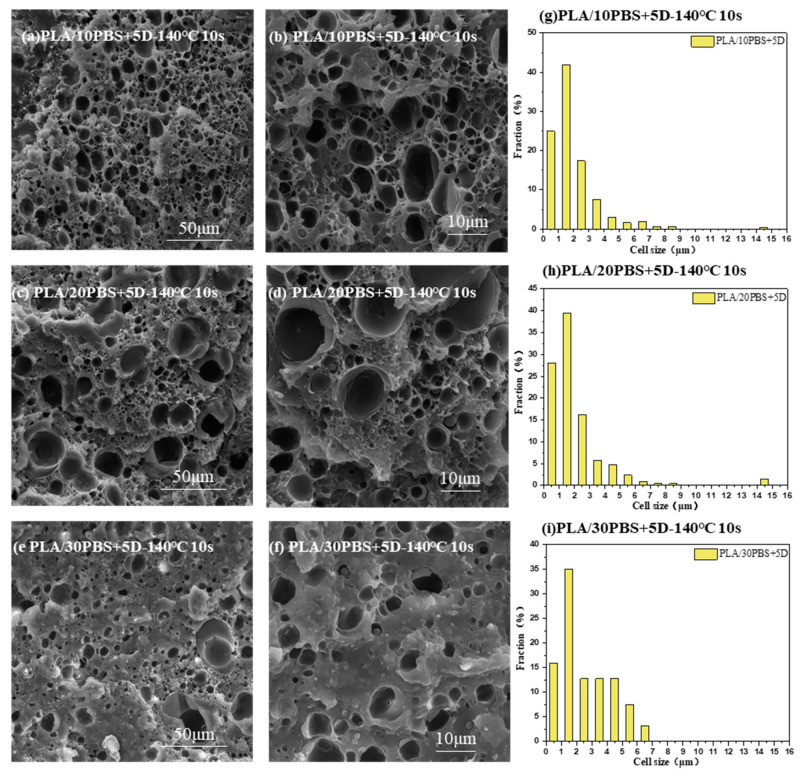
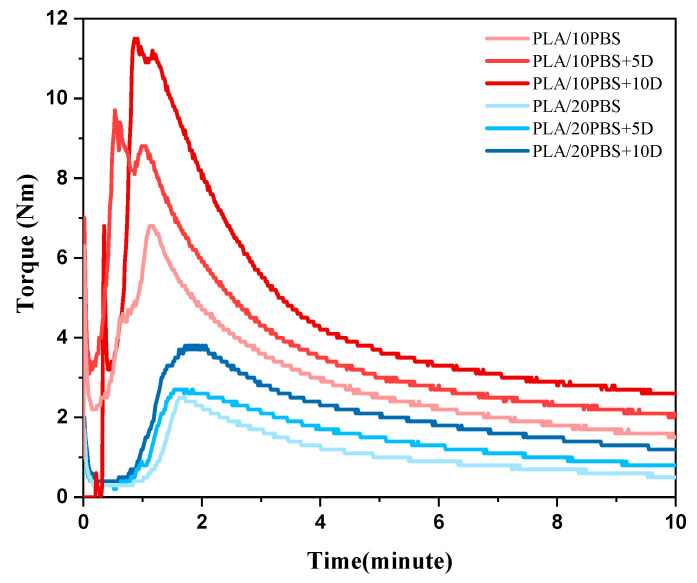
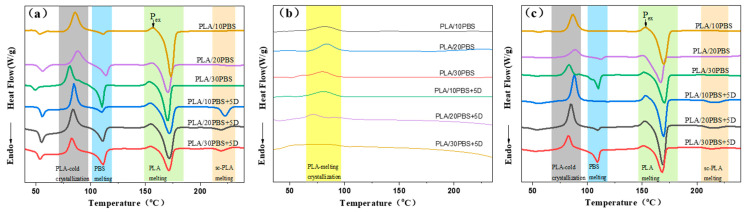
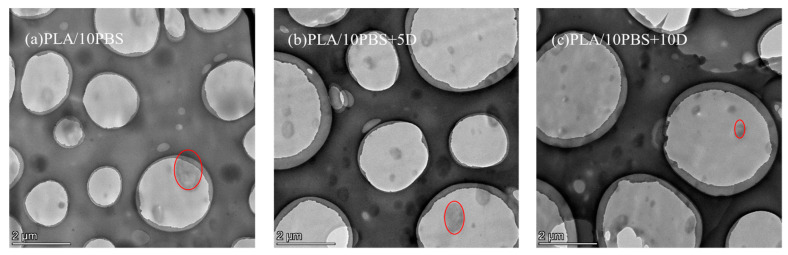
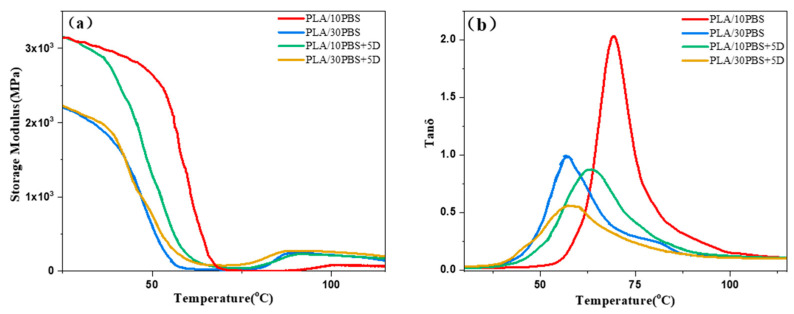
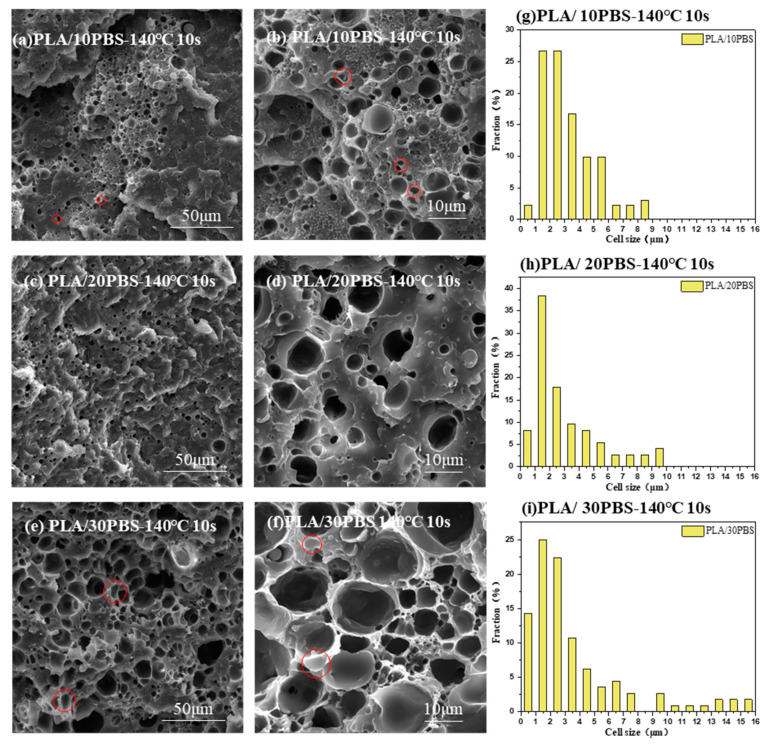
Polylactide foaming materials with promising biocompatibility balance the lightweight and mechanical properties well, and thus they can be desirable candidates for biological scaffolds used in tissue engineering. However, the cells are likely to coalesce and collapse during the foaming process of polylactide (PLA) due to its intrinsic low melt strength. This work introduces a unique PLA stereocomplexation into the microcellular foaming of poly (l-lactide)/poly (butylene succinate) (PLLA/PBS) based on supercritical carbon dioxide. The rheological properties of PLA/PBS with 5 wt% or 10 wt% poly (d-lactide) (PDLA) present enhanced melt strength owing to the formation of PLA stereocomplex crystals (sc-PLA), which act as physical pseudo-cross-link points in the molten blends by virtue of the strong intermolecular interaction between PLLA and the added PDLA. Notably, the introduction of either PBS or PDLA into the PLLA matrix could enhance its crystallization, while introducing both in the blend triggers a decreasing trend in the PLA crystallinity, which it is believed occurs due to the constrained molecular chain mobility by formed sc-PLA. Nevertheless, the enhanced melt strength and decreased crystallinity of PLA/PBS/PDLA blends are favorable for the microcellular foaming behavior, which enhanced the cell stability and provided amorphous regions for gas adsorption and homogeneous nucleation of PLLA cells, respectively. Furthermore, although the microstructure of PLA/PBS presents immiscible sea-island morphology, the miscibility was improved while the PBS domains were also refined by the introduction of PDLA. Overall, with the addition of PDLA into PLA/10PBS blends, the microcellular average cell size decreased from 3.21 to 0.66 μm with highest cell density of 2.23 × 10 cells cm achieved, confirming a stable growth of cells was achieved and more cell nucleation sites were initiated on the heterogeneous interface.
具有良好生物相容性的聚乳酸发泡材料能很好地平衡轻质特性和机械性能,因此它们有望成为组织工程中生物支架的理想候选材料。然而,聚乳酸(PLA)在发泡过程中,由于其固有的低熔体强度,细胞容易聚结和塌陷。这项工作基于超临界二氧化碳,将独特的聚乳酸立体复合引入到聚(L-乳酸)/聚(丁二酸丁二醇酯)(PLLA/PBS)的微孔发泡中。含有5 wt%或10 wt%聚(D-乳酸)(PDLA)的PLA/PBS的流变性能由于聚乳酸立体复合晶体(sc-PLA)的形成而呈现出增强的熔体强度,sc-PLA凭借PLLA与添加的PDLA之间强烈的分子间相互作用,在熔融共混物中充当物理假交联点。值得注意的是,将PBS或PDLA引入PLLA基体中均可增强其结晶度,而在共混物中同时引入两者则会引发聚乳酸结晶度的下降趋势,据信这是由于形成的sc-PLA限制了分子链的移动性所致。尽管如此,PLA/PBS/PDLA共混物增强的熔体强度和降低的结晶度有利于微孔发泡行为,分别增强了泡孔稳定性,并为气体吸附和PLLA泡孔的均匀成核提供了非晶区。此外,尽管PLA/PBS的微观结构呈现出不相容的海岛形态,但通过引入PDLA,相容性得到改善,同时PBS相区也得到细化。总体而言,在PLA/10PBS共混物中添加PDLA后,微孔平均泡孔尺寸从3.21μm降至0.66μm,实现了最高泡孔密度2.23×10个泡孔/cm³,证实实现了泡孔稳定生长,并在异质界面上引发了更多的泡孔成核位点。