Nishida Chinatsu, Izumi Hiroto, Tomonaga Taisuke, Takeshita Jun-Ichi, Wang Ke-Yong, Yamasaki Kei, Yatera Kazuhiro, Morimoto Yasuo
Department of Respiratory Medicine, University of Occupational and Environmental Health, Japan. 1-1 Iseigaoka, Yahata-nishi-ku, Kitakyushu, Fukuoka 807-8555, Japan.
Department of Occupational Pneumology, Institute of Industrial Ecological Sciences, University of Occupational and Environmental Health, Japan. 1-1 Iseigaoka, Yahata-nishi-ku, Kitakyushu, Fukuoka 807-8555, Japan.
Nanomaterials (Basel). 2020 Oct 15;10(10):2032. doi: 10.3390/nano10102032.
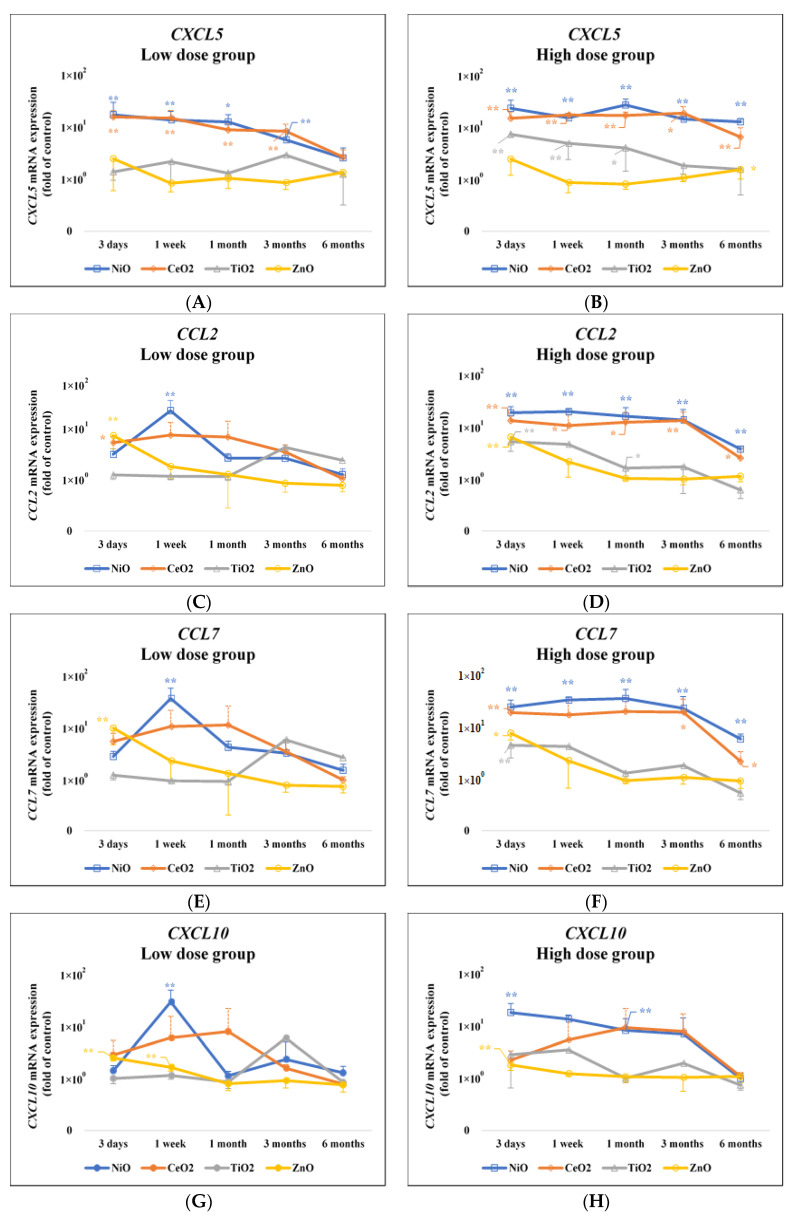
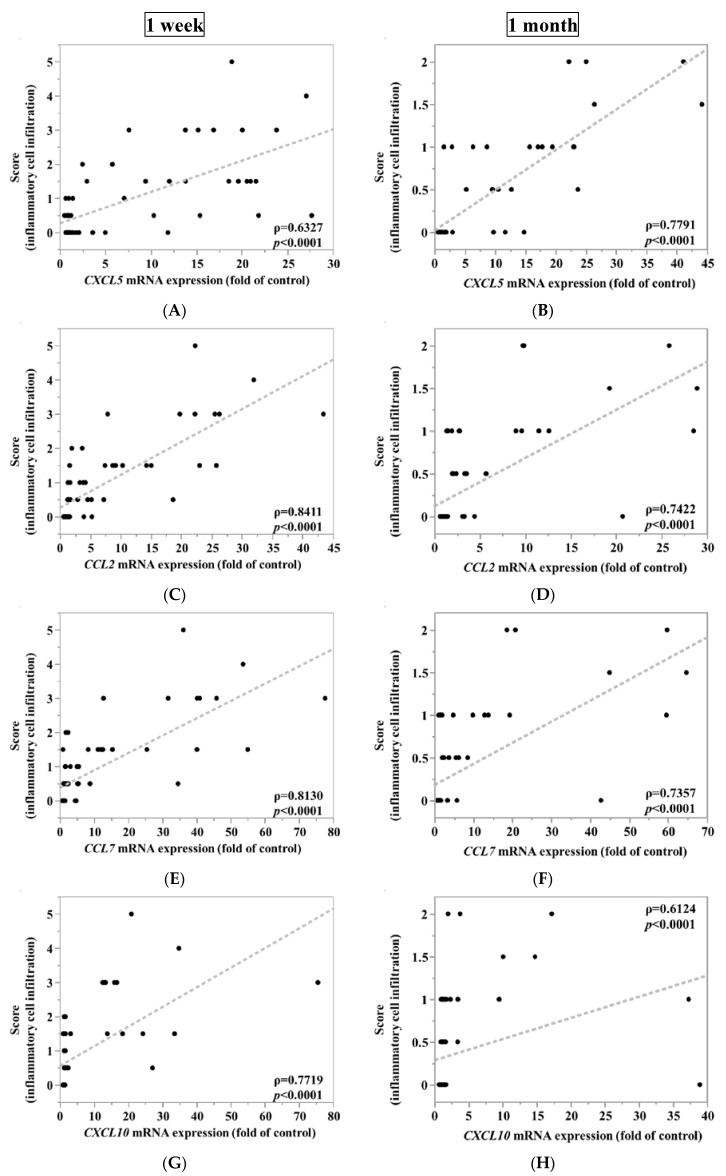
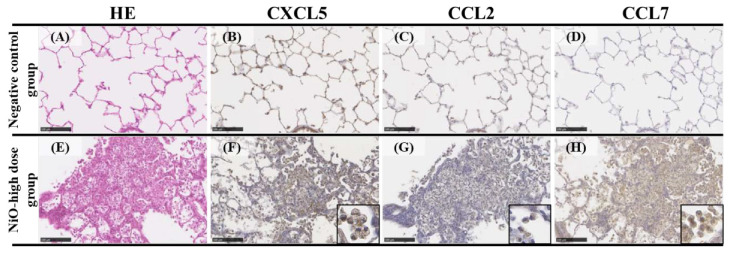
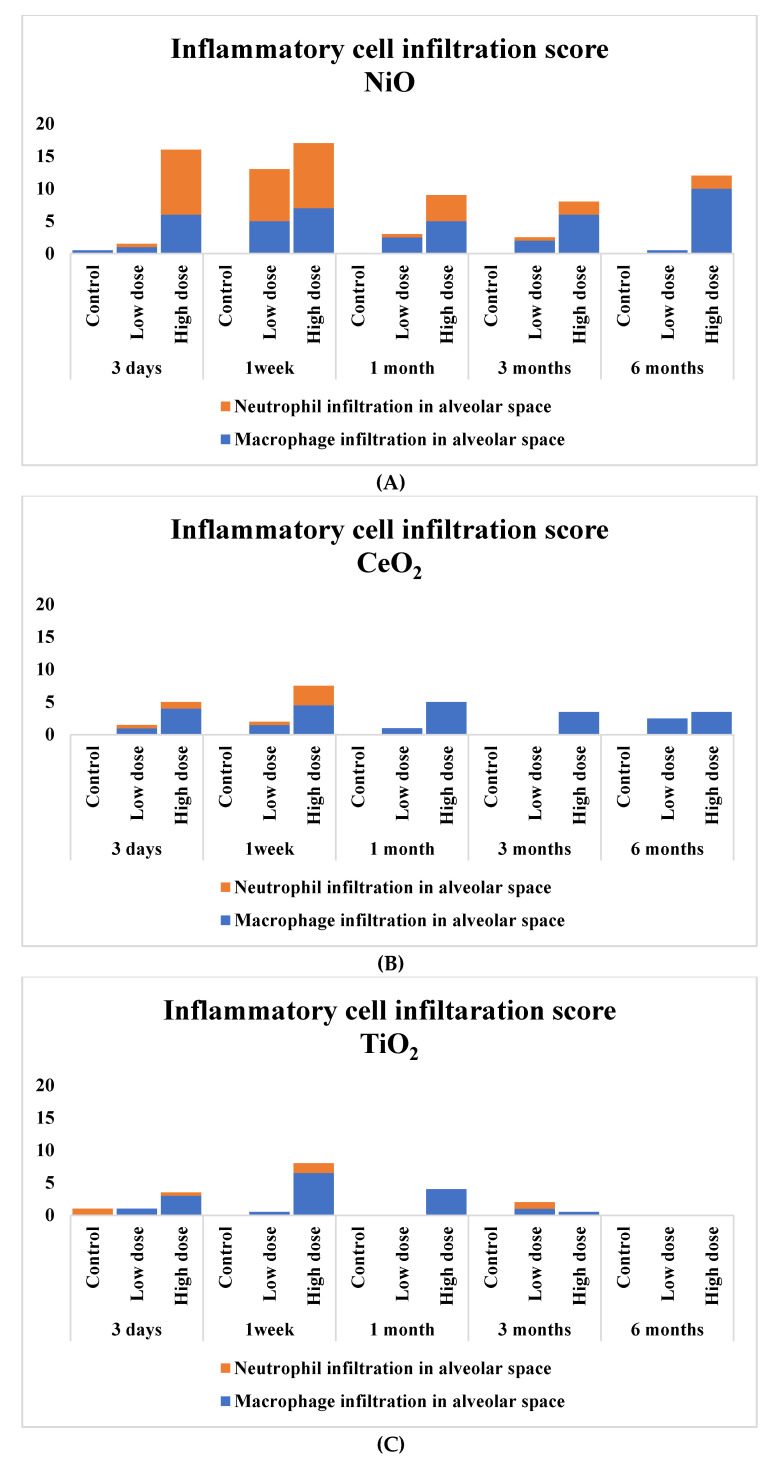
We analyzed the mRNA expression of chemokines in rat lungs following intratracheal instillation of nanomaterials in order to find useful predictive markers of the pulmonary toxicity of nanomaterials. Nickel oxide (NiO) and cerium dioxide (CeO) as nanomaterials with high pulmonary toxicity, and titanium dioxide (TiO) and zinc oxide (ZnO) as nanomaterials with low pulmonary toxicity, were administered into rat lungs (0.8 or 4 mg/kg BW). (), (), (), (), and () were selected using cDNA microarray analysis at one month after instillation of NiO in the high dose group. The mRNA expression of these five genes were evaluated while using real-time quantitative polymerase chain reaction (RT-qPCR) from three days to six months after intratracheal instillation. The receiver operating characteristic (ROC) results showed a considerable relationship between the pulmonary toxicity ranking of nanomaterials and the expression of , , and at one week and one month. The expression levels of these three genes also moderately or strongly correlated with inflammation in the lung tissues. Three chemokine genes can be useful as predictive biomarkers for the ranking of the pulmonary toxicity of nanomaterials.
为了寻找纳米材料肺毒性的有用预测标志物,我们分析了气管内滴注纳米材料后大鼠肺中趋化因子的mRNA表达。将具有高肺毒性的纳米材料氧化镍(NiO)和二氧化铈(CeO),以及具有低肺毒性的纳米材料二氧化钛(TiO)和氧化锌(ZnO)注入大鼠肺中(0.8或4mg/kg体重)。在高剂量组滴注NiO后1个月,使用cDNA微阵列分析选择了()、()、()、()和()。在气管内滴注后3天至6个月期间,使用实时定量聚合酶链反应(RT-qPCR)评估这五个基因的mRNA表达。受试者工作特征(ROC)结果表明,纳米材料的肺毒性排名与()、()和()在1周和1个月时的表达之间存在显著关系。这三个基因的表达水平也与肺组织中的炎症呈中度或强相关。三个趋化因子基因可用作纳米材料肺毒性排名的预测生物标志物。