Nursing and Health Care, Department of Public Health, Aarhus University, Bartholins Allé 2, 8000, Aarhus C, Denmark.
Epidemiology, Department of Public Health, Aarhus University, Bartholins Allé 2, 8000, Aarhus C, Denmark.
BMC Psychol. 2020 Oct 16;8(1):107. doi: 10.1186/s40359-020-00467-5.
Professional support to enhance the early parent-infant relationship in the first months after birth is recommended, but little is known about the effect of universal interventions. The objective was to investigate the effect of health visitors' use of the Newborn Behavioral Observations system in new families.
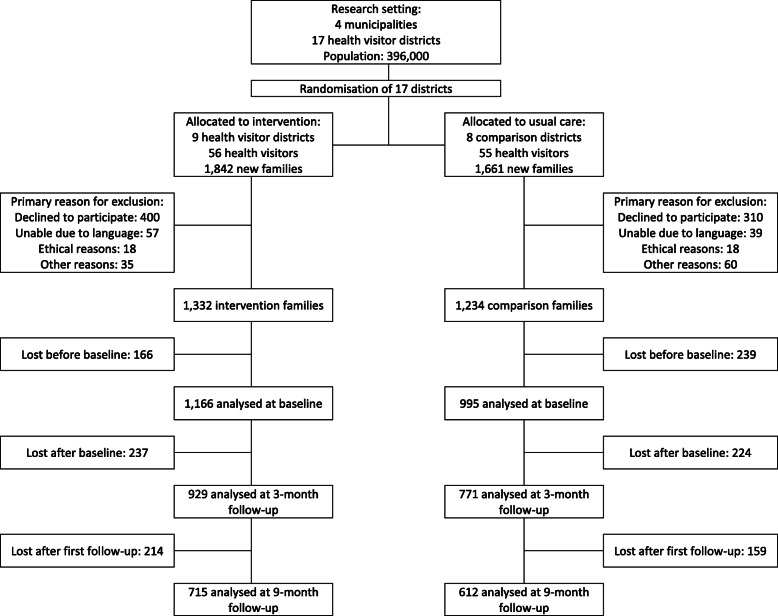
A cluster-randomised study was conducted in four Danish municipalities. Health visitors' geographical districts constituted the units for randomisation (n = 17). In the intervention group, 1332 families received NBO from 3 weeks after birth; in the comparison group, 1234 received usual care. Self-administered questionnaires were collected at baseline one to two weeks after birth, and at follow-up three and nine months postpartum. The outcomes were change over time measured by The Karitane Parenting Confidence Scale (KPCS), The Major Depression Inventory (MDI), The Ages and Stages Questionnaire: social-emotional (ASQ:SE) and The Mother and Baby Interaction Scale (MABIC). Data were analysed with mixed-effects linear regression using the intention-to-treat approach.
At baseline, no significant differences between the two groups were seen regarding maternal and infant factors. At follow-up three and nine months after birth, the change in maternal confidence and mood, infant's socio-emotional behaviour, and early parent-infant relationship moved in a slightly more positive direction in the intervention group than in the comparison group, though not statistically significant. The only significant effect was that the intervention mothers reported higher level of knowledge about infant's communication skills, response to cues, and how to sooth and establish a relation with the infant, compared to the comparison group.
We found no effect of the NBO system delivered in a universal context to all families in a community setting. The only significant difference between groups was a higher maternal degree of knowledge regarding early parenting in the intervention group.
ClinicalTrials.gov ID: NCT03070652 . Registrated February 22, 2017.
专业支持可增强婴儿出生后最初几个月的亲子关系,建议提倡,但对于通用干预措施的效果知之甚少。本研究旨在调查家庭健康访视员使用新生儿行为观察系统(NBO)对新家庭的影响。
在丹麦的四个市进行了一项集群随机对照研究。健康访视员的地理区域构成了随机分组的单位(n=17)。在干预组中,1332 个家庭从出生后 3 周开始接受 NBO;在对照组中,1234 个家庭接受常规护理。在出生后一到两周内以及三个月和九个月时通过自我管理的问卷调查收集数据。主要结局是通过卡瑞坦父母信心量表(KPCS)、主要抑郁量表(MDI)、年龄与阶段问卷:社会情感(ASQ:SE)和母婴互动量表(MABIC)来衡量随时间的变化。采用混合效应线性回归法,使用意向治疗方法进行分析。
在基线时,两组之间在母婴因素方面没有显著差异。在出生后三个月和九个月时,干预组的母亲信心和情绪、婴儿的社会情感行为以及早期亲子关系的变化方向比对照组略为积极,但无统计学意义。唯一的显著效果是,与对照组相比,干预组的母亲报告了更高水平的关于婴儿沟通技巧、对提示的反应、如何安抚和与婴儿建立关系的知识。
我们发现,在社区环境中向所有家庭提供通用的 NBO 系统没有效果。两组之间唯一的显著差异是干预组的母亲在早期育儿方面的知识程度更高。
ClinicalTrials.gov ID:NCT03070652。注册于 2017 年 2 月 22 日。