Department of Orthopedics, University Medical Center Regensburg, Asklepios Klinikum Bad Abbach, Kaiser-Karl-V.-Allee 3, 93077, Bad Abbach, Germany.
Center for Clinical Studies, University Medical Center of Regensburg, Franz-Josef-Strauss-Allee 11, 93053, Regensburg, Germany.
Sci Rep. 2020 Oct 19;10(1):17660. doi: 10.1038/s41598-020-74986-x.
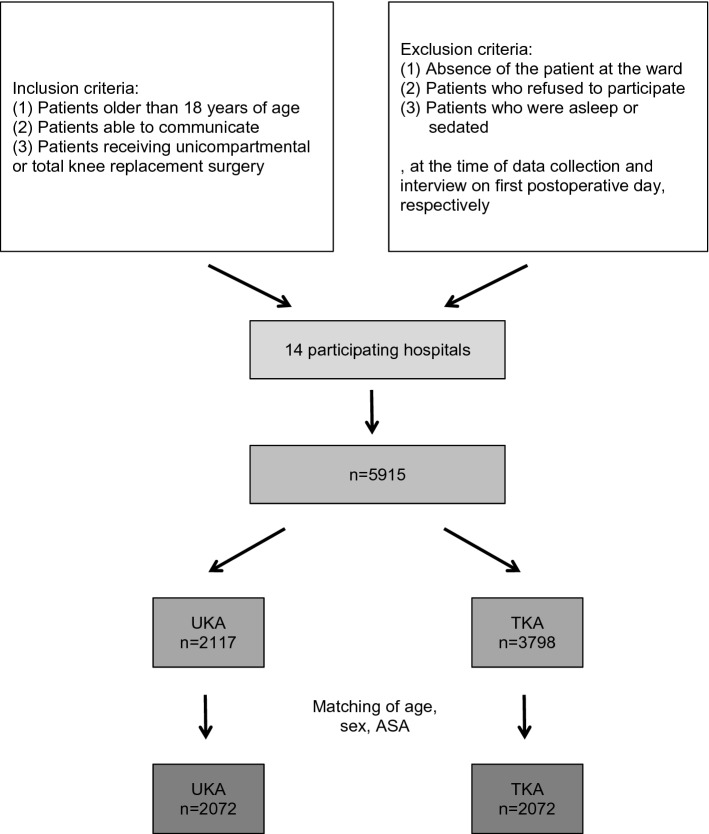
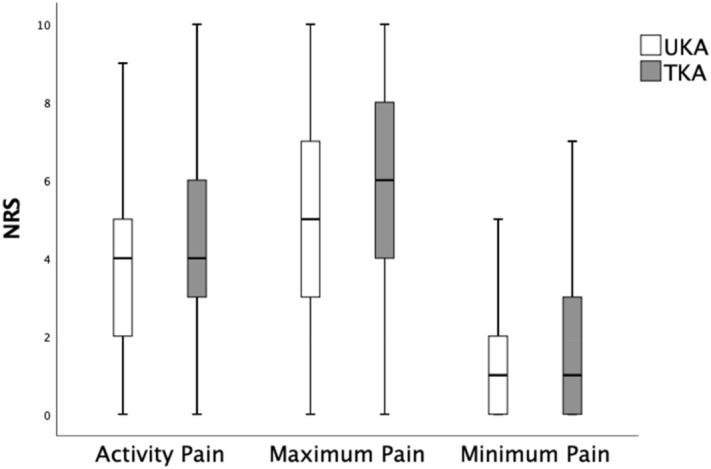
Unicompartmental knee arthroplasty and total knee arthroplasty are well established treatment options for end-stage osteoarthritis, UKA still remains infrequently used if you take all knee arthroplasties into account. An important factor following knee arthroplasty is pain control in the perioperative experience, as high postoperative pain level is associated with persistent postsurgical pain. There is little literature which describes pain values and the need for pain medication following UKA and/or TKA. So far, no significant difference in pain has been found between UKA and TKA. The aim of the study was to evaluate differences in the postoperative course in unicompartmental knee arthroplasty vs. total knee arthroplasty regarding the need for pain medication and patient-reported outcomes including pain scores and side effects. We hypothesized that unicompartmental knee arthroplasty is superior to total knee arthroplasty in terms of postoperative pain values and the need of pain medication. In this project, we evaluated 2117 patients who had unicompartmental knee arthroplasty and 3798 who had total knee arthroplasty performed, from 2015 to 2018. A total of 4144 patients could be compared after performing the matched pair analysis. A professional team was used for data collection and short patient interviews to achieve high data quality on the first postoperative day. Parameters were compared after performing a 1:1 matched pair analysis, multicenter-wide in 14 orthopedic departments. Pain scores were significantly lower for the UKA group than those of the TKA group (p < 0.001 respectively for activity pain, minimum and maximum pain). In the recovery unit, there was less need for pain medication in patients with UKA (p = 0.004 for non-opioids). The opiate consumption was similarly lower for the UKA group, but not statistically significant (p = 0.15). In the ward, the UKA group needed less opioids (p < 0.001). Patient subjective parameters were significantly better for UKA. After implantation of unicompartmental knee arthroplasty, patients showed lower pain scores, a reduced need for pain medication and better patient subjective parameters in the early postoperative course in this study.
单髁膝关节置换术和全膝关节置换术是治疗终末期骨关节炎的成熟治疗方法,如果将所有膝关节置换术都考虑在内,单髁膝关节置换术的应用仍然较为少见。膝关节置换术后的一个重要因素是围手术期的疼痛控制,因为高术后疼痛水平与持续的术后疼痛有关。描述单髁膝关节置换术和全膝关节置换术后疼痛值和对疼痛药物需求的文献很少。到目前为止,单髁膝关节置换术和全膝关节置换术之间的疼痛没有发现显著差异。本研究的目的是评估单髁膝关节置换术与全膝关节置换术在术后疼痛药物需求和患者报告的结果(包括疼痛评分和副作用)方面的差异。我们假设单髁膝关节置换术在术后疼痛值和对疼痛药物的需求方面优于全膝关节置换术。在本项目中,我们评估了 2015 年至 2018 年间接受单髁膝关节置换术的 2117 例患者和接受全膝关节置换术的 3798 例患者。在进行匹配对分析后,共有 4144 例患者可以进行比较。一个专业的团队用于数据收集和简短的患者访谈,以在术后第一天获得高质量的数据。在进行 1:1 匹配对分析后,在 14 个骨科部门进行了多中心的广泛比较。UKA 组的疼痛评分明显低于 TKA 组(分别在活动疼痛、最小和最大疼痛时,p<0.001)。在恢复单元中,UKA 组患者对疼痛药物的需求较少(非阿片类药物,p=0.004)。阿片类药物的消耗量也较低,但无统计学意义(p=0.15)。在病房中,UKA 组需要较少的阿片类药物(p<0.001)。患者主观参数对 UKA 明显更好。在本研究中,与全膝关节置换术相比,单髁膝关节置换术后患者在早期术后阶段的疼痛评分较低,对疼痛药物的需求较低,患者主观参数更好。