Guzman Cesar E, Wood Jennifer L, Egidi Eleonora, White-Monsant Alison C, Semenec Lucie, Grommen Sylvia V H, Hill-Yardin Elisa L, De Groef Bert, Franks Ashley E
Department of Physiology, Anatomy and Microbiology, La Trobe University, Melbourne, VIC, 3086, Australia.
Centre for Future Landscapes, La Trobe University, Melbourne, VIC, 3086, Australia.
Sci Rep. 2020 Oct 19;10(1):17712. doi: 10.1038/s41598-020-74677-7.
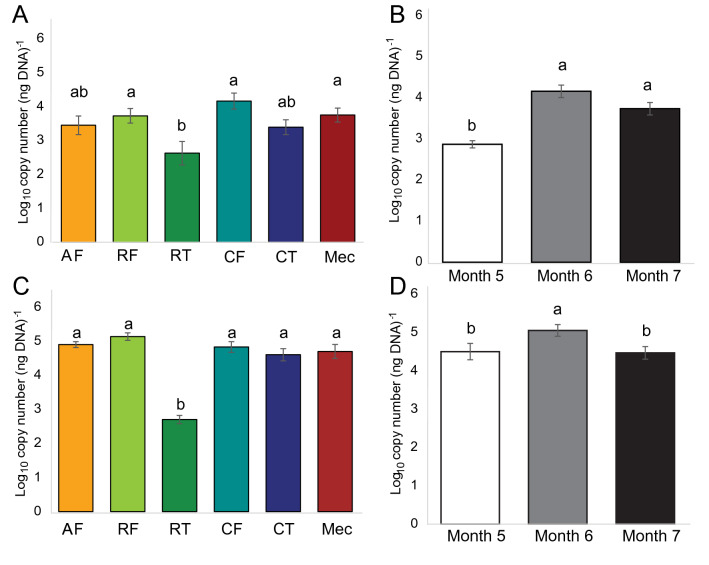
Foetus sterility until parturition is under debate due to reports of microorganisms in the foetal environment and meconium. Sufficient controls to overcome sample contamination and provide direct evidence of microorganism viability in the pre-rectal gastrointestinal tract (GIT) have been lacking. We conducted molecular and culture-based analyses to investigate the presence of a microbiome in the foetal GIT of calves at 5, 6 and 7 months gestation, while controlling for contamination. The 5 components of the GIT (ruminal fluid, ruminal tissue, caecal fluid, caecal tissue and meconium) and amniotic fluid were found to contain a pioneer microbiome of distinct bacterial and archaeal communities. Bacterial and archaeal richness varied between GIT components. The dominant bacterial phyla in amniotic fluid differed to those in ruminal and caecal fluids and meconium. The lowest bacterial and archaeal abundances were associated with ruminal tissues. Viable bacteria unique to the ruminal fluids, which were not found in the controls from 5, 6 and 7 months gestation, were cultured, subcultured, sequenced and identified. We report that the foetal GIT is not sterile but is spatially colonised before birth by a pioneer microbiome.
由于有关于胎儿环境和胎粪中存在微生物的报道,胎儿在分娩前是否无菌仍存在争议。一直缺乏足够的对照来克服样本污染并提供直肠前胃肠道(GIT)中微生物生存能力的直接证据。我们进行了基于分子和培养的分析,以研究妊娠5、6和7个月时犊牛胎儿GIT中微生物群的存在情况,同时控制污染。发现GIT的5个组成部分(瘤胃液、瘤胃组织、盲肠液、盲肠组织和胎粪)以及羊水含有独特细菌和古菌群落的先驱微生物群。细菌和古菌的丰富度在GIT各组成部分之间有所不同。羊水中的主要细菌门与瘤胃液、盲肠液和胎粪中的不同。细菌和古菌丰度最低的与瘤胃组织相关。对瘤胃液中特有的、在妊娠5、6和7个月的对照样本中未发现的活细菌进行了培养、传代培养、测序和鉴定。我们报告胎儿GIT并非无菌,而是在出生前就被先驱微生物群在空间上定殖。