Department of Clinical Nursing, Maternal Nursing and Midwifery, Shiga University of Medical Science, Tsukinowa, Seta, Otsu, Shiga, 520-2192, Japan.
Department of Legal Medicine, Shiga University of Medical Science, Tsukinowa, Seta, Otsu, Shiga, 520-2192, Japan.
Sci Rep. 2020 Oct 19;10(1):17609. doi: 10.1038/s41598-020-74730-5.
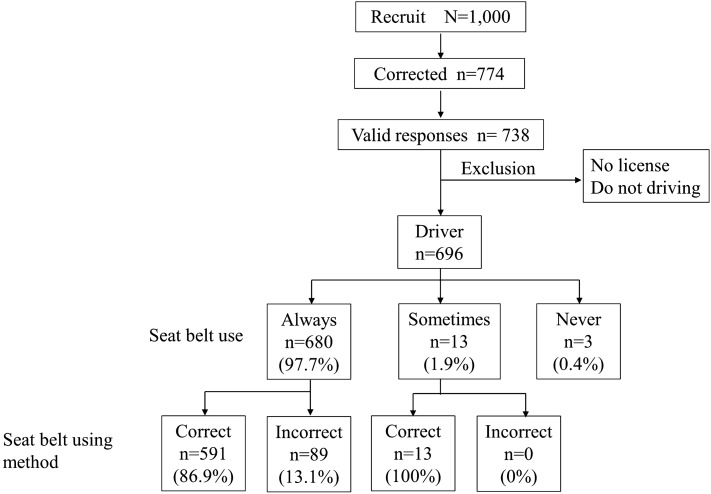
Considerable numbers of pregnant women do not understand the correct way to use seatbelts; thus, they are inappropriately restrained when wearing seatbelts. To improve appropriate seatbelt wearing by pregnant women vehicle passengers, we examined their use by pregnant women drivers and the independent factors influencing appropriate use. We undertook a cross-sectional survey of 1,000 pregnant women in Shiga Prefecture, Japan. Among 774 returned questionnaires, we analysed those of 680 pregnant women who always wore a seatbelt. The mean participant age was 31.4 ± 5.0 years and mean gestational age 26.2 ± 8.2 weeks; 97.7% of subjects always wore a seatbelt; 86.9% wore a seatbelt correctly and 13.1% incorrectly. Multivariate analysis indicated that receiving information about correct seatbelt use (odds ratio, 2.25; P < 0.005) and gestational age (odds ratio, 1.06; P < 0.001) were significant independent factors for correct seatbelt use. Providing information about correct seatbelt use during the early term is required for pregnant women to protect both the mother and fetus.
相当数量的孕妇并不了解正确使用安全带的方法;因此,当她们系安全带时,往往系得不合适。为了提高孕妇乘客正确使用安全带,我们检查了孕妇司机的使用情况以及影响正确使用的独立因素。我们在日本滋贺县进行了一项横断面调查,共调查了 1000 名孕妇。在收回的 774 份问卷中,我们分析了 680 名始终系安全带的孕妇的问卷。参与者的平均年龄为 31.4±5.0 岁,平均妊娠周数为 26.2±8.2 周;97.7%的受试者始终系安全带;86.9%正确系安全带,13.1%不正确。多变量分析表明,接受有关正确使用安全带的信息(比值比,2.25;P<0.005)和妊娠周数(比值比,1.06;P<0.001)是正确使用安全带的显著独立因素。在孕早期提供有关正确使用安全带的信息对于保护母亲和胎儿都很重要。