VCU Pauley Heart Center, Virginia Commonwealth University, 1220 E Broad St, Richmond, VA, 23298, USA.
Istituto di Anatomia Patologica, Università di Trieste, Trieste, Italy.
Inflamm Res. 2021 Jan;70(1):7-10. doi: 10.1007/s00011-020-01413-2. Epub 2020 Oct 20.
The orf8b protein of the coronavirus SARS-CoV, analogous to SARS-CoV-2, triggers the NLRP3 inflammasome in macrophages in vitro. Deregulated inflammasome-mediated release of interleukin-1 family cytokines is important in hyper-inflammatory syndromes, like happens in SARS-CoV-2-mediated cytokine release syndrome. We propose that an intense inflammasome formation characterizes the lungs of patients with fatal COVID-19 disease due to pneumonia and acute respiratory distress syndrome (ARDS).
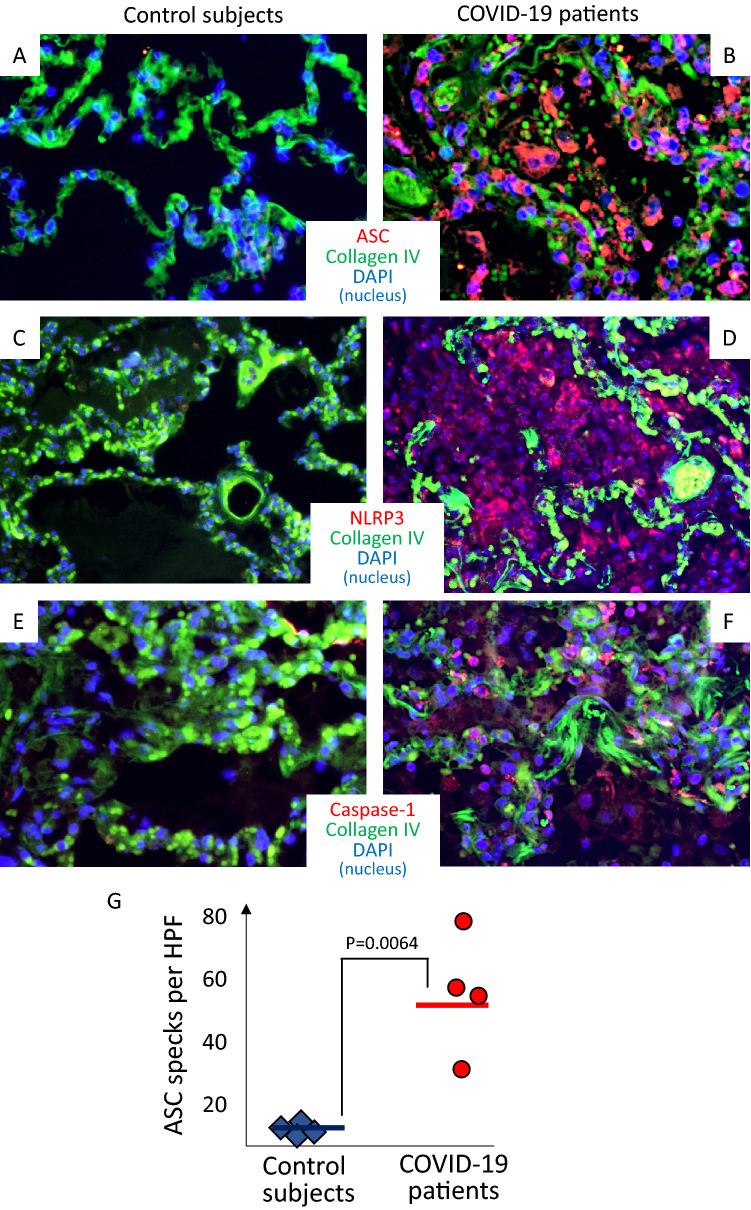
Samples from four patients with confirmed COVID-19 pneumonia who had been hospitalized at the Hospital of the University of Trieste (Italy) and died of ARDS and four lung samples from a historical repository from subjects who had died of cardiopulmonary arrest and had not been placed on mechanical ventilation and without evidence of pulmonary infection at postmortem examination were collected. Pathology samples had been fixed in formalin 10% at time of collection and subsequently embedded in paraffin. We conducted staining for ASC (Apoptosis-associated Speck-like protein containing a Caspase recruitment domain), NLRP3 (NACHT, LRR, and PYD domains-containing protein 3), and cleaved caspase-1.
Intense expression of the inflammasome was detected, mainly in leukocytes, within the lungs of all patients with fatal COVID-19 in the areas of lung injury. The number of ASC inflammasome specks per high power fields was significantly higher in the lungs of patients with fatal COVID-19 as compared with the lungs of control subjects (52 ± 22 vs 6 ± 3, P = 0.0064).
These findings identify the presence of NLRP3 inflammasome aggregates in the lungs of fatal COVID-19 pneumonia thus providing the potential molecular link between viral infection and cytokine release syndrome.
冠状病毒 SARS-CoV 的 orf8b 蛋白类似于 SARS-CoV-2,可在体外诱导巨噬细胞中的 NLRP3 炎性体。失调的炎性体介导的白细胞介素-1 家族细胞因子的释放对于炎症综合征很重要,例如在 SARS-CoV-2 介导的细胞因子释放综合征中发生的那样。我们提出,由于肺炎和急性呼吸窘迫综合征(ARDS),致命 COVID-19 疾病患者的肺部会出现强烈的炎性体形成。
收集了来自在的里雅斯特大学医院(意大利)住院并因 ARDS 而死于 COVID-19 肺炎的 4 名患者和来自历史存档的 4 名死于心肺骤停且未接受机械通气且死后检查未发现肺部感染的患者的确诊 COVID-19 肺炎的样本。收集时,将病理样本用 10%福尔马林固定,随后嵌入石蜡中。我们对 ASC(含有 Caspase 募集结构域的凋亡相关斑点样蛋白)、NLRP3(NACHT、LRR 和 PYD 结构域包含蛋白 3)和裂解的 caspase-1 进行了染色。
在所有致命 COVID-19 患者的肺部损伤区域中,均检测到强烈的炎性体表达,主要在白细胞中。与对照组相比,致命 COVID-19 患者肺部的 ASC 炎性体斑点数量明显更高(52±22 与 6±3,P=0.0064)。
这些发现确定了 NLRP3 炎性体聚集体在致命 COVID-19 肺炎患者肺部的存在,从而为病毒感染与细胞因子释放综合征之间提供了潜在的分子联系。