O'Driscoll Megan, Harry Carole, Donnelly Christl A, Cori Anne, Dorigatti Ilaria
Medical Research Council Centre for Global Infectious Disease Analysis, Department of Infectious Disease Epidemiology, School of Public Health, Imperial College London, London, United Kingdom.
Department of Genetics, University of Cambridge, Cambridge, United Kingdom.
Clin Infect Dis. 2021 Jul 1;73(1):e215-e223. doi: 10.1093/cid/ciaa1599.
As the severe acute respiratory syndrome coronavirus 2 (SARS-CoV-2) pandemic continues its rapid global spread, quantification of local transmission patterns has been, and will continue to be, critical for guiding the pandemic response. Understanding the accuracy and limitations of statistical methods to estimate the basic reproduction number, R0, in the context of emerging epidemics is therefore vital to ensure appropriate interpretation of results and the subsequent implications for control efforts.
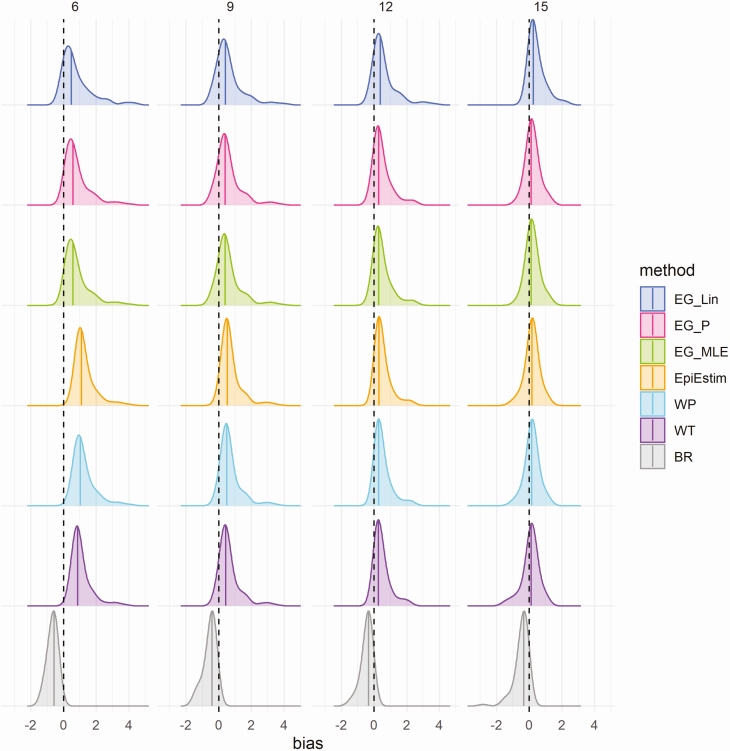
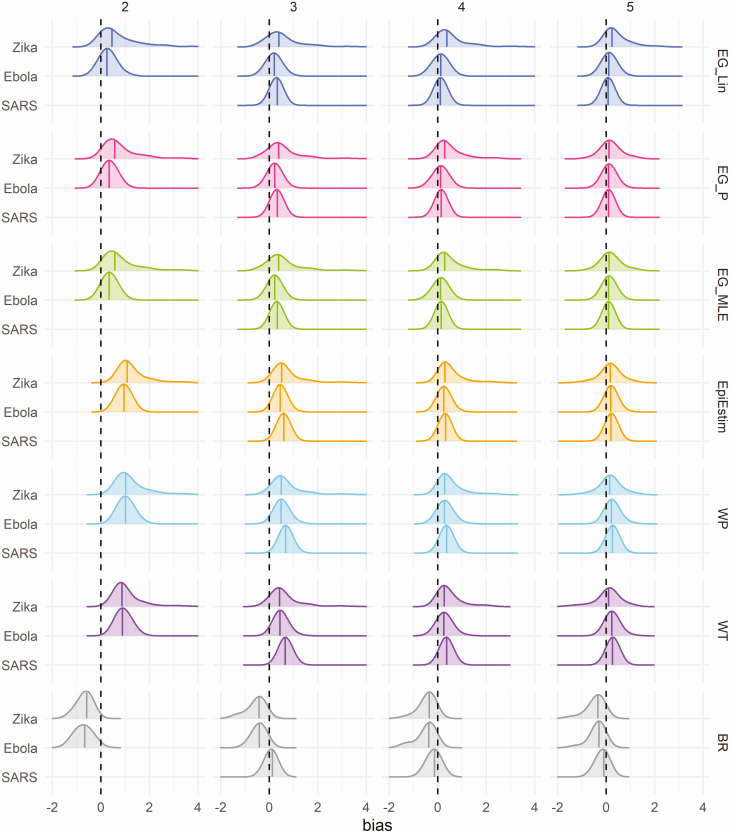
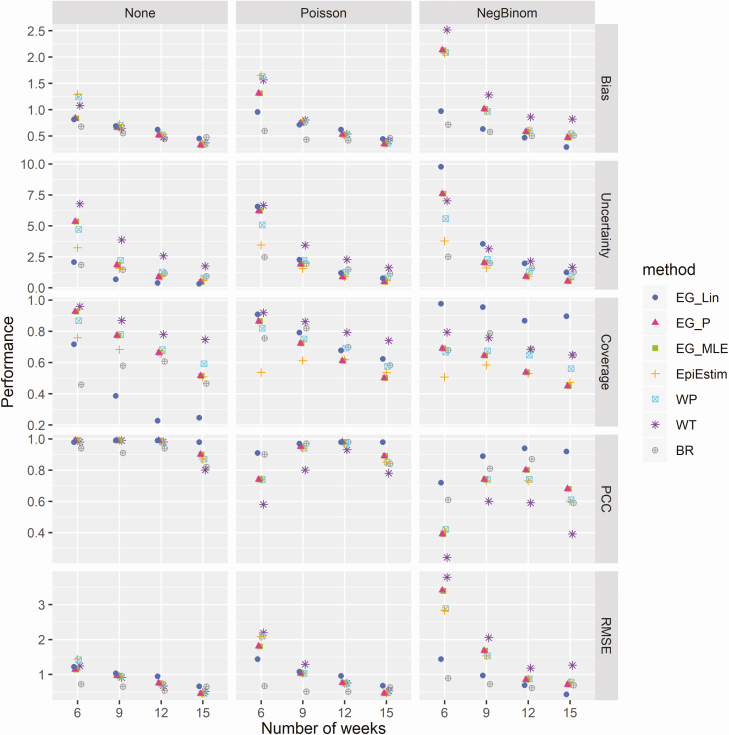
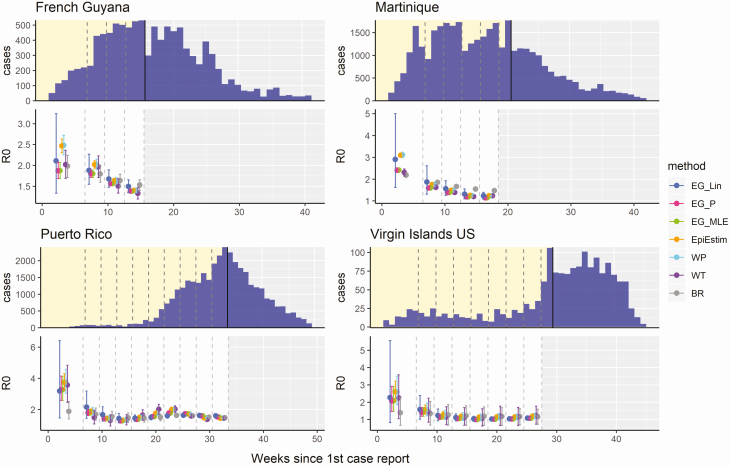
Using simulated epidemic data, we assess the performance of 7 commonly used statistical methods to estimate R0 as they would be applied in a real-time outbreak analysis scenario: fitting to an increasing number of data points over time and with varying levels of random noise in the data. Method comparison was also conducted on empirical outbreak data, using Zika surveillance data from the 2015-2016 epidemic in Latin America and the Caribbean.
We find that most methods considered here frequently overestimate R0 in the early stages of epidemic growth on simulated data, the magnitude of which decreases when fitted to an increasing number of time points. This trend of decreasing bias over time can easily lead to incorrect conclusions about the course of the epidemic or the need for control efforts.
We show that true changes in pathogen transmissibility can be difficult to disentangle from changes in methodological accuracy and precision in the early stages of epidemic growth, particularly for data with significant over-dispersion. As localized epidemics of SARS-CoV-2 take hold around the globe, awareness of this trend will be important for appropriately cautious interpretation of results and subsequent guidance for control efforts.
随着严重急性呼吸综合征冠状病毒2(SARS-CoV-2)大流行在全球范围内迅速蔓延,量化本地传播模式对于指导应对大流行一直并将继续至关重要。因此,了解在新出现的疫情背景下估计基本再生数R0的统计方法的准确性和局限性,对于确保正确解释结果以及对控制措施的后续影响至关重要。
我们使用模拟疫情数据,评估7种常用统计方法在实时疫情分析场景中估计R0的性能:随着时间推移拟合越来越多的数据点,以及数据中存在不同程度的随机噪声。还使用了2015 - 2016年拉丁美洲和加勒比地区寨卡疫情的监测数据,对实际疫情数据进行了方法比较。
我们发现,这里考虑的大多数方法在模拟数据的疫情增长早期经常高估R0,当拟合越来越多的时间点时,高估幅度会减小。这种偏差随时间减小的趋势很容易导致对疫情进程或控制措施需求得出错误结论。
我们表明,在疫情增长的早期阶段,病原体传播性的真实变化可能难以与方法准确性和精确性的变化区分开来,特别是对于具有显著过度离散的数据。随着SARS-CoV-2在全球范围内出现局部疫情,意识到这一趋势对于正确谨慎地解释结果以及对控制措施的后续指导将很重要。