Forde Hannah, Harper Emma, Rochfort Keith D, Wallace Robert G, Davenport Colin, Smith Diarmuid, Cummins Philip M
Department of Endocrinology, Beaumont Hospital and RCSI medical school, Beaumont, Dublin 9, Ireland.
School of Biotechnology, Dublin City University, Glasnevin, Dublin 9, Ireland.
Physiol Rep. 2020 Oct;8(20):e14612. doi: 10.14814/phy2.14612.
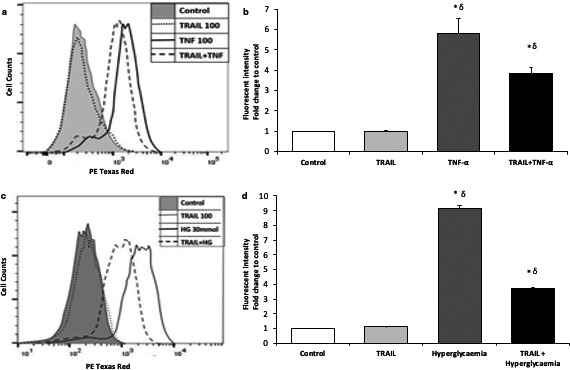
Studies suggest that tumor necrosis factor-related apoptosis-inducing ligand (TRAIL) has vasoprotective potential, as low levels of TRAIL cause accelerated vascular calcification, whereas exogenous TRAIL administration exhibits anti-atherosclerotic activity. The mechanism of TRAIL-mediated vasoprotection remains unclear. We studied the effects of TRAIL (100 ng/ml) on human aortic endothelial cells (HAECs) exposed to pro-atherogenic conditions; (a) oscillatory shear stress (±10 dynes/cm ) using the ibidi µ-slide fluidic system; (b) pro-inflammatory injury, that is, tumor necrosis factor alpha (TNF-α, 100 ng/ml) and hyperglycemia (30 mM d-glucose). End-points examined included inflammatory gene expression and reactive oxygen species (ROS) formation. TRAIL shifted the net gene expression toward an antioxidant phenotype in HAECs exposed to oscillatory shear stress. TRAIL significantly reduced ROS formation in HAECs exposed to both TNF-α and hyperglycemia. Therefore, TRAIL appears to confer atheroprotective effects on the endothelium, at least in part, by reducing oxidative stress.
研究表明,肿瘤坏死因子相关凋亡诱导配体(TRAIL)具有血管保护潜力,因为低水平的TRAIL会导致血管钙化加速,而外源性给予TRAIL则表现出抗动脉粥样硬化活性。TRAIL介导血管保护的机制尚不清楚。我们研究了TRAIL(100 ng/ml)对暴露于促动脉粥样硬化条件下的人主动脉内皮细胞(HAECs)的影响;(a)使用ibidi µ-slide流体系统施加振荡剪切力(±10达因/平方厘米);(b)促炎损伤,即肿瘤坏死因子α(TNF-α,100 ng/ml)和高血糖(30 mM d-葡萄糖)。检测的终点包括炎症基因表达和活性氧(ROS)形成。在暴露于振荡剪切力的HAECs中,TRAIL使基因表达净向抗氧化表型转变。TRAIL显著降低了暴露于TNF-α和高血糖的HAECs中的ROS形成。因此,TRAIL似乎至少部分地通过降低氧化应激对内皮发挥抗动脉粥样硬化作用。