School of Sports, Exercise and Health Sciences, Loughborough University, Loughborough, LE11 3TU, UK.
BMC Biol. 2020 Oct 20;18(1):145. doi: 10.1186/s12915-020-00884-3.
Skeletal muscle (SkM) regenerates following injury, replacing damaged tissue with high fidelity. However, in serious injuries, non-regenerative defects leave patients with loss of function, increased re-injury risk and often chronic pain. Progress in treating these non-regenerative defects has been slow, with advances only occurring where a comprehensive understanding of regeneration has been gained. Tissue engineering has allowed the development of bioengineered models of SkM which regenerate following injury to support research in regenerative physiology. To date, however, no studies have utilised human myogenic precursor cells (hMPCs) to closely mimic functional human regenerative physiology.
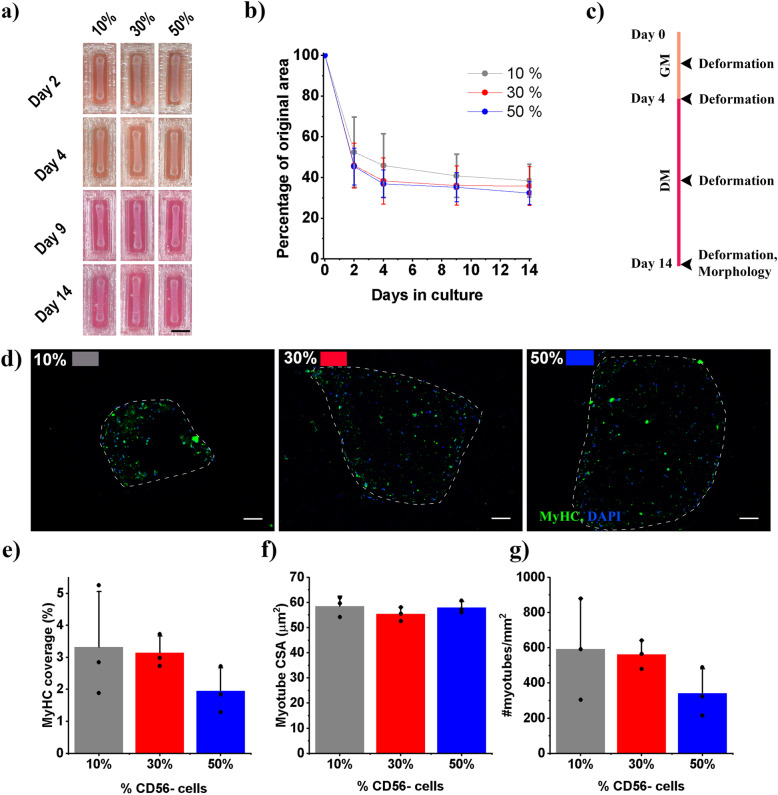
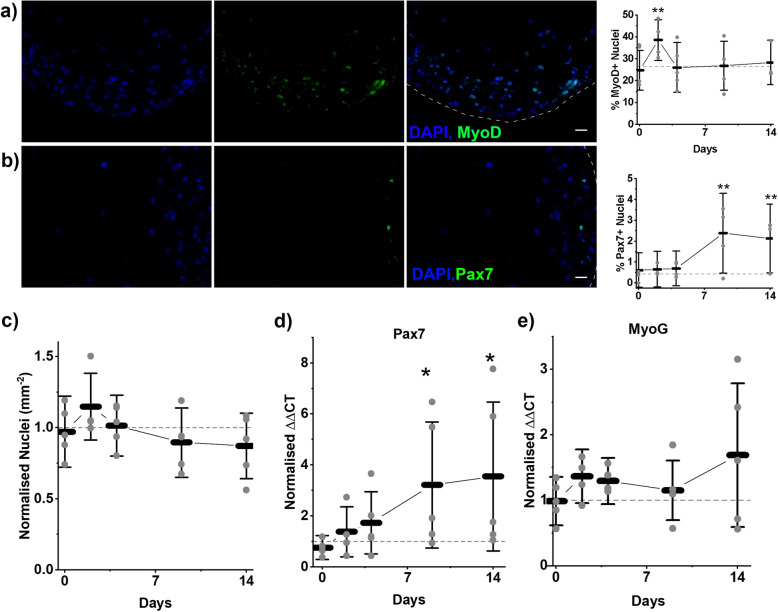
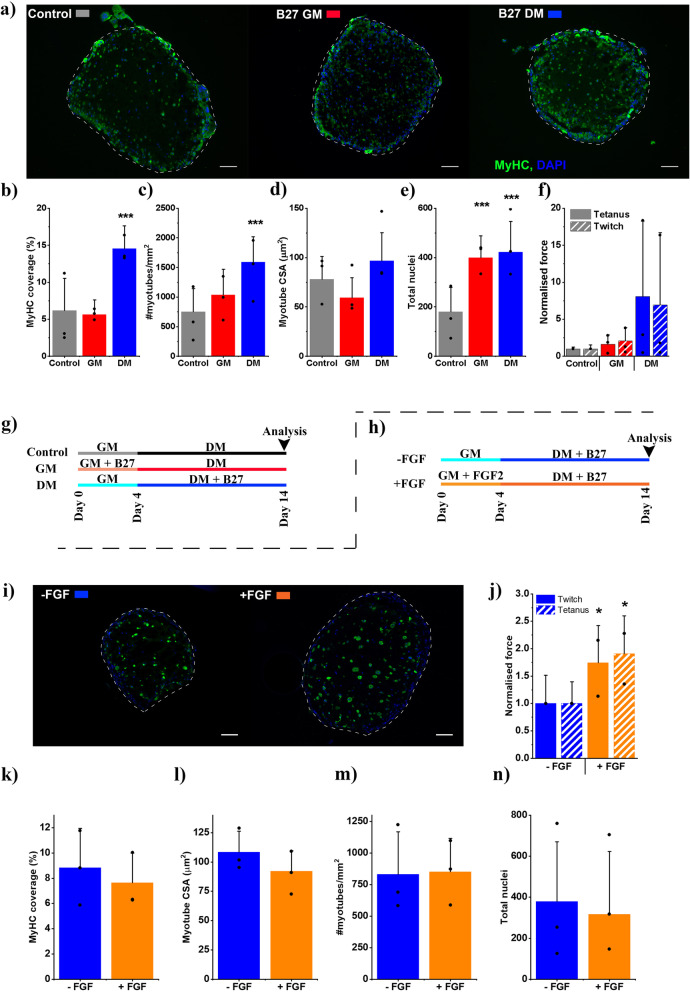
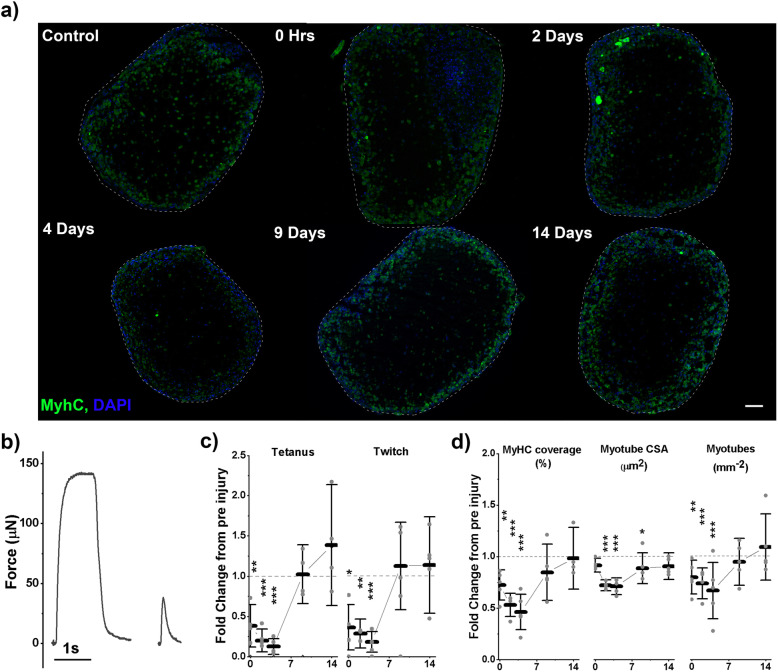
Here we address some of the difficulties associated with cell number and hMPC mitogenicity using magnetic association cell sorting (MACS), for the marker CD56, and media supplementation with fibroblast growth factor 2 (FGF-2) and B-27 supplement. Cell sorting allowed extended expansion of myogenic cells and supplementation was shown to improve myogenesis within engineered tissues and force generation at maturity. In addition, these engineered human SkM regenerated following barium chloride (BaCl) injury. Following injury, reductions in function (87.5%) and myotube number (33.3%) were observed, followed by a proliferative phase with increased MyoD+ cells and a subsequent recovery of function and myotube number. An expansion of the Pax7+ cell population was observed across recovery suggesting an ability to generate Pax7+ cells within the tissue, similar to the self-renewal of satellite cells seen in vivo.
This work outlines an engineered human SkM capable of functional regeneration following injury, built upon an open source system adding to the pre-clinical testing toolbox to improve the understanding of basic regenerative physiology.
骨骼肌(SkM)在受伤后会进行再生,以高度保真度替换受损组织。然而,在严重损伤中,非再生性缺陷会导致患者丧失功能、增加再次受伤的风险,并且常常伴有慢性疼痛。尽管在全面了解再生的基础上取得了一些进展,但这些非再生性缺陷的治疗进展仍然缓慢。组织工程学允许开发生物工程化的 SkM 模型,这些模型在受伤后会进行再生,从而支持再生生理学的研究。然而,迄今为止,尚无研究利用人类成肌前体细胞(hMPCs)来紧密模拟功能性人类再生生理学。
在这里,我们使用磁性偶联细胞分选(MACS)针对 CD56 标记物以及用成纤维细胞生长因子 2(FGF-2)和 B-27 补充剂补充培养基的方法,解决了与细胞数量和 hMPC 有丝分裂原性相关的一些困难。细胞分选允许成肌细胞的广泛扩增,并且补充剂被证明可以改善工程化组织中的成肌作用和成熟时的肌力产生。此外,这些工程化的人类 SkM 在氯化钡(BaCl)损伤后会进行再生。损伤后,观察到功能(87.5%)和肌管数量(33.3%)降低,随后是一个增殖阶段,MyoD+细胞增加,随后功能和肌管数量恢复。在恢复过程中观察到 Pax7+细胞群体的扩大,这表明组织内具有生成 Pax7+细胞的能力,类似于体内卫星细胞的自我更新。
这项工作概述了一种能够在受伤后进行功能性再生的工程化人类 SkM,该模型建立在开源系统之上,增加了临床前测试工具包,以提高对基本再生生理学的理解。