Riangwong Kanamon, Wanchana Samart, Aesomnuk Wanchana, Saensuk Chatree, Nubankoh Phakchana, Ruanjaichon Vinitchan, Kraithong Tippaya, Toojinda Theerayut, Vanavichit Apichart, Arikit Siwaret
Department of Biotechnology, Faculty of Engineering and Industrial Technology, Silpakorn University, Sanamchandra Palace Campus, Nakhon Pathom, 73000 Thailand.
National Center for Genetic Engineering and Biotechnology (BIOTEC), National Science and Technology Development Agency (NSTDA), Khlong Luang Pathum Thani, 12120 Thailand.
Hortic Res. 2020 Oct 1;7:156. doi: 10.1038/s41438-020-00374-1. eCollection 2020.
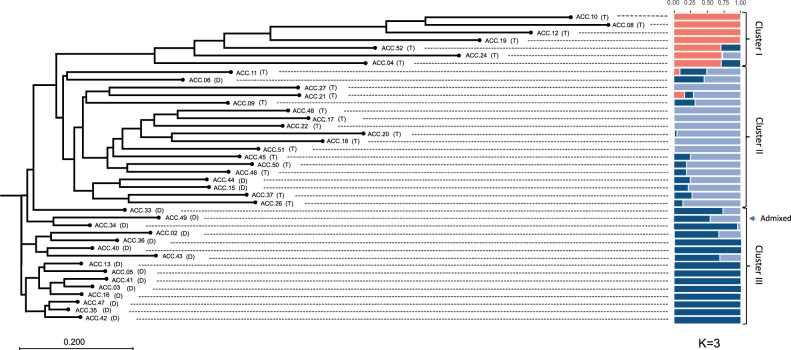
Coconut ( L.) is an important economic crop in tropical countries. However, the lack of a complete reference genome and the limitations of usable DNA markers hinder genomic studies and the molecular breeding of coconut. Here, we present the results of simple sequence repeat (SSR) mining from a high-throughput genotyping-by-sequencing (GBS) study of a collection of 38 coconut accessions. A total of 22,748 SSRs with di-, tri-, tetra-, penta- and hexanucleotide repeats of five or more were identified, 2451 of which were defined as polymorphic loci based on locus clustering in 38 coconut accessions, and 315 loci were suitable for the development of SSR markers. One hundred loci were selected, and primer pairs for each SSR locus were designed and validated in 40 coconut accessions. The analysis of 74 polymorphic markers identified between 2 and 9 alleles per locus, with an average of 3.01 alleles. The assessment of the genetic diversity and genetic relationships among the 40 coconut varieties based on the analysis of population structure, principal coordinate analysis (PCoA), and phylogenetic tree analysis using the 74 polymorphic SSR markers revealed three main groups of coconuts in Thailand. The identified SSR loci and SSR markers developed in this study will be useful for the study of coconut diversity and molecular breeding. The SSR mining approach used in this study could be applied to other plant species with a complex genome regardless of the availability of reference genome.
椰子(L.)是热带国家重要的经济作物。然而,缺乏完整的参考基因组以及可用DNA标记的局限性阻碍了椰子的基因组研究和分子育种。在此,我们展示了从对38份椰子种质进行的高通量测序基因分型(GBS)研究中挖掘简单序列重复(SSR)的结果。共鉴定出22748个具有五个或更多二核苷酸、三核苷酸、四核苷酸、五核苷酸和六核苷酸重复的SSR,其中2451个基于38份椰子种质中的位点聚类被定义为多态性位点,315个位点适合开发SSR标记。选择了100个位点,并为每个SSR位点设计了引物对,并在40份椰子种质中进行了验证。对74个多态性标记的分析表明,每个位点有2至9个等位基因,平均为3.01个等位基因。基于群体结构分析、主坐标分析(PCoA)以及使用74个多态性SSR标记进行的系统发育树分析,对40个椰子品种的遗传多样性和遗传关系进行评估,结果显示泰国的椰子主要分为三大类。本研究中鉴定出的SSR位点和开发的SSR标记将有助于椰子多样性研究和分子育种。本研究中使用的SSR挖掘方法可应用于其他基因组复杂的植物物种,无论是否有参考基因组。