Cheema Huma, Bertoli-Avella Aida M, Skrahina Volha, Anjum Muhammad Nadeem, Waheed Nadia, Saeed Anjum, Beetz Christian, Perez-Lopez Jordi, Rocha Maria Eugenia, Alawbathani Salem, Pereira Catarina, Hovakimyan Marina, Patric Irene Rosita Pia, Paknia Omid, Ameziane Najim, Cozma Claudia, Bauer Peter, Rolfs Arndt
Pediatric Department of Gastroenterology, Children's Hospital of Lahore Hospital, Lahore, Pakistan.
CENTOGENE AG, Rostock, Germany.
NPJ Genom Med. 2020 Oct 5;5:44. doi: 10.1038/s41525-020-00150-z. eCollection 2020.
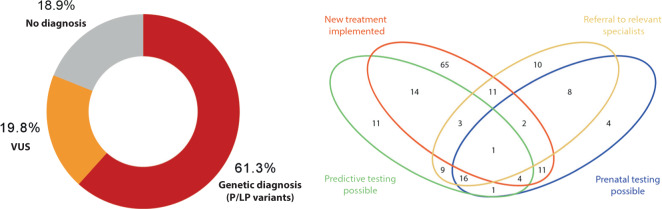
We implemented a collaborative diagnostic program in Lahore (Pakistan) aiming to establish the genetic diagnosis, and to asses diagnostic yield and clinical impact in patients with suspected genetic diseases. Local physicians ascertained pediatric patients who had no previous access to genetic testing. More than 1586 genetic tests were performed in 1019 individuals (349 index cases, 670 relatives). Most frequently performed tests were exome/genome sequencing (ES/GS, 284/78 index cases) and specific gene panels (55 index cases). In 61.3% of the patients ( = 214) a genetic diagnosis was established based on pathogenic and likely pathogenic variants. Diagnostic yield was higher in consanguineous families (60.1 vs. 39.5%). In 27 patients, genetic diagnosis relied on additional biochemical testing, allowing rapid assessment of the functional effect of the variants. Remarkably, the genetic diagnosis had a direct impact on clinical management. Most relevant consequences were therapy related such as initiation of the appropriated treatment in a timely manner in 51.9% of the patients ( = 111). Finally, we report 12 candidate genes among 66 cases with no genetic diagnosis. Importantly, three of these genes were validated as 'diagnostic' genes given the strong evidence supporting causality derived from our data repository dilated cardiomyopathyintellectual disability and liver cholestasis). The high diagnostic yield, clinical impact, and research findings demonstrate the utility of genomic testing, especially when used as first-line genetic test. For patients with suspected genetic diseases from resource-limited regions, ES can be considered as the test of choice to achieve genetic diagnosis.
我们在拉合尔(巴基斯坦)实施了一项协作诊断项目,旨在对疑似遗传性疾病患者进行基因诊断,并评估诊断率和临床影响。当地医生确定了此前未接受过基因检测的儿科患者。对1019名个体(349例索引病例,670名亲属)进行了超过1586次基因检测。最常进行的检测是外显子组/基因组测序(ES/GS,284/78例索引病例)和特定基因检测板(55例索引病例)。在61.3%的患者(n = 214)中,基于致病和可能致病的变异确定了基因诊断。近亲家庭的诊断率更高(60.1%对39.5%)。在27名患者中,基因诊断依赖于额外的生化检测,从而能够快速评估变异的功能影响。值得注意的是,基因诊断对临床管理有直接影响。最相关的后果与治疗有关,例如51.9%的患者(n = 111)及时开始了适当的治疗。最后,我们报告了66例未确诊的病例中的12个候选基因。重要的是,鉴于我们的数据存储库(扩张型心肌病、智力残疾和肝胆汁淤积)中有强有力的因果关系证据,其中三个基因被确认为“诊断性”基因。高诊断率、临床影响和研究结果证明了基因组检测的实用性,特别是当用作一线基因检测时。对于来自资源有限地区的疑似遗传性疾病患者,外显子组测序可被视为实现基因诊断的首选检测方法。