Garnica Sigisfredo, Rosenstein Ronja, Schön Max Emil
Instituto de Bioquímica y Microbiología, Facultad de Ciencias, Universidad Austral de Chile, Valdivia, Isla Teja, Chile.
Institute of Evolution and Ecology, Plant Evolutionary Ecology, University of Tuebingen, Tuebingen, Germany.
PeerJ. 2020 Oct 13;8:e9732. doi: 10.7717/peerj.9732. eCollection 2020.
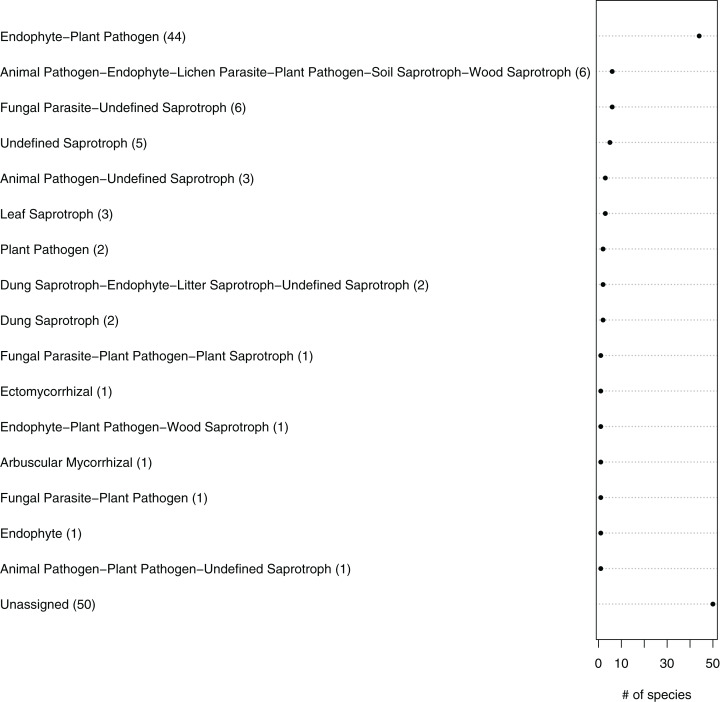
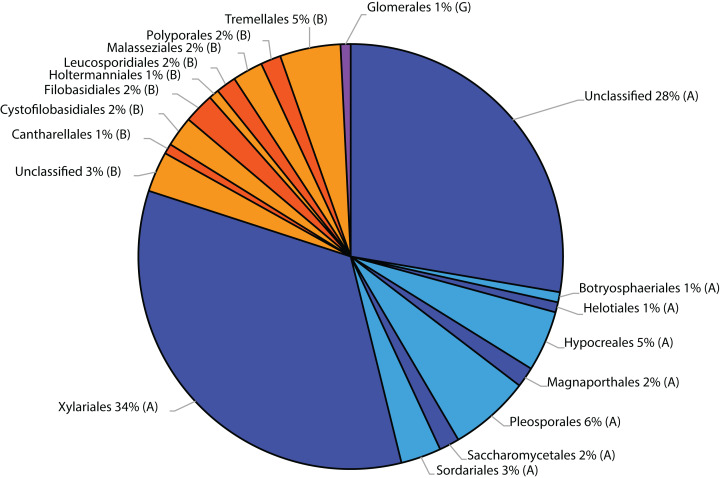
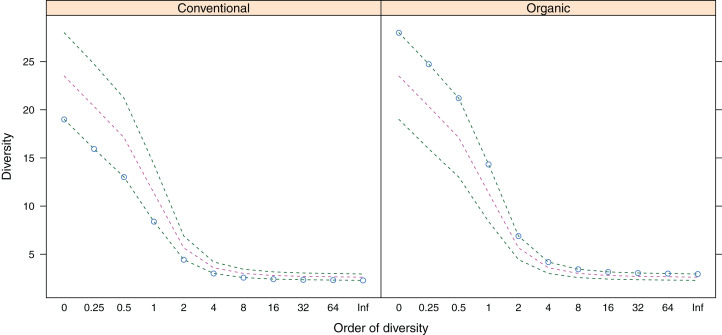
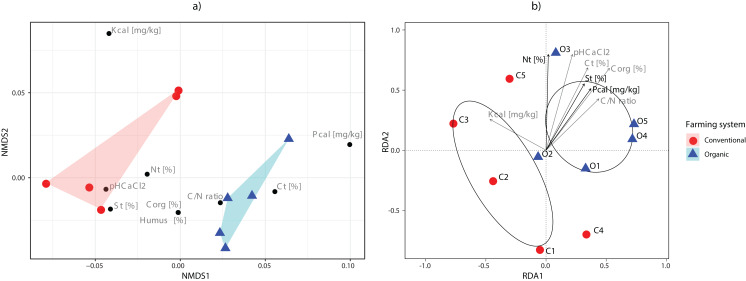
Understanding the impacts of agricultural practices on belowground fungal communities is crucial in order to preserve biological diversity in agricultural soils and enhance their role in agroecosystem functioning. Although fungal communities are widely distributed, relatively few studies have correlated agricultural production practices. We investigated the diversity, composition and ecological functionality of fungal communities in roots of winter wheat () growing in conventional and organic farming systems. Direct and nested polymerase chain reaction (PCR) amplifications spanning the internal transcribed spacer (ITS) region of the rDNA from pooled fine root samples were performed with two different sets of fungal specific primers. Fungal identification was carried out through similarity searches against validated reference sequences (RefSeq). The R package 'picante' and FUNGuild were used to analyse fungal community composition and trophic mode, respectively. Either by direct or cloning sequencing, 130 complete ITS sequences were clustered into 39 operational taxonomic units (OTUs) (25 singletons), belonging to the Ascomycota (24), the Basidiomycota (14) and to the Glomeromycota (1). Fungal communities from conventional farming sites are phylogenetically more related than expected by chance. Constrained ordination analysis identified total N, total S and Pcal that had a significant effect on the OTU's abundance and distribution, and a further correlation with the diversity of the co-occurring vegetation could be hypothesised. The functional predictions based on FUNGuild suggested that conventional farming increased the presence of plant pathogenic fungi compared with organic farming. Based on diversity, OTU distribution, nutrition mode and the significant phylogenetic clustering of fungal communities, this study shows that fungal communities differ across sampling sites, depending on agricultural practices. Although it is not fully clear which factors determine the fungal communities, our findings suggest that organic farming systems have a positive effect on fungal communities in winter wheat crops.
了解农业实践对地下真菌群落的影响对于保护农业土壤中的生物多样性并增强其在农业生态系统功能中的作用至关重要。尽管真菌群落分布广泛,但相对较少的研究将其与农业生产实践相关联。我们调查了常规和有机耕作系统中冬小麦()根系真菌群落的多样性、组成和生态功能。使用两组不同的真菌特异性引物对来自汇集细根样品的核糖体DNA(rDNA)内部转录间隔区(ITS)进行直接和巢式聚合酶链反应(PCR)扩增。通过与经过验证的参考序列(RefSeq)进行相似性搜索来进行真菌鉴定。分别使用R包“picante”和FUNGuild来分析真菌群落组成和营养模式。通过直接测序或克隆测序,130个完整的ITS序列被聚类为39个操作分类单元(OTU)(25个单例),属于子囊菌门(24个)、担子菌门(14个)和球囊菌门(1个)。来自常规耕作地点的真菌群落在系统发育上比随机预期的更相关。受限排序分析确定总氮、总硫和有效磷对OTU的丰度和分布有显著影响,并且可以假设与共存植被的多样性存在进一步的相关性。基于FUNGuild的功能预测表明,与有机耕作相比,常规耕作增加了植物病原真菌的存在。基于真菌群落的多样性、OTU分布、营养模式和显著的系统发育聚类,本研究表明,根据农业实践的不同,不同采样地点的真菌群落存在差异。尽管尚不完全清楚哪些因素决定真菌群落,但我们的研究结果表明,有机耕作系统对冬小麦作物中的真菌群落有积极影响。