Pakdemirli Emre, Wegner Urszula
Radiology, St. Albans City Hospital, West Hertfordshire Hospitals NHS Trust, St. Albans, GBR.
Radiology, King George Hospital, Barking, Havering and Redbridge University Hospitals, London, GBR.
Cureus. 2020 Oct 15;12(10):e10961. doi: 10.7759/cureus.10961.
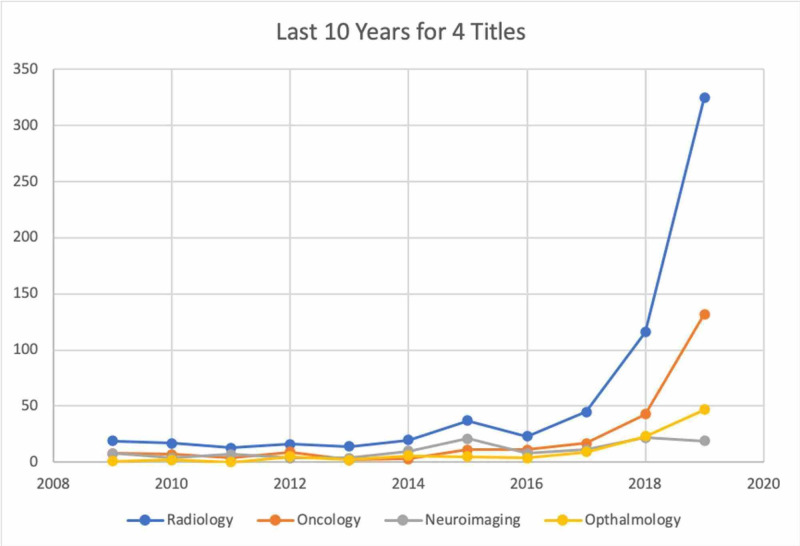
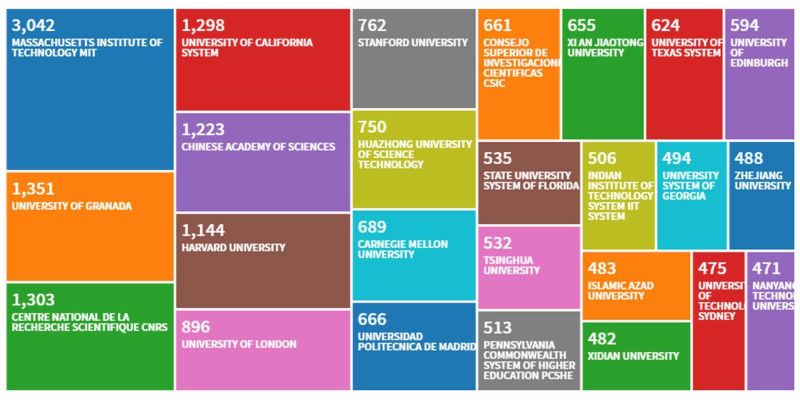
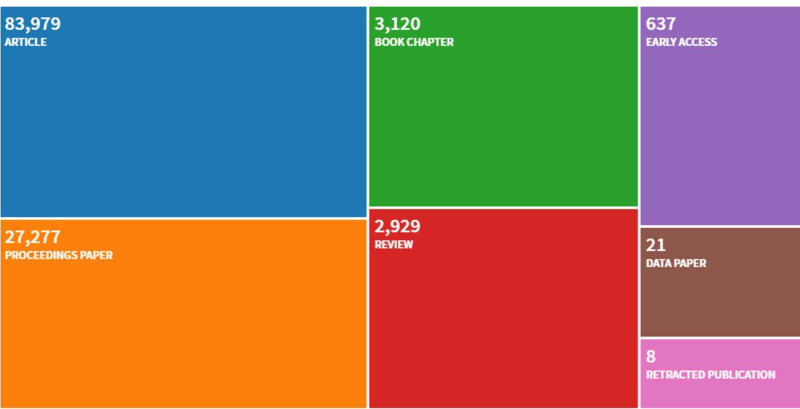
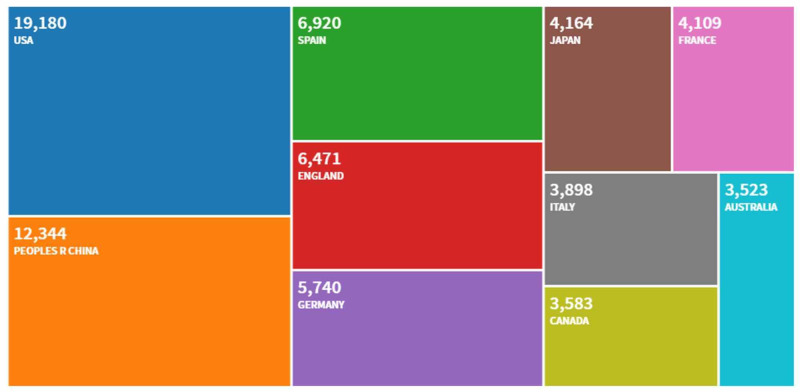
Background Artificial intelligence (AI) has significantly impacted numerous medical specialties with high emphasis on radiology. Associated novel diagnostic methods have become a rapidly emerging hot topic, and it is essential to provide insights into quantitative analysis of the growing literature. Purpose The purpose of this study is to highlight future academic trends, identify potential research gaps, and analyze scientific landscape of AI in the field of medicine. The main aim is to explore comprehensive dataset over a 46-year period in terms of publication type, publication citation, country of origin, institution, and medical specialty. Material and Methods The Web of Science database was searched from 1975 to 2020, and publications on AI were explored. Both original research reports and review articles were included in comprehensive bibliometric analysis. Descriptive statistics were calculated, and numerous variables were applied, namely year of publication, institution, type of publication, specialty area, country of origin, and citation numbers, and the Kruskal-Wallis analysis of variance was used. Results A total of 117,974 relevant citations were retrieved, of which 83,979 original research and review articles were retained for analysis. Not surprisingly, the largest proportion of citations were from the United States (23%, n = 19,180) followed by China, Spain, England, and Germany. The number of citations was relatively consistent during the 1970s and emerging gradually during the 1980s. However, ongoing scientific trend positively evolved, and the numbers started to grow significantly in the 1990s and demonstrated continuous increasing wave since then. The most frequently represented key medical specialties were oncology, radiology, neuroradiology, and ophthalmology. Overall, no major statistical difference was found between these four domains (p = 0.753). Conclusions In summary, research on AI-powered technologies in the medical domain was at early stage in the 1970s. However, associated deep learning algorithms significantly attracted and revolutionized the scientific community with subsequent evolution of research and exponential growth of multidisciplinary publications since that time. Work in this field has impacted radiology as an area of predominant interest and has been led by institutions in the United States, Spain, France, China, and England. The bibliometric study reported herein can provide a broad overview and valuable guidance to help medical researchers gain insights into key points and trace the global trends regarding the status of AI research in medicine, particularly in radiology and other relevant multispecialty areas.
背景 人工智能(AI)已对众多医学专业产生了重大影响,其中对放射学的影响尤为显著。相关的新型诊断方法已成为迅速兴起的热门话题,深入了解对日益增多的文献进行定量分析至关重要。目的 本研究的目的是突出未来学术趋势,识别潜在研究差距,并分析医学领域人工智能的科学格局。主要目标是从出版物类型、出版物引用、原产国、机构和医学专业等方面,探索46年间的综合数据集。材料与方法 在科学网数据库中检索1975年至2020年期间关于人工智能的出版物。综合文献计量分析纳入了原始研究报告和综述文章。计算了描述性统计数据,并应用了众多变量,即出版年份、机构、出版物类型、专业领域、原产国和引用次数,并使用了Kruskal-Wallis方差分析。结果 共检索到117,974条相关引用,其中保留83,979篇原始研究和综述文章用于分析。不出所料,引用量最大的是美国(23%,n = 19,180),其次是中国、西班牙、英国和德国。20世纪70年代引用量相对稳定,80年代逐渐增加。然而,科学发展趋势持续积极演变,90年代引用量开始显著增长,此后呈持续上升趋势。最常涉及的关键医学专业是肿瘤学、放射学、神经放射学和眼科学。总体而言,这四个领域之间未发现重大统计学差异(p = 0.753)。结论 总之,20世纪70年代医学领域对人工智能技术的研究尚处于早期阶段。然而,相关的深度学习算法自那时起随着研究的不断发展和多学科出版物的指数级增长,极大地吸引并变革了科学界。该领域的工作对作为主要关注领域的放射学产生了影响,并且由美国、西班牙、法国、中国和英国的机构引领。本文报道的文献计量研究可以提供广泛的概述和有价值的指导,帮助医学研究人员深入了解关键点,并追踪医学领域人工智能研究现状的全球趋势,特别是在放射学和其他相关多专业领域。