Institute of Cardiovascular and Medical Sciences, BHF Glasgow Cardiovascular Research Centre, University of Glasgow, Glasgow, UK.
Robertson Centre for Biostatistics, Institute of Health and Wellbeing, University of Glasgow, Glasgow, UK.
Am J Hypertens. 2021 Feb 18;34(1):92-99. doi: 10.1093/ajh/hpaa166.
Genome-wide association studies have identified single nucleotide polymorphisms (SNPs) near the uromodulin gene (UMOD) affecting uromodulin excretion and blood pressure (BP). Uromodulin is almost exclusively expressed in the thick ascending limb (TAL) of the loop of Henle and its effect on BP appears to be mediated via the TAL sodium transporter, NKCC2. Loop-diuretics block NKCC2 but are not commonly used in hypertension management. Volume overload is one of the primary drivers for uncontrolled hypertension, so targeting loop-diuretics to individuals who are more likely to respond to this drug class, using the UMOD genotype, could be an efficient precision medicine strategy.
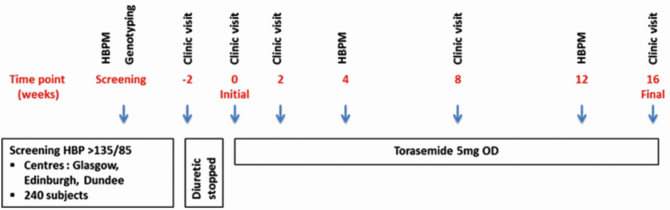
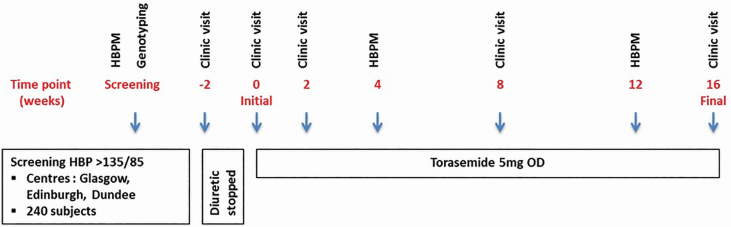
The BHF UMOD Trial is a genotype-blinded, multicenter trial comparing BP response to torasemide between individuals possessing the AA genotype of the SNP rs13333226 and those possessing the G allele. 240 participants (≥18 years) with uncontrolled BP, on ≥1 antihypertensive agent for ≥3 months, will receive treatment with Torasemide, 5 mg daily for 16 weeks. Uncontrolled BP is average home systolic BP (SBP) >135 mmHg and/or diastolic BP >85 mmHg. The primary outcome is the change in 24-hour ambulatory SBP area under the curve between baseline and end of treatment. Sample size was calculated to detect a 4 mmHg difference between groups at 90% power. Approval by West of Scotland Research Ethics Committee 5 (16/WS/0160).
The study should conclude August 2021.
If our hypothesis is confirmed, a genotype-based treatment strategy for loop diuretics would help reduce the burden of uncontrolled hypertension.
全基因组关联研究已经确定了位于尿调蛋白基因(UMOD)附近的单核苷酸多态性(SNPs),这些 SNPs 影响尿调蛋白的排泄和血压(BP)。尿调蛋白几乎仅在 Henle 袢的升支粗段(TAL)中表达,其对 BP 的影响似乎是通过 TAL 钠转运体 NKCC2 介导的。袢利尿剂会阻断 NKCC2,但在高血压管理中并不常用。容量超负荷是未控制高血压的主要驱动因素之一,因此,使用 UMOD 基因型将袢利尿剂靶向到更有可能对这种药物类别产生反应的个体,可能是一种有效的精准医学策略。
英国心脏基金会尿调蛋白试验(BHF UMOD Trial)是一项基因型盲法、多中心试验,比较了携带 SNP rs13333226 的 AA 基因型和携带 G 等位基因的个体对托拉塞米的血压反应。240 名(年龄≥18 岁)血压未得到控制的患者,接受至少 1 种降压药治疗≥3 个月,将接受托拉塞米治疗,每天 5 mg,持续 16 周。血压未得到控制的定义为平均家庭收缩压(SBP)>135 mmHg 和/或舒张压>85 mmHg。主要结局是基线和治疗结束时 24 小时动态 SBP 曲线下面积的变化。根据 90%的功效计算出样本量,以检测出两组之间 4 mmHg 的差异。西苏格兰研究伦理委员会 5 号(16/WS/0160)批准。
研究预计于 2021 年 8 月结束。
如果我们的假设得到证实,基于基因型的袢利尿剂治疗策略将有助于降低未控制高血压的负担。