Department of Neurosurgery, The Second Affiliated Hospital of Nanchang University, Nanchang, Jiangxi, China (mainland).
Institute of Neuroscience, Nanchang University, Nanchang, Jiangxi, China (mainland).
Med Sci Monit. 2020 Oct 21;26:e926440. doi: 10.12659/MSM.926440.
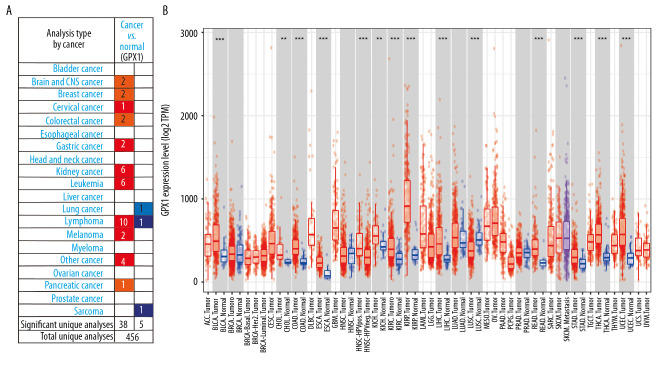
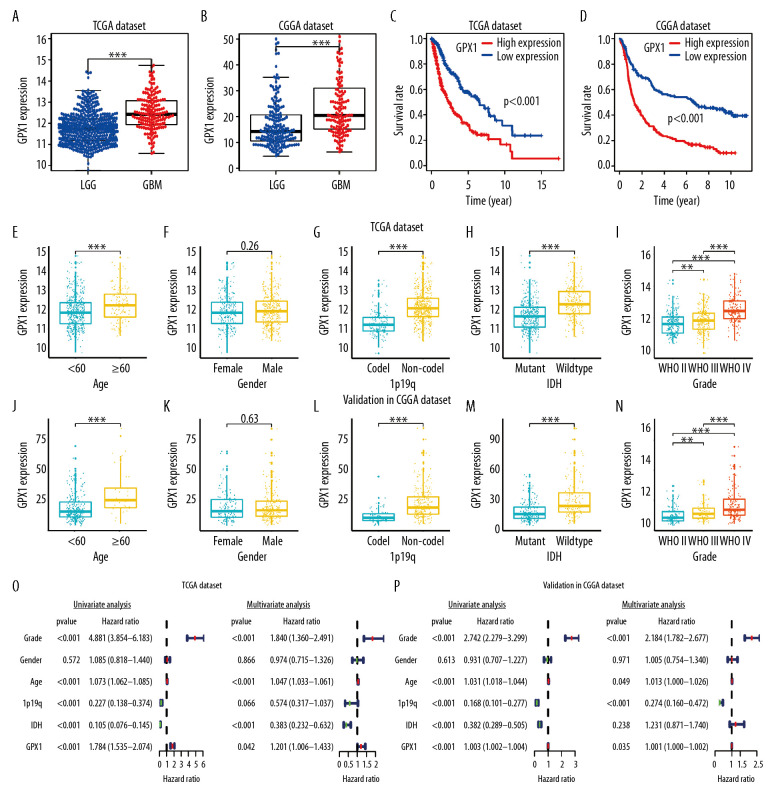
BACKGROUND Glutathione peroxidase 1 (GPX1) is an essential component of the intracellular antioxidant enzyme system, but little is known about the role of GPX1 in the progression of malignancy in gliomas. Using public datasets, this study investigated the prognostic role of GPX1 and immune infiltrates in glioma. MATERIAL AND METHODS We investigated GPX1 expression levels in different cancers using the ONCOMINE and Tumor Immune Estimation Resource (TIMER) datasets. We also explored the prognostic landscape of GPX1 in gliomas based on The Cancer Genome Atlas (TCGA) and Chinese Glioma Genome Atlas (CGGA) datasets. Some significant pathways were identified by function enrichment analysis. We then explored the association between GPX1 expression and levels of tumor-infiltrating immune cells based on TIMER and Gene Expression Profiling Interactive Analysis (GEPIA) datasets. RESULTS Expression of GPX1 in brain and central nervous system cancers is at a much high level than in normal tissues, and it is higher in glioblastoma (GBM) than in lower-grade glioma (LGG). We found GPX1 expression to be positively correlated with the malignant clinicopathologic characteristics of gliomas. Univariate analysis and multivariate analysis revealed that overexpression of GPX1 was correlated with a worse prognosis in patients, and a nomogram indicated that GPX1 expression can predict clinical prognosis of glioma. Function enrichment analysis showed that some important pathways are related to glioma malignancy. Expression of GPX1 was positively associated with infiltrating levels of 6 types of immune cells and most of their gene markers in GBM and LGG. CONCLUSIONS These results indicate that GPX1 is an independent prognostic factor and a novel biomarker for predicting the progression of malignancy in gliomas, which is associated with immune infiltration.
谷胱甘肽过氧化物酶 1(GPX1)是细胞内抗氧化酶系统的重要组成部分,但关于 GPX1 在胶质瘤恶性进展中的作用知之甚少。本研究使用公共数据集探讨了 GPX1 和免疫浸润在胶质瘤中的预后作用。
我们使用 ONCOMINE 和 Tumor Immune Estimation Resource(TIMER)数据集研究了不同癌症中 GPX1 的表达水平。我们还基于 The Cancer Genome Atlas(TCGA)和 Chinese Glioma Genome Atlas(CGGA)数据集探讨了 GPX1 在胶质瘤中的预后情况。通过功能富集分析确定了一些重要的途径。然后,我们基于 TIMER 和 Gene Expression Profiling Interactive Analysis(GEPIA)数据集探讨了 GPX1 表达与肿瘤浸润免疫细胞水平之间的关联。
脑和中枢神经系统癌症中 GPX1 的表达水平远高于正常组织,且在胶质母细胞瘤(GBM)中高于低级别胶质瘤(LGG)。我们发现 GPX1 表达与胶质瘤的恶性临床病理特征呈正相关。单因素和多因素分析显示,GPX1 过表达与患者预后较差相关,列线图表明 GPX1 表达可预测胶质瘤的临床预后。功能富集分析表明,一些重要途径与胶质瘤恶性有关。在 GBM 和 LGG 中,GPX1 的表达与 6 种免疫细胞及其大多数基因标志物的浸润水平呈正相关。
这些结果表明,GPX1 是胶质瘤恶性进展的独立预后因素和预测标志物,与免疫浸润有关。