Internal Medicine, Section on Molecular Medicine, Wake Forest School of Medicine, Winston-Salem, NC 27157, USA.
Biostatistics and Data Science, Wake Forest School of Medicine, Winston-Salem, NC 27101, USA.
Nutrients. 2020 Oct 19;12(10):3188. doi: 10.3390/nu12103188.
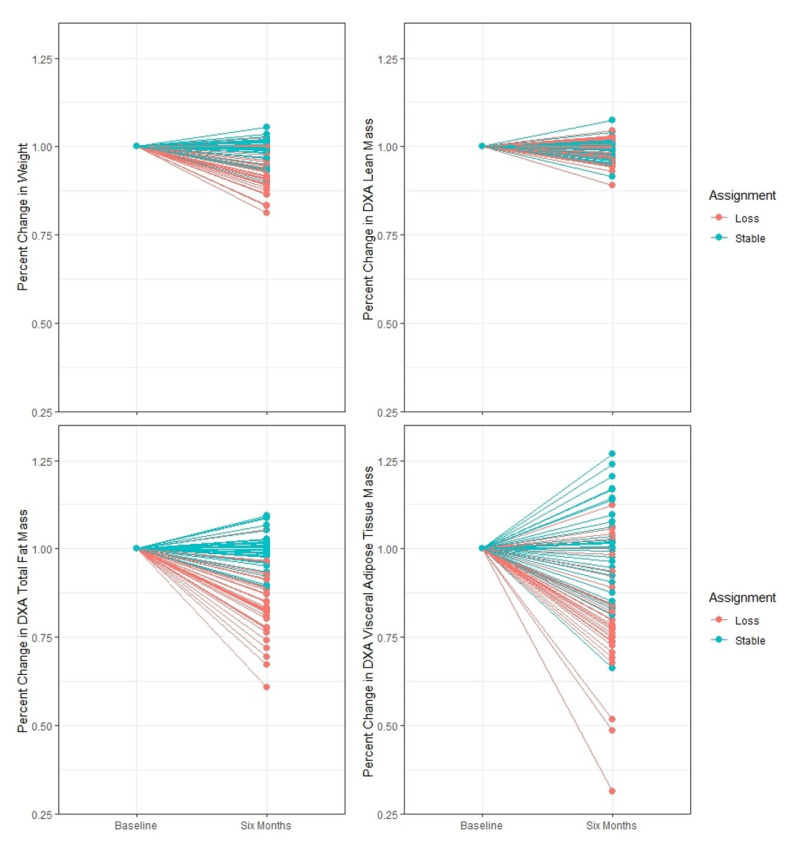
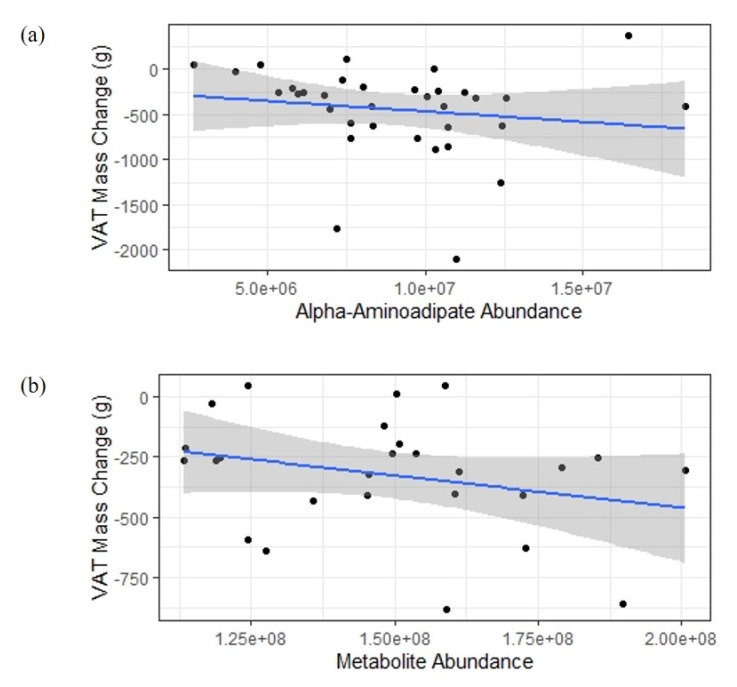
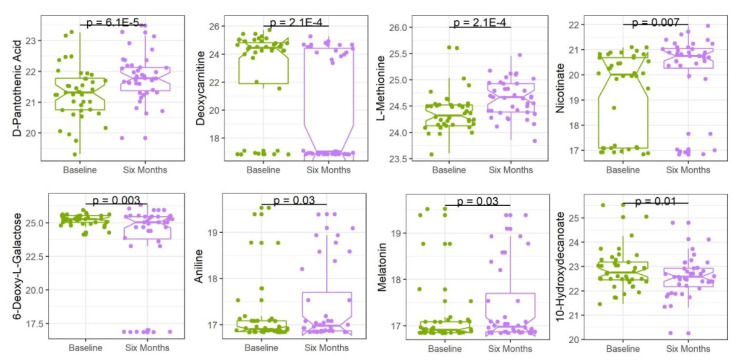
Inter-individual response to dietary interventions remains a major challenge to successful weight loss among older adults. This study applied metabolomics technology to identify small molecule signatures associated with a loss of fat mass and overall weight in a cohort of older adults on a nutritionally complete, high-protein diet. A total of 102 unique metabolites were measured using liquid chromatography-mass spectrometry (LC-MS) for 38 adults aged 65-80 years randomized to dietary intervention and 36 controls. Metabolite values were analyzed in both baseline plasma samples and samples collected following the six-month dietary intervention to consider both metabolites that could predict the response to diet and those that changed in response to diet or weight loss.Eight metabolites changed over the intervention at a nominally significant level: D-pantothenic acid, L-methionine, nicotinate, aniline, melatonin, deoxycarnitine, 6-deoxy-L-galactose, and 10-hydroxydecanoate. Within the intervention group, there was broad variation in the achieved weight-loss and dual-energy x-ray absorptiometry (DXA)-defined changes in total fat and visceral adipose tissue (VAT) mass. Change in the VAT mass was significantly associated with the baseline abundance of α-aminoadipate ( = 0.0007) and an additional mass spectrometry peak that may represent D-fructose, myo-inositol, mannose, α-D-glucose, allose, D-galactose, D-tagatose, or L-sorbose ( = 0.0001). This hypothesis-generating study reflects the potential of metabolomic biomarkers for the development of personalized dietary interventions.
个体对饮食干预的反应仍然是老年人成功减肥的主要挑战。本研究应用代谢组学技术,在一组接受营养完整、高蛋白饮食的老年人中,鉴定与脂肪量和总体体重减轻相关的小分子特征。使用液相色谱-质谱(LC-MS)对 38 名年龄在 65-80 岁的成年人进行了总共 102 种独特代谢物的测量,这些成年人随机分为饮食干预组和 36 名对照组。在基线血浆样本和六个月饮食干预后的样本中分析了代谢物值,以考虑既能预测饮食反应又能响应饮食或体重减轻而改变的代谢物。在干预期间有 8 种代谢物在名义上达到显著水平发生了变化:D-泛酸、L-蛋氨酸、烟酸、苯胺、褪黑素、脱氧肉碱、6-脱氧-L-半乳糖和 10-羟基癸酸。在干预组中,实现的体重减轻和双能 X 射线吸收法(DXA)定义的总脂肪和内脏脂肪组织(VAT)质量变化有很大差异。VAT 质量的变化与基线α-氨基己二酸的丰度显著相关(=0.0007),另外一个质谱峰可能代表 D-果糖、肌醇、甘露糖、α-D-葡萄糖、阿洛糖、D-半乳糖、D-塔格糖或 L-山梨糖(=0.0001)。这项生成假说的研究反映了代谢组学生物标志物在个性化饮食干预开发中的潜力。