Assi Khaled
Civil & Environmental Engineering Department, King Fahd University of Petroleum & Minerals, Dhahran 31261, Saudi Arabia.
Int J Environ Res Public Health. 2020 Oct 19;17(20):7598. doi: 10.3390/ijerph17207598.
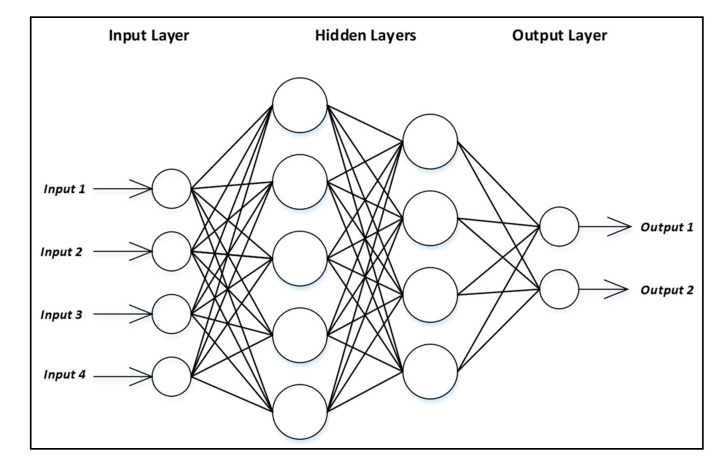
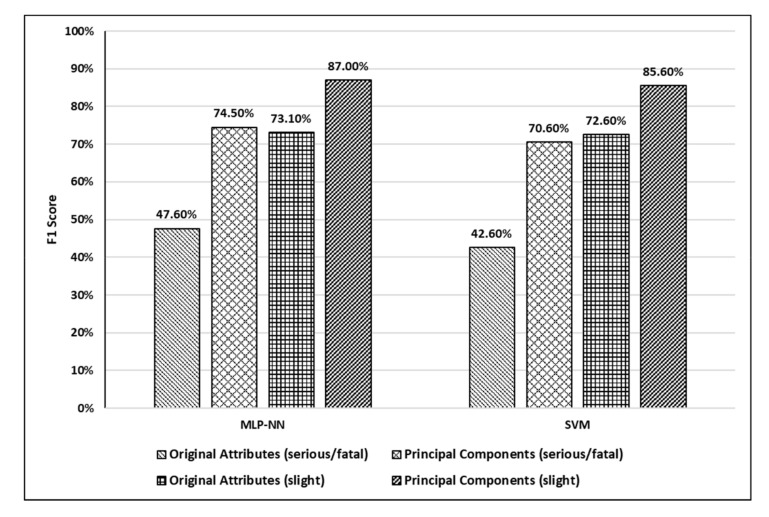
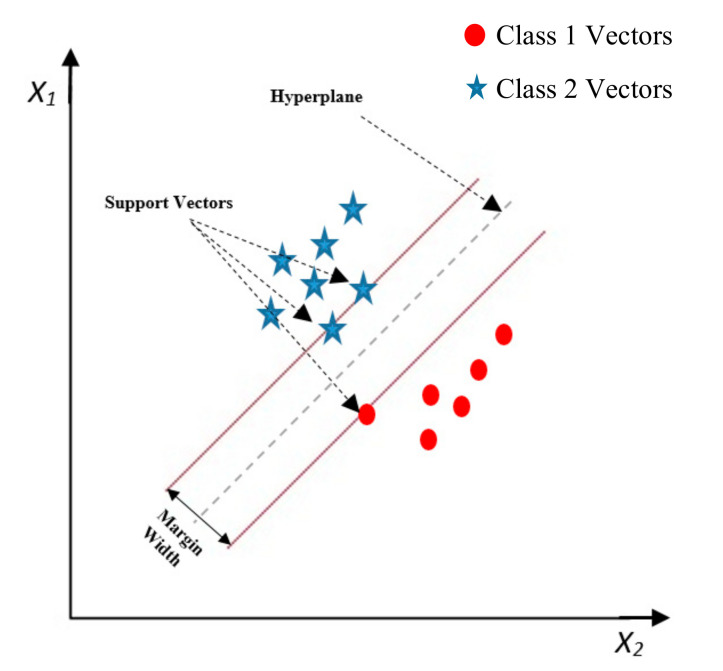
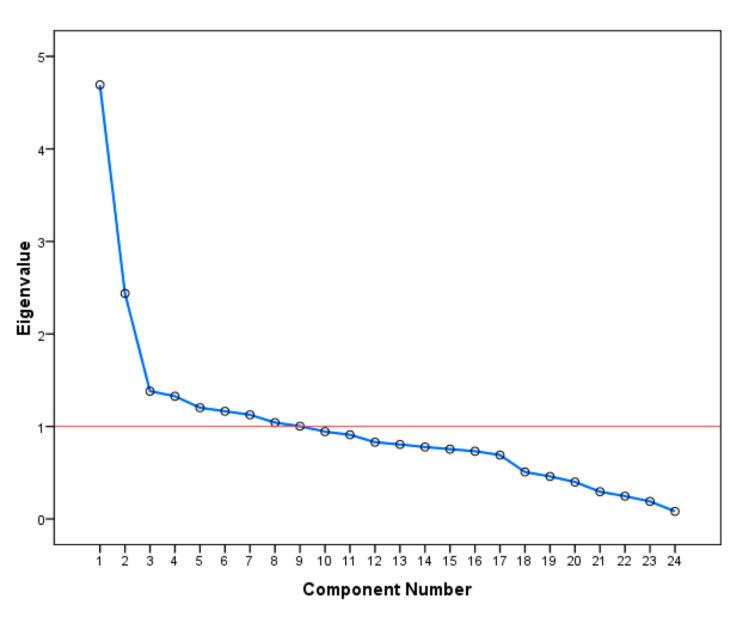
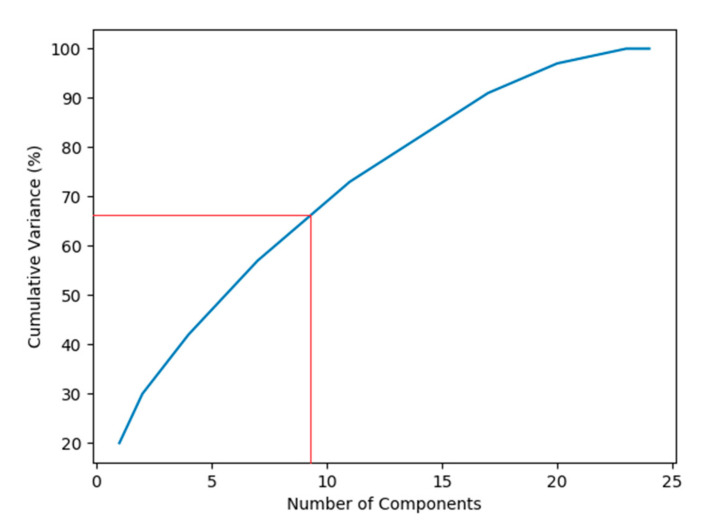
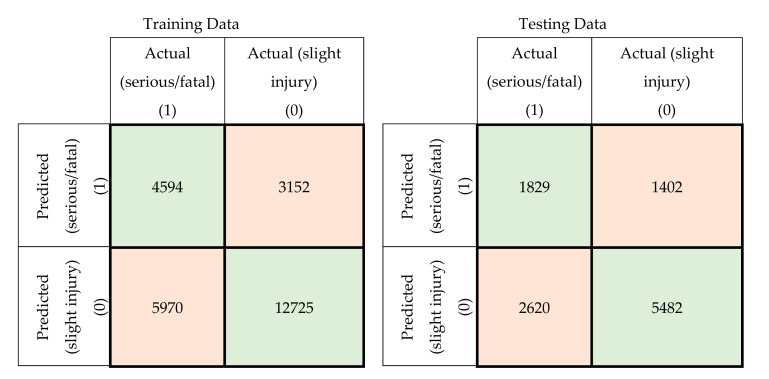
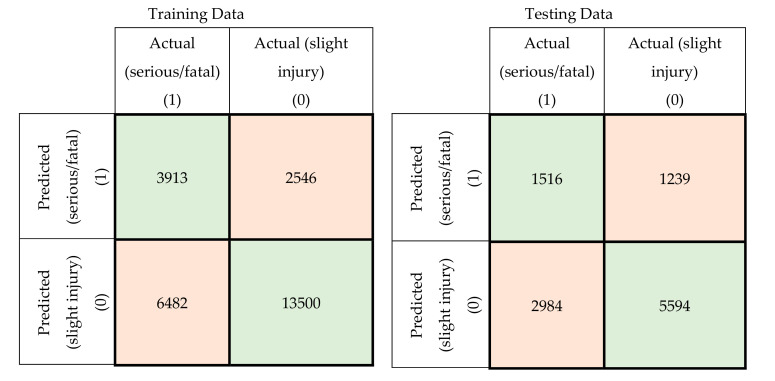
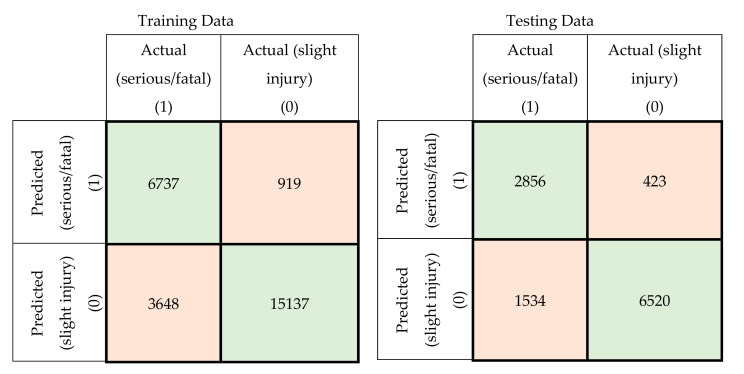
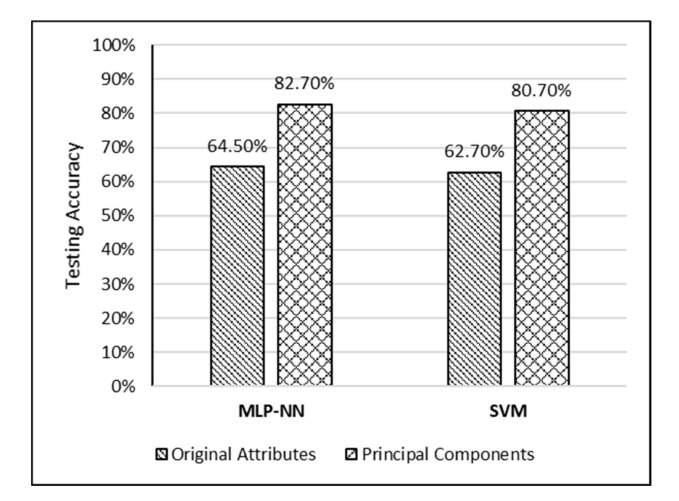
The accurate prediction of road traffic crash (RTC) severity contributes to generating crucial information, which can be used to adopt appropriate measures to reduce the aftermath of crashes. This study aims to develop a hybrid system using principal component analysis (PCA) with multilayer perceptron neural networks (MLP-NN) and support vector machines (SVM) in predicting RTC severity. PCA shows that the first nine components have an eigenvalue greater than one. The cumulative variance percentage explained by these principal components was found to be 67%. The prediction accuracies of the models developed using the original attributes were compared with those of the models developed using principal components. It was found that the testing accuracies of MLP-NN and SVM increased from 64.50% and 62.70% to 82.70% and 80.70%, respectively, after using principal components. The proposed models would be beneficial to trauma centers in predicting crash severity with high accuracy so that they would be able to prepare for appropriate and prompt medical treatment.
准确预测道路交通事故(RTC)的严重程度有助于生成关键信息,这些信息可用于采取适当措施以减少事故后果。本研究旨在开发一种混合系统,该系统使用主成分分析(PCA)与多层感知器神经网络(MLP-NN)和支持向量机(SVM)来预测RTC严重程度。主成分分析表明,前九个成分的特征值大于1。发现这些主成分解释的累积方差百分比为67%。将使用原始属性开发的模型的预测准确性与使用主成分开发的模型的预测准确性进行了比较。结果发现,使用主成分后,MLP-NN和SVM的测试准确率分别从64.50%和62.70%提高到了82.70%和80.70%。所提出的模型将有助于创伤中心高精度地预测事故严重程度,以便它们能够为适当和及时的医疗治疗做好准备。