Vaccalluzzo Amanda, Pino Alessandra, De Angelis Maria, Bautista-Gallego Joaquín, Romeo Flora Valeria, Foti Paola, Caggia Cinzia, Randazzo Cinzia L
Department of Agricultural, Food and Environment, University of Catania, 95123 Catania, Italy.
Department of Soil, Plant and Food Science, University of Bari Aldo Moro, 70121 Bari, Italy.
Microorganisms. 2020 Oct 19;8(10):1607. doi: 10.3390/microorganisms8101607.
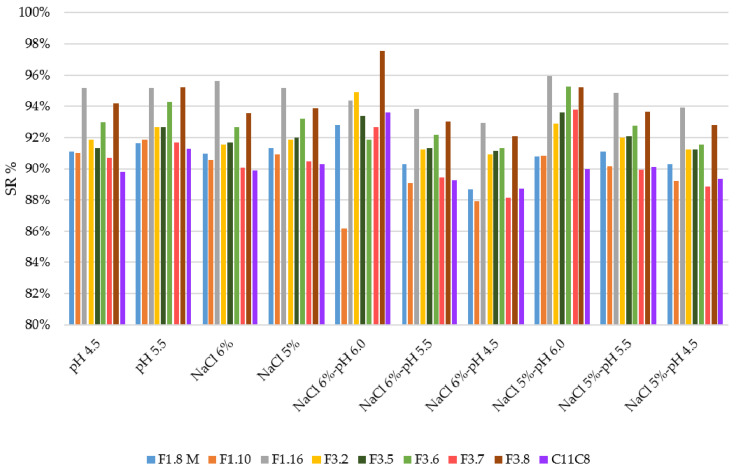
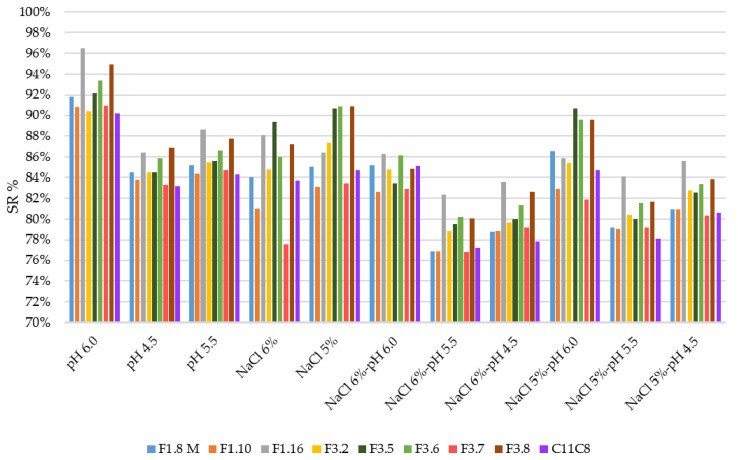
The use of β-glucosidase positive strains, as tailored-starter cultures for table olives fermentation, is a useful biotechnological tool applied to accelerate the debittering process. Nowadays, strains belonging to species are selected for their high versatility and tolerance to stress conditions. The present study investigated the effect of different stress factors (pH, temperature and NaCl) on growth and on oleuropein-degrading abilities of selected strains. In addition, the presence of the beta-glucosidase gene was investigated by applying a PCR based approach. Results revealed that, overall, the performances of the tested strains appeared to be robust toward the different stressors. However, the temperature of 16 °C significantly affected the growth performance of the strains both singularly and in combination with other stressing factors since it prolongs the latency phase and reduces the maximum growth rate of strains. Similarly, the oleuropein degradation was mainly affected by the low temperature, especially in presence of low salt content. Despite all strains displayed the ability to reduce the oleuropein content, the beta-glucosidase gene was detected in five out of the nine selected strains, demonstrating that the ability to hydrolyze the oleuropein is not closely related to the presence of beta-glucosidase. Data of the present study suggest that is extremely important to test the technological performances of strains at process conditions in order to achieve a good selection of tailored starter cultures for table olives.
使用β-葡萄糖苷酶阳性菌株作为油橄榄发酵的定制发酵剂培养物,是一种用于加速脱苦过程的有用生物技术工具。如今,因其高通用性和对胁迫条件的耐受性而选择了属于特定物种的菌株。本研究调查了不同胁迫因素(pH值、温度和氯化钠)对所选菌株生长和橄榄苦苷降解能力的影响。此外,通过基于聚合酶链反应的方法研究了β-葡萄糖苷酶基因的存在情况。结果显示,总体而言,受试菌株对不同应激源的表现似乎很强健。然而,16℃的温度显著影响了菌株的生长性能,无论是单独影响还是与其他胁迫因素共同影响,因为它延长了延迟期并降低了菌株的最大生长速率。同样,橄榄苦苷的降解主要受低温影响,尤其是在低盐含量的情况下。尽管所有菌株都表现出降低橄榄苦苷含量的能力,但在所选的9个菌株中有5个检测到了β-葡萄糖苷酶基因,这表明水解橄榄苦苷的能力与β-葡萄糖苷酶的存在没有密切关系。本研究的数据表明,在工艺条件下测试菌株的技术性能对于为油橄榄选择合适的定制发酵剂培养物非常重要。